
 Worksheets
CHEM 241 - NSU - Chapter 4 - Stereochemistry
Total questions: 75
Worksheet time: 2hrs 38mins

constitutional isomers
enantiomers
diastereomers
identical
none of these
Identify the relationship I and II and III and IV
enantiomer
diastereomer
identical
constitutional isomer
None of the structures
Identify the relationship I and V
enantiomer
diastereomer
identical
constitutional isomer
different compounds

I, II, III, IV, and V
I, II, III, and IV
I and II
III and IV
IV alone

I and II
IV and V
II and III
I, II, and III
None of the above options

constitutional isomers
enantiomers
diastereomers
identical
none of the above

II
II and III
II and IV
III and V
IV and V

What is the Configuration of the Chirality Centers? (Red, Blue)
(S,R)
(S,S)
(R,R)
(R,S)

What is the Relationship between these Molecules?
Same Molecule
Diastereomers
Enantiomers
Constitutional Isomers

How many Stereoisomers Exist for this Molecule?
One
Two
Three
Four

What is the Relationship between these Molecules?
Same Molecule
Diastereomers
Enantiomers
Constitutional Isomers

Give the correct absolute configuration of this molecule
(1R, 2S)-2-isopropylcyclohexanol
(1R,2R)-2-isopropylcyclohexanol
(1S,2R)-2-isopropylcyclohexanol
(1S,2S)-2-isopropylcyclohexanol

What is the relationship between the compounds?
unrelated
enantiomers
diastereomers
conformational isomers
constitutional isomers

Choose the compound that is a constitutional isomer of this compound:


What is the relationship between the compounds:
(3S,4R)-4-methylheptan-3-ol
and
(3R,5S)-5-methylheptan-3-ol
unrelated
enantiomers
diastereomers
conformational isomers
constitutional isomers
What is the relationship between the compounds:
(3S,5R,8S)-8-chloro-5-methyldecan-3-ol
and
(3R,5S,8S)-8-chloro-5-methyldecan-3-ol
unrelated
enantiomers
diastereomers
conformational isomers
constitutional isomers

What is the relationship between the compounds?
same compound
enantiomers
diastereomers
conformational isomers
constitutional isomers

What is the relationship between the compounds?
unrelated
enantiomers
diastereomers
conformational isomers
constitutional isomers

What is the relationship between the compounds?
unrelated
enantiomers
diastereomers
conformational isomers
constitutional isomers

What is the relationship between the compounds?
same compound
enantiomers
diastereomers
conformational isomers
constitutional isomers

What is the relationship between the compounds?
same compound
enantiomers
diastereomers
conformational isomers
constitutional isomers

What is the relationship between the compounds?
same compound
enantiomers
diastereomers
conformational isomers
constitutional isomers
Assume all you know about a compound is that the name is (+)-d-glucose and select all true statements. (i.e., do NOT look up information about the structure. Use the name only.)
It is chiral.
It has one chiral center.
The enantiomer rotates plane-polarized light counterclockwise.
It has three diastereomers.
It rotates plane-polarized light clockwise.
Select ALL meso compounds.


To determine the R/S configuration, the groups attached to a chiral center would go in this order for highest priority (1) to lowest (4). Listed 1-2-3-4.
Br, ethyl, isopropyl, methyl
methyl, ethyl, isopropyl, Br
Br, ethyl, methyl, isopropyl
Br, isopropyl, ethyl, methyl
Select ALL compounds that are chiral.


You have a sample of decan-2-ol that is a mixture of the two enantiomers with 95:5 relative abundance S:R. Select the true statement.
The sample will rotate plane-polarized light clockwise because S is more abundant and S always rotates the light clockwise.
The sample will rotate plane-polarized light counterclockwise because S is more abundant and S always rotates the light counterclockwise.
The sample will rotate plane-polarized light but you cannot know the direction without running the experiment.
The sample will not rotate plane-polarized light.

What is the maximum number of configurational isomers for the line structure shown?
2
4
8
16

This compound has:
No enantiomer and two diastereomers.
One enantiomer and two diastereomers.
Two enantiomers and no diastereomers.
One enantiomer and one diastereomer.
What is the relationship between 1,4-dichlorobutane and 1,6-dichlorohexane?
unrelated
enantiomers
diastereomers
conformational isomers
constitutional isomers
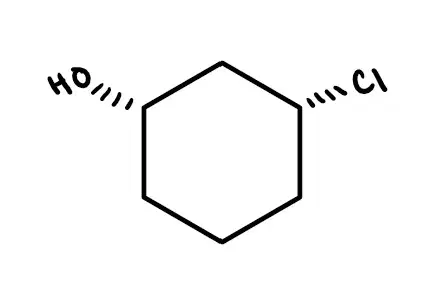
Determine the configuration of the following chiral centers, then name the molecule.
(a)

Determine the configuration of the following chiral centers, then name the molecule.
(a)
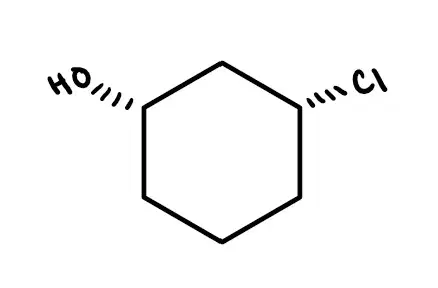
Determine the configuration of the following chiral centers, then name the molecule.
(a)
Compounds which have different arrangements of atoms in space while having same atoms bonded to each other are said to have
position isomerism
functional group isomerism
chain isomerism
stereoisomerism
Which of the following can make difference in optical isomers?
heat
temperature
polarized light
pressure

Which of the following terms best describes the following pair of molecules?
Isomers
Constitutional isomers
Configurational isomers
Geometrical isomers
Which of the following molecules does not possess enantiomers?
CH3CH2CH2CHBrCH3
CH3CH2CBr2CH3
CH3CHBrCH2CH3
CHBr2CH2CHBrCH3
Is it true that enantiomer have the same physical and chemical properties?
Yes
False
Can enantiomer rotates plane-polarised light?
Yes in all situations
No because it is optically active
Yes but it can only rotate the polarised light in opposite direction
No due to its restricted rotation of carbon-carbon double bond

What is the relationship between 1 and 4?
diastereoisomers
enantiomers
no relationship
meso compounds
What is the relationship between 1 and 2?
diastereoisomers
enantiomers
no relationship
meso compounds

Which of the following statement is FALSE about stereoisomerism?
Same molecular formula
Same structural formula
Different structural arrangement or connectivity
Different spatial arrangement
An asymmetric carbon is the same as a...
achiral carbon
chiral carbon
prochiral carbon
axial carbon

What property can be assigned to a carbon atom that has four different atoms or structural groups attached to it?
isomerity
chirality
chivalry
geometry

Can this compound can form optical isomers?
No
yes
depends on whether it wants to or not

How many chiral centers?
1
3
4
2

What is the relationship between A and B.
structural isomers
meso compounds
diastereoisomers
both have chiral carbons

How many chiral centers are there?
1
3
2
6

R or S configuration?
R
S

Is it in R or S configuration?
R
S

How many chiral centers are there?
1
2
3
4

Designate whether it's an R or S configuration
R
S

Chiral or achiral?
Chiral
Achiral

Is it chiral or a chiral?
Chiral
Achiral

Determine if the chiral center is R/S
R
S
Does not have a chiral center

Determine if the chiral center is R/S
R
S
Does not have a chiral center

Determine if the chiral center is R/S
R
S
Does not have a chiral center

Determine if the chiral center is R/S
R
S
Does not have a chiral center

Determine if the chiral center is R/S
R
S
Does not have a chiral center

Determine if the chiral center is R/S
R
S
Does not have a chiral center

Determine if the chiral center is R/S
R
S
Does not have a chiral center

Determine if the chiral center is R/S
R
S
Does not have a chiral center

Determine if the chiral center is R/S
R
S
Does not have a chiral center

Determine if the chiral center is R/S
R
S
Does not have a chiral center

Determine if the chiral center is R/S
R
S
Does not have a chiral center

Determine if the chiral center is R/S
R
S
Does not have a chiral center

Determine if the chiral center is R/S
R
S
Does not have a chiral center
Define the meaning chiral or stereogenic carbon.
The molecule is a optically active compound.
It has 4 different groups attached to it.
It must have a chlorine atom attached to it.
It is an alkene.

Assign the configuration of the below two structures
S,S
S,R
R,S
R,R,

Number of stereoisomers of camphor is
2
3
4
1

The given compounds 1 and 2 are
Identical
Diastereomers
Enantiomers
Constitutional isomers

Which one of the following is optically active
d
a
b
c
The correct statement about optical activity is
a molecule having two or more chiral centers is always optically active
a molecule having just one chiral center is always optically active
a molecule having alternating axis of symmetry is optically inactive is always optically active
an optically active molecule should have atleast one chiral center
The maximum number of stereoisomers possible for 4-phenyl but-3-en-2ol is
1
2
3
4
A racemic mixture is optically active.
yes
no

