
 Worksheets
Rica 2 Multiple Choice
Total questions: 25
Worksheet time: 13mins
Lately, when choosing a book to read, a third grader who reads at grade level always selects books from a series that is written in a very formulaic style that does little to extend his conceptual or language development. The teacher's best response to this behavior would be to:
No
Provide the student with books with similar themes or on similar topics that are more challenging for him.
Provide the student harder stuff
Nothing
A second-grade student has limited vocabulary knowledge, which hinders the student's word recognition and reading comprehension. The student's oral reading is slow and labored, and the student typically spends the majority of independent reading time browsing through books, making little effort to read the actual words on the page. Research has shown that which of the following is most likely to happen if this student receives no instructional intervention?
nothing
The student will run away
The student will get ahead
The student will begin to fall behind peers in reading development and will continue to fall further behind in later grades as texts include increasingly difficult vocabulary.
Which of the following statements best explains an important limitation of teaching students to rely on context as their primary strategy for determining the meaning of unfamiliar words in texts?
Explicit context clues about a word's meaning are not very common in most texts, while implicit contextual clues often require students to apply background knowledge they lack.
nothing
no
nada
A fifth-grade teacher is planning a multidisciplinary unit on water pollution. For this unit, students will read chapters from their social studies and science textbooks as well as relevant fictional narratives. These materials will also be incorporated into a variety of instructional activities designed to promote students' reading development. Which of the following statements best describes an important advantage of using a cross-curricular approach such as this unit to promote students' reading development?
o
n
Reading instruction that integrates a variety of related texts promotes deep processing of new vocabulary through multiple exposures to key words and concepts.
no

A web diagram with an oval in the center labeled dict open parens speak close parens. Lines extend out from the oval to the following five English words: benediction, dictionary, contradict, predict, dictator.
This activity is likely to promote students' vocabulary development primarily by helping the students:
apply knowledge of word roots as a word-learning strategy.
yes
no
n
A teacher substitutes blank spaces for several nouns, verbs, adjectives, and adverbs in an appropriate level text and asks students to determine reasonable and logical words to complete each blank. This technique is useful as an informal assessment of students' understanding of English language structures primarily because it requires them to:
no
no
select appropriate words based on their grammatical function as well as on their mean
no
A fifth-grade teacher gives students the following sentence:
Neither walking on the beach nor running around the track cheered Ahmed up.
The teacher asks the students how the phrases that come just after neither and just after nor are similar. This exercise can promote students' reading comprehension by helping them:
no
no
Parallel Gramatical structures
recognize parallel grammatical structures.
A middle school teacher designs an instructional activity in which students combine several sentences to form a single sentence, as illustrated below.
Combine
Matthew stood and waited for the bus.
The sun was blazing hot.
Matthew fanned himself with the newspaper.Single sentence:
Waiting for the bus, Matthew stood in the blazing sun, fanning himself with the newspaper.
This activity is likely to be most effective in helping students:
no
strengthen their ability to comprehend and write complex sentences.
no
no
. Structural analysis would be the most appropriate strategy for a student to use to determine the meaning of which of the following words?
impassable
no
no
no

This comprehension strategy is most effective in facilitating students' ability to:
organize textual information according to similarities and differences.
no
no
no

After reading an assigned story, students divide into small groups, and the teacher distributes a copy of the star diagram to each group. The members of each group discuss how the six questions (who, what, when, where, why, and how) apply to the story and write answers in the six points of the star. The teacher then displays the completed star diagrams and leads a whole-class discussion about them. This instructional activity is most likely to promote students' reading proficiency in which of the following ways?
no
no
helping students learn a strategy for using visual representation to analyze key elements of a text
no
. An eighth-grade class will be reading a drama that is a challenging grade-level text. The teacher is concerned that a student in the class who has a reading disability will have difficulty keeping up with and understanding the reading assignments. Which of the following strategies would be most effective for the teacher to use to promote the student's access to the text and his ability to participate fully in class discussions related to it?
no
providing the student with an audiorecording of the play to listen to in conjunction with his reading
no
no
13. A first-grade teacher plans to assess a student's comprehension of a short story through oral retelling. After the student silently reads the story, the teacher will prompt the student's retelling by asking open-ended questions. To prepare for this assessment, the teacher reads the story carefully and composes the questions. Which of the following additional steps would be most helpful for the teacher to take before the retelling activity begins?
no
no
no
Prepare a checklist of the key elements that an effective retelling of this story should include.
14. A fifth-grade teacher is teaching a unit on fiction. To begin, students read several simple fairy tales and discuss the moral or meaning of each one. The teacher then assigns a more complex story and leads a discussion about the moral of the story after students finish reading it. This instructional strategy is most likely to promote students' reading proficiency by:
no
helping students identify and understand the theme of a literary text.
no
no

This writing activity promotes students' comprehension and analysis of expository texts primarily by:
no
no
no
developing their ability to evaluate the adequacy of an author's conclusions.

Creating such a web is likely to promote students' ability to retain and use information they read about a topic by:
helping students learn to use categories to organize their thinking about the topic.
no
no
no

After giving each student a copy of the web developed by the class, the teacher could best help students make use of the web to learn and retain facts from their reading by asking them to:
NO
nO
no
add continuously to the web as they encounter and analyze new information in their reading.
Use the information below to answer the four questions that follow.
A sixth-grade teacher reads his students the nonsense poem "Jabberwocky" by Lewis Carroll. The first four lines of the poem are shown below.
'Twas brillig, and the slithy toves
Did gyre and gimble in the wabe;
All mimsy were the borogoves,
And the mome raths outgrabe.
Competency 12—Understand literal, inferential, and evaluative comprehension and factors affecting reading comprehension.
18. The teacher reads aloud the clause "All mimsy were the borogoves" and asks students what that might mean. One student responds, "It means that the borogoves were all mimsy!" This student's response demonstrates skill in which of the following reading comprehension strategies?
interpreting unusual grammatical constructions
no
A sixth-grade teacher reads his students the nonsense poem "Jabberwocky" by Lewis Carroll. The first four lines of the poem are shown below.
'Twas brillig, and the slithy toves
Did gyre and gimble in the wabe;
All mimsy were the borogoves,
And the mome raths outgrabe.
The teacher plans a variety of activities related to "Jabberwocky." Students will work in pairs to make up definitions for some of the nonsense words (e.g., slithy). They will read the poem aloud using tone of voice to express various moods. Finally, they will create their own nonsense poems and give oral readings of them. These activities are most likely to promote students' reading development by:
no
fostering students' enjoyment of playing with and thinking about language.
A sixth-grade teacher reads his students the nonsense poem "Jabberwocky" by Lewis Carroll. The first four lines of the poem are shown below.
'Twas brillig, and the slithy toves
Did gyre and gimble in the wabe;
All mimsy were the borogoves,
And the mome raths outgrabe.One student pronounces gyre with a hard g sound, while his classmate uses a soft g sound. They ask the teacher who is correct. The teacher's best response would be to:
explain that one strategy for determining a likely pronunciation of a new word is to consider other words that contain a similar root (e.g., gyrate, gyroscope).
no
no
A sixth-grade teacher reads his students the nonsense poem "Jabberwocky" by Lewis Carroll. The first four lines of the poem are shown below.
'Twas brillig, and the slithy toves
Did gyre and gimble in the wabe;
All mimsy were the borogoves,
And the mome raths outgrabe.The teacher asks the students if they can tell which of the nonsense words in the poem are nouns. One student says that toves is a noun. Another says that wabe and borogoves are nouns and adds that gyre and gimble are verbs. The class then discusses how students were able to draw these conclusions. This exercise would be especially useful for helping students understand that:
no
being familiar with common language structures can help a reader interpret a text.
o
mp

The paragraph-building activity described is likely to promote students' reading development primarily by helping them:
no
no
no
transfer skills from oral language to written language.
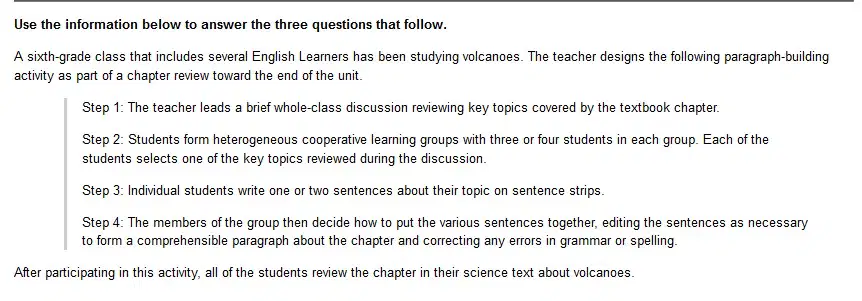
The paragraph-building activity described is likely to promote students' reading development primarily by helping them:
transfer skills from oral language to written language.
no

.After assessing the effectiveness of this activity, the teacher decides to include an additional step. For step 5, the teacher will guide students to develop topic sentences for the paragraphs they generated. This modification is most likely to promote students' reading development by:
no
no
helping students recognize main ideas and how supporting details relate to main ideas.
no

Which of the following best describes one important way in which this activity is likely to benefit English Learners?
Discussing and writing about a content-area topic support English Learners' reading related to the topic by reinforcing key concepts and academic-language development.
no
no
no

