wayground logo

Free Printable Worksheets

Font size

S
M
L
XL
Worksheets

Physics Review 5th Year Topics

Total questions: 35

Worksheet time: 38mins

Name
Class
Date
1.

Buoyancy is the tendency for objects to float in a fluid. We consider buoyancy the...

a)

Un-gravity force

b)

The upward force

c)

Gravitational pull

d)

Downwards pull on an object

2.

Volume is ...

a)

Mass/Volume

b)

The amount of matter in an object.

c)

The amount of space an object occupies.

d)

Anything that has mass and occupies space

3.
Which of the following quantities are vectors?
a)
speed, velocity, acceleration
b)
velocity, acceleration, force
c)
force, acceleration, mass
d)
length, mass, time
4.

Identify the SI unit to measure length

a)

Kilogram

b)

Kelvin

c)

metre

d)

second

5.
Which of the following pairs of physical quantity and SI unit is correct ?
a)
Mass - SI unit : Gram
b)
Time - SI unit : Hour
c)
Electric current - SI unit : Volt
d)
Temperature - SI unit : Kelvin
6.

A (a)   is a quantity that has magnitude but no direction.

7.

What is the SI unit of weight?

a)

kilograms

b)

grams

c)

newtons

d)

kg

8.
If a boomerang is thrown 20 m in a straight line and returns exactly to the spot it was thrown what is its displacement?
a)
20m
b)
40m
c)
0m
d)
-20m
9.
Which of the following lines shows the object is moving back?
a)
A
b)
B
c)
C
d)
D
10.
Which object is traveling faster? 
a)
B
b)
D
11.
What is happening in this graph from point B to C?
a)
The object is going down a hill.
b)
The object is returning to its starting location.
c)
The object is slowing down.
d)
The object is staying still.
12.

A bicycle can travel 100 meters in 20 seconds. The velocity of the bicycle is

a)

2 m/s

b)

5 m/s

c)

8 m/s

d)

11 m/s

13.

What is the unit for FORCE?

a)

N (Newtons)

b)

lbs (pounds)

c)

g (grams)

d)

m/s (meters per second)

14.
The ______of an object tends to make the object resist being set into motion.
a)
mass
b)
force
c)
motion
d)
unbalanced forces 
15.

The number of waves that pass a fixed point in a given amount of time is the ---.

a)

frequency

b)

speed

c)

period

d)

wavelength

16.

The amount of time it takes for one full cycle of a wave to repeat is the ---.

a)

frequency

b)

speed

c)

amplitude

d)

period

17.

The distance between repetitions in a wave is the ---.

a)

frequency

b)

wave speed

c)

amplitude

d)

wavelength

18.

What type of wave is this?

a)

Transverse

b)

Longitudinal

c)

Rayleigh

d)

electromagnetic

19.

What type of wave is this?

a)

Transverse

b)

Longitudinal

c)

Rayleigh

d)

electromagnetic

20.
What is represented by the letter 'x'?
a)
Crest
b)
Compression
c)
Rarefaction
d)
Wavelength
21.
The distance between the crests in a wave is called ___
a)
the wave distance
b)
the wavelength
c)
the amplitude
d)
the frequency
22.
The spread of colors, or wavelengths of EM radiation, is called ___
a)
a wave-spread
b)
the bandwidth
c)
a spectrum
d)
the audible range
23.
Light with a wavelength that the human eye can detect is called ___
a)
visible light
b)
ultraviolet light'
c)
infrared light
d)
invisible light
24.
Light waves with the shortest wavelengths of all are called ___
a)
ultraviolet light
b)
microwaves
c)
x-rays
d)
gamma rays
25.
A converging lens is also known as a ____ lens.
a)
convex
b)
concave
c)
double
d)
refracted
26.
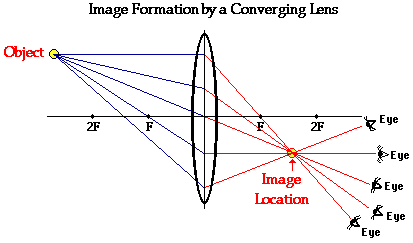
When an object is placed between the focal point and the convex lens, the image produced is ___.
a)
real, reduced, and inverted
b)
real, enlarged, and inverted
c)
virtual, enlarged, and upright
d)
virtual, reduced, and upright
27.
What does the word "diverging" mean?
a)
to spread apart
b)
to come together
c)
parallel
d)
perpendicular
28.
A diverging lens is also known as a ____lens.
a)
refracted
b)
diffracted
c)
convex
d)
concave
29.
This image is.....
a)
inverted and smaller
b)
inverted and larger
c)
not inverted and smaller
d)
not inverted and larger
30.
This image is...
a)
Inverted and smaller
b)
inverted and bigger
c)
not inverted and smaller
d)
not inverted and bigger
31.
a real image...
a)
is produced by virtual rays and can be projected on a screen
b)
is produced by real rays and cannot be projected on a screen
c)
is produced by virtual images and cannot be projected on a screen
d)
is produced by real rays and can be projected on a screen
32.
a)
Reflection
b)
Refraction
33.
Refraction is the bending of a wave disturbance as it passes from one _________ into another.
a)
glass
b)
medium
c)
area
d)
boundary
34.
How is light affected by an increase in the index of refraction?
a)
Its frequency increases
b)
Its frequency decreases
c)
Its speed increases
d)
Its speed decreases
35.
The velocity of light in vacuum is _______ m/s
a)
3x10⁸
b)
3x10¹²
c)
3x10⁶
d)
3x10¹⁰