
 Worksheets
08 Colonization
Total questions: 132
Worksheet time: 1hrs 16mins
Who helped John Smith become allies with the Powhatan Indians?
Beyonce
Ms. Hence
Pocahontas
Elsa
Who came to Jamestown with the Colonist ?
Indians
Africans
More Colonist
What were they looking for in Jamestown?
gold , sliver and new route to Asia
Birkin's
Food
Lightsaber
Cash Crop
money money money
crop produced for its commercial value rather than for use by the grower
Food
James Madison
In what year was Jamestown founded?
1612
1611
1607
1610
What area is Jamestown in?
South Carolina
Virginia
NY
North Carolina
The state where Jamestown is located is the state of ___________.
Maryland
New Jersey
Pennsylvania
Virginia
Why was Jamestown a great place for the English to settle?
The English like to fish.
They wanted to be a part of the Boston Tea Party.
It is surrounded by water making escapes from attacks by boat convenient.
The English loved having the water as a view.
The English took the voyage to a new land because _________________.
They wanted to live at a place where they were free to colonize.
They wanted to live at a place where they could take voyages from.
They wanted to live near water.
They wanted to live with the Native Americans.

Jamestown
Plymouth
Both
John Smith as leader
Jamestown
Plymouth
Both
Goal was economic benefit to England
Jamestown
Plymouth
Both
House of Burgesses
Jamestown
Plymouth
Both
1st Representative Government in the colonies
Jamestown
Plymouth
Both
Looking for a better life in the new world
Jamestown
Plymouth
Both
Established some form of government to organize society
Jamestown
Plymouth
Both
Goal was religious freedom
Jamestown
Plymouth
Both
Mayflower Compact
Jamestown
Plymouth
Both
Separated from the Church of England
Jamestown
Plymouth
Both
Self government
Jamestown
Plymouth
Both

Jamestown
Plymouth
Both
Jamestown
Plymouth
Both


The group of people who left the Church of England because they no longer shared its beliefs and practices.
Separatists
Puritans
Protestants
Quakers
Separatists who left the Church of England to establish a colony in North America aboard the Mayflower to practice their religion freely.
Puritans
Pilgrims
Catholics
Quakers
Persecution means....
receiving a charter from the King
receiving investment money in a joint-stock company
receiving a chance to work in a colony as an indentured servant
receiving harm because of a belief
Who were the group known as the "Strangers" on the Mayflower.
Friends they hadn't met yet.
Treasure Hunters who went with them seeking fortune.
Catholic Missionaries who stowed away to sabotage the colony.
The King's Gaurds who were not part of their church.
The colony established by the Pilgrims for the purpose to freely practice their religion was called...
Plymouth
Jamestown
Massachusetts Bay Colony
Pennsylvania
Why did the Pilgrims need to write the Mayflower Compact?
They had forgotten their official charter
They had gotten off course and landed several hundred miles off north of Jamestown.
They arrived in the right location, but later than they expected.
They needed an agreement in order to trade with Jamestown
Who was Squanto?
A Native American who helped the Pilgrims survive.
The Conquistador who conquered Plymouth
The Chief of the Powhatan people
The Governor of Plymouth
The First written PLAN of Self Government was called....
The Virginia Charter
The Plymouth Charter
The Mayflower Compact
Plymouth Compact
Which of the following was agreed upon in the Mayflower Compact? (Four Correct).
Self Government
vote on just and equal laws
harsh punishments for non-Pilgrims
meetings to discuss issues
elect leaders
Half of the Plymouth Colonists died in the first winter of December of 1620. Which of the following were hardships faced by Pilgrims in the Plymouth Colony.
poor weather
sickness
scarce food
mutiny by the Strangers
predators in the region
Choose All of the ways in which Squanto helped the Plymouth Colony Survive.
Introduced them to the Wampanoag Chief, Massasoit.
He served as interpretor and helped establish trade
Provided Guidance on how to raise crops
Allowed the leader to marry his daughter Pocahontas
Provided support against the Wampanoag during the Indian Wars
Which Holidays origins trace back to the Plymouth Colony?
Christmas
Halloween
Easter
Independence Day
Thanksgiving
A government run by religious leaders and religious laws.
Democracy
Republic
Theocracy
Monarchy
The religious group who wanted to reform the Church of England was called...
Pilgrims
Separatists
Quakers
Puritans
In 1629, a large group of Puritans got the financial backing to start the ____________________________________ in North America.
Jamestown Colony
Plymouth Colony
Massachusetts Bay Colony
Pennsylvania
Why was the Massachusetts Bay Colony founded?
profit and trade
glory and trade
Northwest passage
religious freedom
Even though its government was based on a strict theocracy, what form of self-government did Massachusetts Bay use?
Town Meetings
Mayflower Compact
House of Burgesses
There was no self-government in Massachusetts
What was the purpose of town meetings in Massachusetts Bay?
Men gathered to vote on laws
Men and women gathered to vote on laws
Men gathered to attend religious services
Men and women gathered to attend religious services
Who was Anne Hutchinson?
Religious leader who was celebrated for in favor of the harshness of Puritan belief. She was the first female governor of Massachusetts.
Religious leader who was accused of speaking against the harshness of Puritan belief. She was exiled and left town.
A nurse who invented X-Ray while attempting to photograph the soul in the body
The woman who gave birth to the first baby born in North America of European Decent.
How many of those accused of witchcraft in Salem were executed?
18
19
20
21
What was known as the time period from 1691-1692, in Massachusetts, in which two girls accused a neighbor of practicing witchcraft?
Massachusetts Witch Hunt
Massachusetts Witch Trials
Salem Witch Hunt
Salem Witch Trials
Why did the Salem Witch Trials finally end?
All of the witches were found and executed
Community leaders finally spoke out against the Trials for Lack of Evidence/
The town was abandoned for fear of the witches.
Salem strengthened its strict Puritan beliefs
What was the Dutch system of land grants to encourage settlements in the Hudson River valley?
indentured servitude
slavery
Manifest destiny
patroon system
Who was the Dutch governor of New Amsterdam who was so disliked that they would not defend the colony against the British in 1664?
Peter Zenger
Peter Stuyvesant
John Winthrop
William Bradford
Which colony, originally owned by the Dutch, was renamed after the King of England’s brother?
New Jersey
Georgia
Viginia
New York
Which of the following were Dutch influences on New York?
a Puritan society focused on converting Native Americans
a Catholic majority persecuting Protestant minorities
a diverse population focused on trade
a tolerant and egalitarian Quaker society
What religious group originally settled Pennsylvania?
Quakers
Puritans
Separatists
Catholics
Who was the founder of Pennsylvania?
James Oglethorpe
Pennsylvania Company of London
Charles II
William Penn
(T/F) Pennsylvania was a tolerant colony.
True
False
Why was Pennsylvania more generous of women’s rights than other colonies?
The Puritan religion required that women know how to read the Bible.
The Quakers believed in a society where men and women are equal.
The Anglicans allowed women to sign contracts and inherit property.
The Catholics established schools throughout the colony.
Why did Pennsylvania have better relations with Native Americans than other colonies?
Quakers were pacifists and didn’t believe in violence.
Quakers managed to convert all the Natives to Christianity.
Quakers quickly conquered natives and avoided lots of violence later.
Quakers did not interact at all with Native Americans.
How was Georgia a “buffer colony”?
It protected the Carolinas from French Louisiana.
It protected New England from French Canada.
It protected the Carolinas from Spanish Florida.
It protected Virginia from Spanish Cuba.
Who was the utopian founder of Georgia?
James, Duke of York
John Winthrop
John Rolfe
James Oglethorpe
What group in England was provided new opportunity in Georgia?
Catholics
Quakers
Puritans
Debtors
How did French settlements in North America differ from British and Spanish settlements?
They were abandoned once they didn't find gold.
They traded furs.
Puritans could worship freely.
They were abandoned if Indians were near.
Which country had colonies farthest to the North?
Great Britain
France
Spain
Which country had colonies farthest to the North?
Great Britain
France
Spain
What two countries had missionaries who wanted to convert American Indians to Catholicism?
Great Britain
France
Spain
What two countries had groups who settled in North America to escape religious persecution?
Great Britain
France
Spain

Which country controlled the least amount of territory?
French
English
Spanish
Which country established colonies the furthest to the south?
French
English
Spanish
Which country established colonies the furthest to the north?
French
English
Spanish
Which of the following was a primary reason France sought to colonize North America?
To reduce overpopulation in Europe
To create communities founded on religious tolerance
To profit from trading in furs and other goods
To create joint ventures with other European powers

Which of these describes the primary reason for French colonization?
1
2
3
4

Area of French trading posts

Take a look at the image. What country's colonies are in PURPLE?
Portugal
Spain
England/Great Britain
France
Take a look at the image. What country's colonies are in PINK?
Portugal
Spain
England/Great Britain
France
One final time looking at the map. What two nations have land very close together that might cause a war?
Spain and Portugal
Portugal and France
England and Spain
England and France
Take a look at the image. What country's colonies are in LIGHT ORANGE?
Portugal
Spain
England/Great Britain
France

Which human geographic factor most likely prompted this observation?
The number of Quakers living in British colonies
The Caribbean slave trade with British colonies
The number of religious sects in the British colonies
The Spanish land claims close to the British colonies
Which factor led to the creation of the Mayflower Compact, the charter for the House of Burgess, and the Fundamental Orders of Connecticut?
The opportunity for trade with American Indians
The distance of the colonies from Great Britain
The doctrine of the Church of England
The economic system of mercantilism.
Which of the following is a reason Spain sought to form colonies in North America?
Religion Freedom
Expand the Spanish Empire
Set up trading posts for furs
Individual wealth
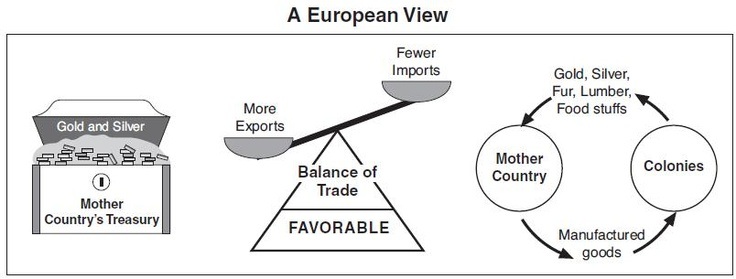
What is mercantilism?
A system where a mother countries gains money and power from natural resources that come from its colonies.
where colonies trade gold and silver with each other.
Wars that start over money.
Plantation colonies trading slaves for money.

Which term means a good to sold another country?
Import
Export

EXPORTS of the 13 colonies included:
Manufactured goods
Raw Materials
Slaves
Gold

The impact of mercantilism was that
The rate of slavery in the Americas went down
Trade was limited in the Atlantic
The Colony grew wealthy
The Mother Country grew wealthy

Raw materials are used to make the things we make ourselves or buy in stores. Those things are:___________.
raw materials
manufactured goods
natural resources
from the earth
Which of the following describes why the colonist began to smuggle goods:
They hated the English taxes on their exports
The English would pay more for smuggled goods
Pirates saw an opportunity to steal from ships
None of these
All of these
Smuggling means
Trading good illegally
Trading slaves
Trading provisions
None of these
Which British Act governed trade between the colonies and Britain (England)?
Bribe Act
Smuggling Acts
Triangular Trade
Navigation Acts
What does smuggle mean?
To refuse to buy something
To send a document making a demand
To make a top secret group
To sneak goods in or out
What was the goal of mercantilism?
To control trade and gain wealth
Make colonies wealthy
Import many goods from other nations
Share wealth with other nations

What economic principle is illustrated in the image below?
Captialism
Feudalism
Socialism
Mercantilism
Why were colonists only allowed to trade with their mother country?
The colonists did not know other countries existed
The mother country can gain more wealth
The colonists were prideful
The mother country can share their wealth
Merchants
A person or company who sells goods/products (merchandise)
In: goods coming into a country
Exit: goods going out of a country (selling)
The specific laws passed by England to control the trade
Navigation Acts
A person or company who sells goods/products (merchandise)
In: goods coming into a country
Exit: goods going out of a country (selling)
The specific laws passed by England to control the trade
Imports
A person or company who sells goods/products (merchandise)
In: goods coming into a country
Exit: goods going out of a country (selling)
The specific laws passed by England to control the trade
Exports
A person or company who sells goods/products (merchandise)
In: goods coming into a country
Exit: goods going out of a country (selling)
The specific laws passed by England to control the trade
Mercantilism
Being angry with England-The colonists were not accustomed to British control
The specific laws passedy by England to control trade
Mother Country Controls Trade-Colonys role is to serve the mother country
Exit: goods going out into a country (selling)
Colonists' Reaction
Being angry with England-The colonists were not accustomed to British control
The specific laws passedy by England to control trade
Mother Country Controls Trade-Colonys role is to serve the mother country
Exit: goods going out into a country (selling)
Triangular Trade
Used prior to slaves; had to work for 5-7 years before being free.
Slaves
The most famous leg
Important trading route
What was the Middle Passage called?
Used prior to slaves; had to work for 5-7 years before being free.
Slaves
The most famous leg
Important trading route
What was brought in in through the Middle Passage?
Used prior to slaves; had to work for 5-7 years before being free.
Slaves
The most famous leg
Important trading route
Indentured Servants were_______________________________?
Used prior to slaves; had to work for 5-7 years before being free.
Slaves
The most famous leg
Important trading route
The Columbian Exchange was
Used prior to slaves; had to work for 5-7 years before being free.
The exchange of goods between the New World and the Old World
The most famous leg
Important trading route
What did the Navigation Acts of the 1600's and the 1700's, allow England to do? (Select all that apply)
Open trade with all countries in the World.
Control all trade into and out of England and the American colonies.
Raise money for the English government.
Reducing trade competition from the colonies and foreign countries.
How did the Navigation Acts allow the English government to achieve the answer to #1? (select all that apply)
By requiring all trade to be on English or colonial ships.
Restricting the production of certain goods to be made and sold in the colonies.
putting tariffs on imports going to the American colonies.
confiscating the natural resources of the American colonies.
How did the Navigation Acts impact the American colonists? select all that apply.
American trade was resricted to Britain only.
Americans were prohibited from making certain products.
Americans had to pay more for imported goods.
Americans were able to trade with anyone they wanted.
Which group benefited the most from Mercantilism?
The colonies
Africa
England
Which of these was an effect of the Navigation Acts on England?
The colonies developed very little industry or manufacturing ability
The economy was thriving due to selling manufactured goods
Smuggling became common to resist trade rules
There was a decrease in population due to the slave trade
Which of these was an effect of the Navigation Acts on Africa?
The colonies developed very little industry or manufacturing ability
The economy was thriving due to selling manufactured goods
Smuggling became common to resist trade rules
There was a decrease in population due to the slave trade
Which of these was an effect of the Navigation Acts on the colonies?
The colonies developed very little industry or manufacturing ability
The economy was thriving due to selling manufactured goods
A huge migration of humans took place
There was a decrease in population due to the slave trade
What was the goal of the Navigation Acts?
To loosen up restrictions on the colonies
To help people navigate the ocean
To regulate trade so Europe could make more profit
To sell the colonies to France
The trade pattern between the colonies, Africa, and Europe was called what?
Middle Passage
Navigation Acts
Triangular Trade
Columbian Exchange

The economic policy that made the "mother country" rich by not letting colonies trade with anyone else was known as...
Salutary Neglect
Free Market System
Capitalism
Mercantilism
Economy where mother country establishes colonies as a source of raw materials and markets.
Joint Stock Company
Salutary Neglect
Mercantilism
Colony
Relaxed enforcement on trade laws imposed on colonies
Burgesses
Joint Stock Company
Charter
Salutary Neglect
In its economic relationship with its North American colonies, Great Britain followed principles of mercantilism by
outlawing the African slave trade
encouraging the development of manufacturing in the colonies
limiting the colonies' trade with other nations
establishing laws against business monopolies
During the early to mid-1700s, the British policy of salutary neglect toward the American colonies contributed to
a decline in colonial maufacturing
the decline of slavery in the northern colonies
a decrease in French and Spanish influence in North America
the development of independent colonial trade practices
The British system of mercantilism was opposed by many American colonists because it
placed quotas on immigration
placed restriction on trading
discouraged the export of raw materials to England
encouraged colonial manufacturing
Under mercantilism, the thirteen American colonies were expected to provide Great Britain with
finished American-manufactured goods
raw materials and markets for British products
officials to represent colonial interests in Parliament
laborers to work in British factories
What were the effects of the Great Awakening?
Divided the colonies against each other.
Drove people to leave the Anglican Church.
Made people more aware of their individual spiritual obligations.
Diminished the colonists appreciation of education.
Associated spiritual freedom with political freedom.
George Whitefield was the first American _____ ?
outdoor preacher
celebrity
pastor
protester
What was the central message of Whitefield's preaching?
No King but Jesus!
Loyalty to the state is loyalty to the church!
God created, now we must act!
You must be born again!
Which of the following are signs of the American colonies growing cold spiritually?
Salem Witch Trials
Half-way covenant
Ol' Deluder Satan Act
Founding of Harvard College
Deism

US clergyman whose intense sermons on the power of God helped to create the Great Awakening in New England in 1734-5
John Calvin
Martin Luther
Jonathan Edwards
John Thomas Lorton
What Christian denomination was founded by John and Charles Wesley?
Society of Friends
Baptist
Methodist
Presbyterian
Who was credited with preaching the first sermon of the Great Awakening?
George Whitefield
Jonathan Edwards
John Wesley
Charles Wesley

