
 Worksheets
Progressive Era & Imperialism Fast & Curious
Total questions: 53
Worksheet time: 27mins

What was Jacob Riis reveal to the public through his book, How The Other Half Lives?
living conditions of the tenement buildings in New York
working conditions of a textile mill
food production of a meatpacking plant
medical care of soldiers in WWI

These were journalists who wrote book and articles that exposed corruption in business and government:
Progressives
Muckrakers
Sensationalists
Investigative reporters

This time period focused on social and political reforms in the United States in the early 1900s:
Civil War Era
Industrialization Era
Progressive Era
Reconstruction Era

This U.S. president made significant contributions to breaking up big business during the Progressive Era:
Howard Taft
Woodrow Wilson
William McKinley
Theodore Roosevelt

Why did the Progressive Era grow in the United States?
because of the negative impact of industrialization
because of the negative impact of the civil war
because industrial tycoons were appalled by the conditions of factories
because the American people were disillusioned by WWI

People who were trying to get the 19th Amendment passed were supporting what?
Right to vote for 18 year olds
Right to vote for African Americans
Right to vote for women
Right to vote for those in prison

Those who wanted to make economic reform may have been concerned about which issue?
the influence of monopolies and trusts
eliminating political machines/bosses
conservation of natural resources
ending racial discrimination

People like W.E.B. du Bois participated in the movement against what?
Racism
Women's suffrage
Child Labor
Prohibition
What do we call it when people walk out of their job and refuse to work?
Boycott
Strike
Strikebreakers
Walk out
Why would people go on strike?
To demand better working conditions
To demand for more money
To demand to work less hours
All of these are correct
Why were immigrants more willing to take the jobs that Americans were on strike from?
The jobs paid a lot of money.
Immigrants were desperate for money and willing to do work.
Immigrants were bored with their new lives in America away from their home country.
Immigrants didn't think the conditions were bad at all.
People who tried to find solutions to problems
Muckrakers
Progressives
Politicians
Crooks
Which law broke up big business trusts into small companies?
Sherman Antitrust Act
Roosevelt Antitrust Act
Trust Act
Act of breaking up trusts
These were journalists who wrote book and articles that exposed corruption in business and government:
Progressives
Muckrakers
Sensationalists
Investigative reporters
The complete control of an industry by one person or company.
Progressive Era
Assembly line
Industrial Revolution
Monopoly
A community center established to help immigrants get familiarized with American culture.
urbanization
Settlement house
Muckraker
Tenement
A company of several owners (trustees) that collectively purchase their competition so that they create one large company.
Labor Union
Nativism
Trust
Sherman Anti-Trust Act
A law passed in 1890 that prohibited businesses to become monopolies and therefore encourage competition.
Compromise of 1877
Child Labor Act
Trust
Sherman Anti-Trust Act
An organization of workers that tries to help its members receive higher wages and have better working conditions.
Labor Union
Nativism
Trust
Sherman Anti-Trust Act
Suffrage is -
the right to vote
the right to suffer
the right to live
the right to speak

Conservation is-
when a country's trade and industry are controlled by private owners for profit
using vigorous campaigning to bring about political or social change
protection of natural resources
the unjust or prejudicial treatment of different categories of people

Reforming means
Changing something for the better
Controlling something despite hardships
Buying something
Arguing something against the government
What did Upton Sinclair hope to illustrate in his book, "The Jungle?"
The plight of workers in the dangerous Chicago Stockyards and Meatpacking Plant
The dangers of Standard Oil being a monopoly and abusing employees and consumers
The corrupt government officials who took bribes to help get special projects done
The extreme poverty, horrible living conditions, and disease of urban poor.

This political cartoon of Standard Oil is best summarized by which phrase below?
In 1911 the Supreme Court ruled Standard Oil needed to be split into several different companies
By the 1880s, Standard Oil became the largest oil refiner in the country, controlling access to 90 percent of the oil in the US.
By the early 1890s, there were more than 4,000 millionaires in America, and most of them claimed to be self-made men.
Throughout the year 1904, investigative journalist Upton Sinclair published articles on Standard Oil, critiquing the company's ruthless practices.
What territorial acquisition was labeled “Seward’s Folly” by the American public?
Hawaii
Alaska
Philippines
Cuba
What is the takeover of weaker nations by stronger nations called?
Imperialism
Defense
Free Market
Nationalism
American planters living in what area overthrew the local government and subsequently requested annexation to the United States?
Cuba
Nicaragua
Hawaii
Philippines
Industrialists supported U.S. imperialism because they were interested in finding new:
defenses.
markets.
imperialism.
allies.
This term is used to describe a type of sensational journalism that was popular in the late 1800s.
Yellow Journalism
tabloids
broadcast Journalism
Trade Journalism
In 1898, the United States declared war on:
Spain
Cuba
Philippines
Mexico
As a result of the Spanish-American War, the United States acquired control over all of the following territories EXCEPT:
Puerto Rico
Cuba
Mexico
Philippines
The Panama Canal...
linked the Atlantic Ocean and the Indian Ocean.
linked the Mississippi River with the Gulf of Mexico.
linked the Atlantic Ocean and Pacific Oceans.
linked the Gulf of Mexico with the Mediterranean Sea.
The Roosevelt Corollary...
Was the name of the treaty ending the Russo-Japanese War
Stated U.S. intentions to intervene in Latin America if their stability was threatened
Was the term for the agreement between the U.S. and Cuba regarding its independence
Stated U.S. intentions to build a canal in Panama
The Open Door Policy dealt with __________ issues in China.
territory
political
trade
border
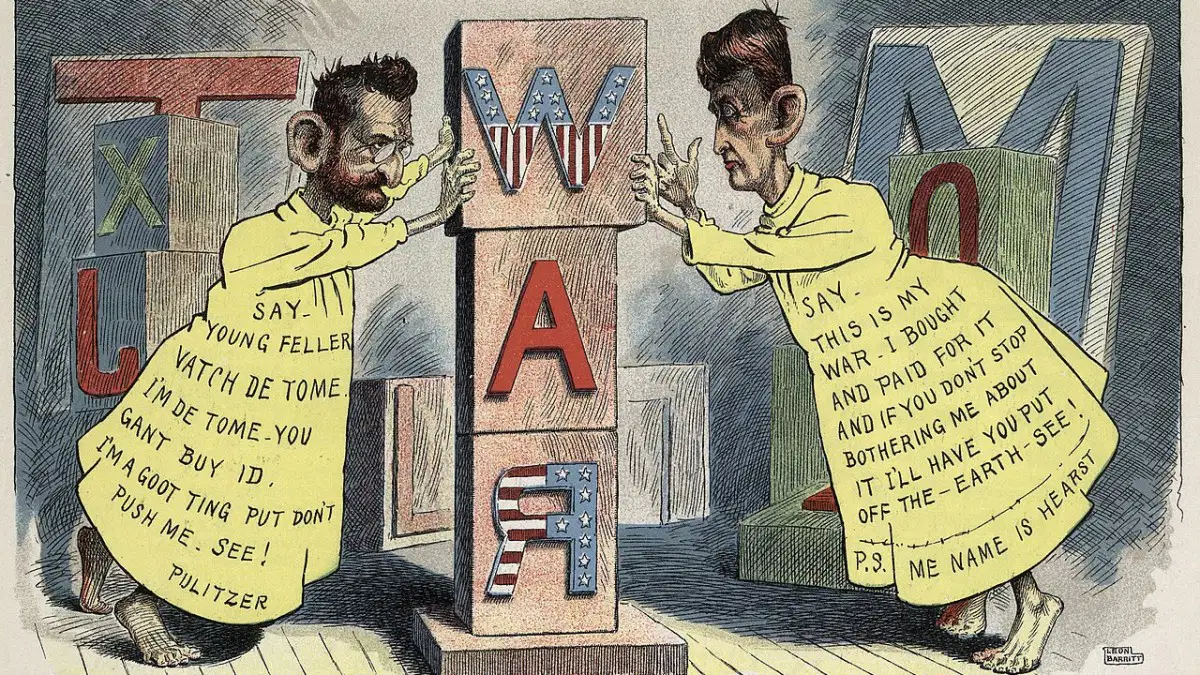
Reporting in newspapers and magazines that exaggerates the news in order to make it more exciting
Investigative journalism
Sensationalism
yellow journalism
Tabloid journalism

After taking control of Puerto Rico, the new American government focused on assimilating the locals, then means. . .
Puerto Ricans were given full rights.
Puerto Ricans relocated to the mainland of the U.S.
Puerto Ricans were forced to adopt or learn American culture.
When the United States annexed the Philippines. . .
the Philippines became a territory of the Unites States.
the Philippines became an independent country.
the Philippines became an official state of the U.S.

Following the Spanish American War, the Spanish remained in control of Cuba
True
False

Citizens in American states have more rights than American territories.
True
False

The Monroe Doctrine increased the power of the United States in North and South America
True
False

The Monroe Doctrine of 1823 stated that:
European countries could not interfere with North and South American countries.
America would not do any trading or business with European countries.
What movement emphasized "soup and soap": feeding and cleaning people and society rather than true salvation?
Modernism
Fundamentalism
Social gospel
Unitarianism
I established the federal Reserve in 1913
Roosevelt
Wilson
Taft
This woman was arrested in 1872 after illegally attempting to vote. She went on to lead the National American Women's Suffrage Association.
Susan B. Anthony
Ida B. Wells
Jane Adams
Ida Turnbell
The right to vote.
Suffrage
Referendum
Representation
Ballot

Ida B. Wells wrote, “The way to right wrongs is to turn the light of truth upon them.” This quote best explains
The work of muckrakers
The growth of big business in America
The rise of the American middle class
The need for the US strengthen their military

The big accomplishment of the Temperance movement during the Progressive Era was the
Abolition of slavery (13th Amendment)
Prohibition of drinking (18th Amendment)
The right of 18 year olds to vote (26th Amendment)
The direct election of senators (17th Amendment)
What years best show when the Progressive Era happened?
1840-1860
1860-1900
1890-1920
1939-1945


Between 1860 and 1900, a primary cause of migration from rural to urban areas was ____.
inflationary pressure on crop prices
lack of rural housing as building slowed
increasing economic opportunity in cities
government resettlement policies
Overcrowding and pollution were caused primarily by what?
Urbanization
Industrialization
Nativism
Assimilation
The progressive era reform that outlawed price-fixing.
Sherman Anti-Trust Act
Clayton Anti-Trust Act
The Federal Trade Commission Act
The Federal Reserve Act

