
 Worksheets
Unit 1 Review
Total questions: 22
Worksheet time: 11mins
What is the main difference between the colors of the visual spectrum?
They all have different wavelengths.
The brightness of the color is different.
They all provided different amounts of heat.
The all travel at different speeds.

Which of the following represents a wavelength?
Point A to Point B
Point E to Point F
Point B to Point H
Point C to Point H
What does point A represent in the photo provided?
Crest
Trough
Wavelength
Amplitude

The following chart shows the amount of 3 different products ordered from Jan to June. Which month the product 1 grow the most?
April to May
Jan to Feb
March to April
Feb to March
Which of the following has waves from the EM spectrum correctly ordered from SHORTEST to LONGEST wavelength?
Infrared, Microwaves, Radio waves
Radio waves, Microwaves, Infrared
Radio waves, Infrared, Microwaves
Infrared, Radio waves, Microwaves,
Why do some apples appear red?
Because they absorb all colors except red, red is reflected.
Because they reflect all colors except red, red is absorbed.
What is the dependent (outcome) variable in the following experiment?
A group of students are investigating if the amount of sunlight affects a plant's height. The students grow plants in several different amounts of light and then measure their height. All the plants receive the same amount of water and no fertilizer.
Use of fertilizer
What is the independent variable in the following experiment?
A group of students are investigating if the amount of sunlight affects a plant's height. The students grow plants in several different amounts of light and then measure their height. All the plants receive the same amount of water and no fertilizer.
Use of fertilizer
How does infrared light differ from microwave and radio light waves?
Infrared light has a longer wavelength and lower frequency than microwave and radio light waves.
Infrared light is visible to humans while microwaves and radio waves are not.
Infrared light, microwave, and radio light waves all have the same wavelength and frequency.
What can we use to separate the different colors of light.
Triangle
Which type of wave has the shortest wavelength?
Which of the following is an example of refraction?
Light bounce off a steel beam.
Light absorbing into a t-shirt.
light moving from air to water.
light from the sun making a shadow.
Which of the following is the LEAST reliable source?
responses on a website where anyone can answer the question.
When is the best time to come to a conclusion when working on an experiment?
After completing the experiment ONCE and analyzing the results.
After repeating the experiment many times (multiple trials) & analyzing all the results
Why do scientists replicate other experiments?
Why do scientists repeat their own experiments?
Which of the following is true about the Sun's radiant energy and how it travels to Earth?
Radiation from the sun travels to earth is varying (different) frequencies
Radiant energy from the Sun must travel through matter
Gamma rays and ultraviolet rays have longer wavelengths than visible light.
Visible light is only ONE color of light and only have one wavelength.
Why does white light separate into different colors by a prism?
Because the colors have different wavelengths.
Because the colors travel at different speeds.
Because the color strike the prism at different times.
Because the colors are from different sources.
Which of the following best describes refraction?
Light wave change speed as they pass through and object.
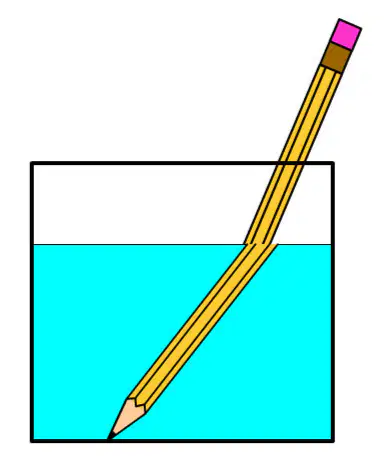
Why does the pencil in the glass NOT appear straight in the glass of water?
transmission of light
reflection of light
refraction of light
absorption of light
Where do light waves travel the fastest?
Which sound wave would travel the fastest?

