
 Worksheets
Compounds and Chemical Equations
Total questions: 25
Worksheet time: 39mins
Name
Class
Date
1.
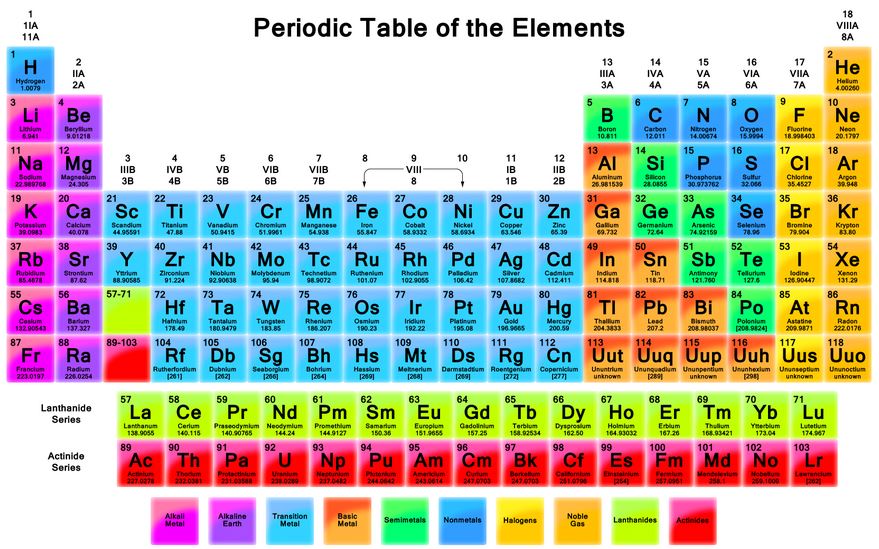
Elements on the LEFT side of the periodic table will most likely form:
a)
Positive ions
b)
Negative ions
c)
Neutral Ions
d)
None of these
2.
Which of the following has a full valence shell?
a)
Oxygen
b)
Neon
c)
Barium
d)
Carbon
3.
An ionic bond forms when atoms ___________ electrons.
a)
gain
b)
share
c)
increase
d)
transfer
4.
Which type of bond has a transfer of an electron from on atom to another?
a)
Polar Covalent
b)
Non Polar Covalent
c)
Ionic
d)
Metallic
5.
Chemical bonds form when atoms
a)
combined nuclei
b)
give up neutrons
c)
gain protons
d)
share or transfer electrons
6.
All chemical bonds involve two atoms sharing electrons.
a)
True
b)
False
7.
Bonds that form between two metals are called ______________ bonds.
a)
ionic
b)
covalent
c)
metallic
d)
pervasive
8.
If an atom loses two electrons what charge will it have?
a)
+ 2
b)
- 2
c)
+1
d)
-1
9.
If an atom gains one electron what charge will it have?
a)
-2
b)
-1
c)
+1
10.
Covalent compounds
a)
Share electrons
b)
transfer electrons
c)
contain a sea of electrons
d)
conduct electricity
11.
What is the number of valence electrons for Oxygen?
a)
8
b)
6
c)
2
d)
1
12.

How many valence electrons in this structure?
a)
6
b)
5
c)
4
d)
7
13.
How are covalent bonds explained?
a)
When one atom takes the other atom's electron
b)
When the atom shares an electron with an another atom
c)
When the two nucleus merge
d)
When the neutrons leave the nucleus
14.
Atoms joined together by SHARING electrons are?
a)
Ionic bonds
b)
Covalent bonds
c)
Metallic Bonds
d)
James Bonds
15.
What is the name of the compound CaS?
a)
Carbon Sulfur
b)
Carbon Sulfide
c)
Calcium Sulfide
d)
Calcium Sulfate
16.
Which of the following is not an element?
a)
Hydrogen
b)
Oxygen
c)
Water
d)
Potassium
17.
Which of the following is not a sign that a chemical change is taking place?
a)
Iron melts
b)
Light is produced
c)
Heat is produced
d)
Change in colour
18.

Is this equation balanced?
a)
yes
b)
no
c)
Not enough information
19.

Is this equation balanced?
a)
yes
b)
no
c)
Not enough information
20.
Is the equation balanced?: 2H2O + O2 --> 4MgO + 3Fe
a)
Yes
b)
No
21.
Balance this equation
_N2 + _H2 --> _NH3
_N2 + _H2 --> _NH3
a)
1,2,3
b)
1,3,2
c)
1,1,2
d)
2,1,1
22.
What does the Law of Conservation of Mass state?
a)
Matter cannot be gained or lost in a chemical reaction.
b)
Matter can only be lost in a chemical reaction.
c)
Matter can only be gained in a chemical reaction.
d)
Matter can be gained and lost in a chemical reaction.
23.
LiBr is called
a)
lithium bromine
b)
lithium (I) bromine
c)
lithium bromide
d)
lithuim (I) bromide
24.
What is the correct formula for Sodium Oxide?
a)
NaO
b)
NaO2
c)
Na2O
d)
Na2O2
25.
What is the name of the compound Na2(SO4)?
a)
Sodium sulfate
b)
Sodium sulfide
c)
Sodium sulfite
d)
Sodium sulfuroxide
100 %

