
Font size
S
M
L
XL
 Worksheets
AP THEORY CH 1 EXAM
Total questions: 40
Worksheet time: 20mins
Name
Class
Date
1.

Identify the letter name of the given pitch.
a)
G
b)
C
c)
A
d)
D
2.

What is wrong with the notation of these note heads?
a)
They are circles rather than ovals.
b)
They are written on the wrong lines and spaces.
c)
They are too big.
d)
They are too small.
3.

Which series of letter names matches the pitches? John Lennon and Paul McCartney, "Hey Jude," mm. 1–4
a)
B | G G B C | F F G | A E E D B | C B A G
b)
G | E E G A | D D E | F E E D G | A G F E
c)
G | E E G A | D D E | F C C B G | A G F E
d)
B | G G B C | F F G | A E E B G | A G F E
4.
What pitch class is an enharmonic equivalent to A♭?
a)
B♭
b)
C
c)
G♯
d)
B
5.
The interval from A to B♭ is a _____.
a)
whole step
b)
half step
6.
What is 4 above E?
a)
C
b)
A
c)
B
d)
G
7.

What is the lowest pitch in this excerpt? J. S. Bach, Minuet I, Unaccompanied Cello Suite No. 1 View online resource: https://player.wwnorton.com/iframe?playertype=audio&layout=wide&theme=default&themecolor=&file=/wwnorton.college.protected.editorial/music/mustheo4/audio/testmaker/TheoryAndAnalysis/mgta4_tb_ch01_44.mp3&height=44
a)
E3
b)
E4
c)
G2
d)
G3
8.

What is the pitch and octave number for the pitch?
a)
D3
b)
B3
c)
B4
d)
D2
9.
The interval from B to C♯ is a _____.
a)
half step
b)
whole step
10.

What does the pp marking at the beginning of this composition indicate to the performer? Amy Beach, Gavotte, Op. 36, No. 2, mm. 1–4 View online resource: https://player.wwnorton.com/iframe?playertype=audio&layout=wide&theme=default&themecolor=&file=/wwnorton.college.protected.editorial/music/mustheo4/audio/testmaker/TheoryAndAnalysis/mgta4_tb_ch01_49.mp3&height=44
a)
The piece should begin loudly.
b)
The piece should begin softly.
c)
The piece should begin at a medium loudness.
11.
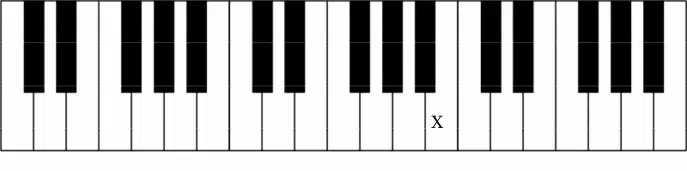
Which pitch-class letter name is indicated by the X on the piano keyboard?
a)
B
b)
A
c)
D
d)
E
12.
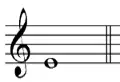
Identify the letter name of the given pitch.
a)
C
b)
E
c)
F
d)
G
13.
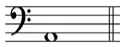
Identify the letter name of the given pitch. a. A b. B c. G d.
a)
true
b)
false
14.
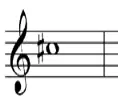
What is enharmonically equivalent to the notated pitch?
a)
C♯
b)
C
c)
B♯
d)
D♭
15.

Which pitch-class letter name is indicated by the X on the piano keyboard?
a)
G♭ or F
b)
F♯ or G♭
c)
G♭ only
d)
F only
16.
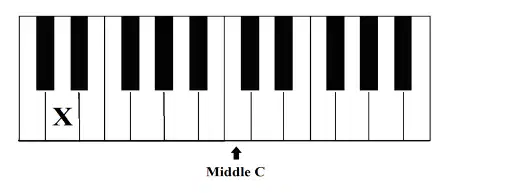
What is the letter name and octave number for the piano key marked by an X?
a)
D3
b)
G3
c)
G2
d)
D4
17.
Which two pairs of white keys are not separated by a black key on the piano keyboard?
a)
E–F and D–E
b)
B–C and F–G
c)
E–F and B–C
d)
A–B and D–E
18.
What is 7 above B?
a)
D
b)
B
c)
A
d)
C
19.
What pitch class is not an enharmonic equivalent to C?
a)
D♭♭
b)
Bx
c)
B♯
20.
If I refer to the tone F, am I referring to a pitch or a pitch class?
a)
pitch class
b)
pitch
21.

Which series of letter names matches the pitches? J. S. Bach, Minuet I, Unaccompanied Cello Suite No. 1 View online resource: https://player.wwnorton.com/iframe?playertype=audio&layout=wide&theme=default&themecolor=&file=/wwnorton.college.protected.editorial/music/mustheo4/audio/testmaker/TheoryAndAnalysis/mgta4_tb_ch01_16.mp3&height=44
a)
G D B A B C B
b)
E B G F G A G
c)
E B E D E F E
d)
G D G F G A G
22.
What is 6 below F?
a)
A
b)
B
c)
G
d)
C
23.
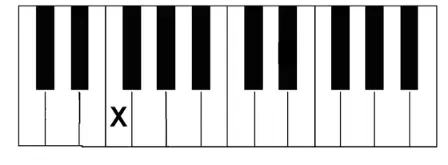
Which pitch-class letter name is indicated by the X on the piano keyboard?
a)
B♯ or C
b)
E♯ or F
c)
E♯ or F♭
d)
B♯ or C♭
24.

Which pattern of whole steps (W) and half steps (H) matches the intervals in the musical example? Traditional, "Lannigan's Ball," mm. 1–2
a)
W W W W W W W H
b)
W H W H H W W H
c)
W H W W W W W H
d)
W H W W W W W W
25.
Which option represents sounding pitches from lowest to highest?
a)
G♭♭–G–G♭–Gx–G♯
b)
Gx–G♯–G–G♭–G♭♭
c)
G♭♭–G♭–G–G♯–Gx
d)
G♭–G–G♯–Gx–G♭♭
26.

What is the letter name and octave number for the pitch?
a)
A4
b)
A3
c)
B3
d)
C4
27.

What is enharmonically equivalent to the notated pitch?
a)
F
b)
E
c)
E♯
d)
F♭
28.

What is the pitch and octave number for the pitch?
a)
E4
b)
F3
c)
E3
d)
F4
29.
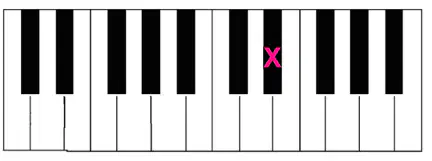
Which pitch-class letter name is indicated by the X on the piano keyboard?
a)
D♯ or E♭
b)
E♯ or F
c)
E♭ only
d)
D♯ only
30.

What is the highest pitch in this melody? Fred E. Weatherly, "Danny Boy," mm. 1–4
a)
C4
b)
C5
c)
A5
d)
A4 Clara Schumann, Romanze, Op. 21, No. 1, mm. 1–4
31.

At the beginning of the excerpt, what are the pitches notated in the bass clef?
a)
A E C
b)
A E A
c)
F C F
d)
F C A
32.

At the beginning of the excerpt, what are the pitches notated in the treble clef?
a)
G E G
b)
G A G
c)
E A E
d)
E C E
33.

What are the first two pitches notated with a sharp in the excerpt?
a)
B♯, E♯
b)
D♯, G♯
c)
D♯, B♯
d)
F♯, B♯
34.
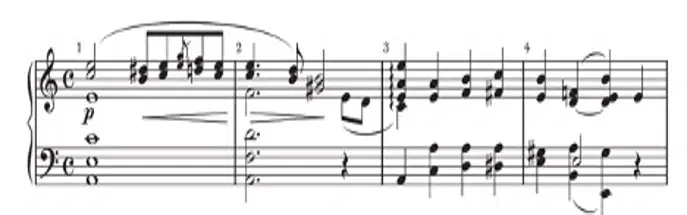
What is the highest pitch in the excerpt?
a)
G4
b)
G5
c)
B3
d)
B4
35.
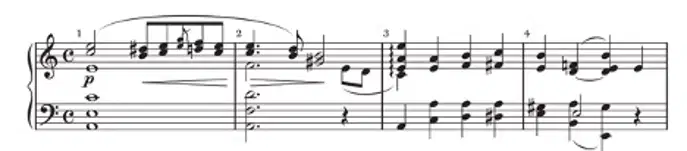
What are the first two pitches notated with ledger lines in the excerpt?
a)
C3, D3
b)
C3, D4
c)
C4, D4
d)
C2, D3
36.

In the lowest line of the bass clef, following three statements of one pitch, the line ascends by whole and half step: C–D–D♯–E. What is the sequence of intervals between these pitches?
a)
W W H
b)
W H H
c)
H H W
d)
H H H
37.
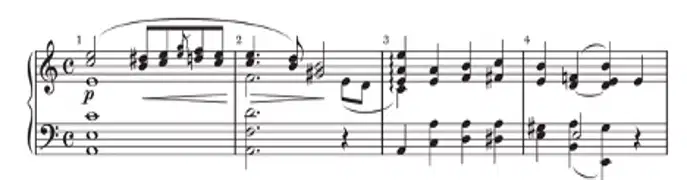
What is the interval between the first two pitches in the highest part?
a)
half step
b)
whole step
38.

How many letter names are spanned between the two lowest pitches at the end of the excerpt?
a)
3
b)
4
c)
5
d)
6
39.

What does the p at the beginning of the passage indicate to the performer?
a)
The excerpt should begin softly.
b)
The excerpt should begin loudly.
c)
The excerpt should begin at a medium loudness.
40.

After the initial p between the staves, what do the angled lines indicate to the performer?
a)
a diminuendo, followed by a crescendo
b)
a crescendo, followed by a diminuendo
Reset

