
 Worksheets
Bioenergetics and Enzymes
Total questions: 25
Worksheet time: 13mins
The study of energy transformations in living systems is (a) .
Energy cannot be created or destroyed, it only changes in form.
True
False
How does an organism consuming chemical energy have to do with free energy?
It doesn't.
When an organism consumes chemical energy, it transforms into thermal energy and free energy which is usable.
When an organism consumes chemical energy, the energy that it consumed transforms into thermal and potential energy, with potential storing energy for later.
The amount of energy that is used for chemical energy is (a) than what is consumed.
Another example of free energy is (a) . (abbreviation)
The two basic types of energy are
Potential and Mechanical.
Kinetic and Thermal
Potential and Kinetic.
Chemical and Thermal.
When a bond is formed, energy is _____ and energy is ______ as well.
added, stored
released, stored
preserved, added
stored, preserved
When a bond is broken, energy is _____ to the products from the environment, and energy that was stored in the body is also _____.
released, preserved
preserved, stored
added, stored
added, released
Reactions that absorb energy are endergonic.
True
False
Reactions that release energy are exergonic.
True
False
In living organisms, exergonic reactions drive endergonic reactions, and these are called _______ _____.
(a)
Oxidation is the gain of electrons. Reduction is the loss of electrons.
True
False
Special molecules that accept and transport high energy electrons are called (a) .
Adenosine Triphosphate (ATP) is a nucleic acid that is used for very (a) term transport and storage.
Humans use 90lbs of ATP per day. (It is recycled).
True
False
Metabolism involves building (________) or breaking (_________) chemical bonds. (put and between your 2 answers and CAPITALIZE BOTH WORDS!!).
(a)
Enzymes each have special functions. They can come in all different shapes, sizes. They have many different functions.
True
False
Enzymes help speed up chemical reactions by lowering the ___________.
Potential Energy.
Mechanical Energy
Activation Energy
Endergonic Reactions
Each enzyme has an ______ ____ for different types of substrates. (reactant or reactants.)
(a)
The Lock and Key Hypothesis has a ________, while the Induced Fit Hypothesis _________
Perfect fit, Hydrogen bonds adjust size to fit
Hydrogen bonds adjust size to fit, Perfect fit
An enzymes cannot function properly if the enzyme's temperature and/or pH fall out of its optimal conditions. This is called (a) .
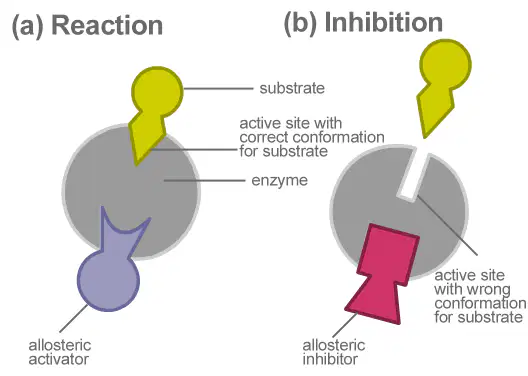
An Allosteric Site includes an activator or inhibitor that changes the shape of the _____ to either fit or not fit the substrate.
Allosteric Site.
Active Site.
Tense Site.
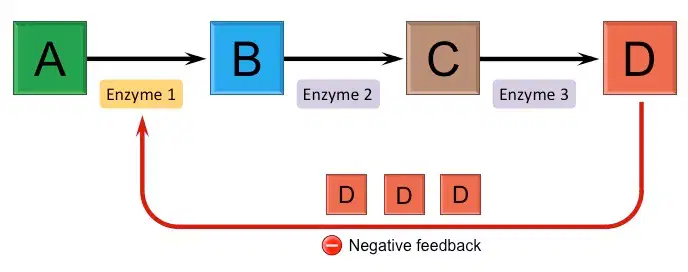
Cells can control the production of biochemical pathways with allosteric enzymes at the start of a pathway or within a pathway. This is called _______.
Organic Chemistry
Feedback Inhibition
Allosteric Cycle
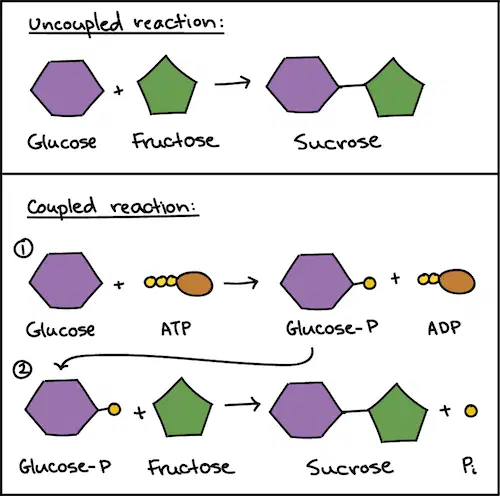
A coupled reaction is a reaction where the energy releasing side is coupled with the side that needs the energy.
True
False
A coupled reaction is a reaction where the energy releasing side is coupled with the side that needs the energy.
True
False

