
NEW
Font size
 Worksheets
LET Review
Total questions: 15
Worksheet time: 8mins
why is science valued?
Because science has helped in satisfying many human basic needs.
Because science has helped in improving living conditions.
Because science has caused detrimental effects in the environment.
Both Blue and Green
It is concerned about learning, teaching, and understanding science
science education
science process skills
science teacher
science workshop
It is a series of processes for validating and expanding scientific knowledge
scientific literacy
scientific method
scientific name
scientific jargon
It refers to addressing our own needs without jeopardizing future generations’ potential to do same. We need not only natural but also social economic resources
sustainability
scientific literacy
scientific education
development goals
what are the characteristics of students who are proficient in science
students know, use , and interpret scientific explanations
students generate and evaluate scientific evidence and explanations.
students understand the nature and development of scientific knowledge.
all the above.
all the following statements is true except:
the teaching of science develops inquiring minds and curiosity about the world.
the teaching of science appreciates the benefits and limitations of science and its applications.
the teaching of science obscures the understanding of the international nature of science.
None of the above
This strategy aims to expose students to a broad range of concepts/topics and discipline until they master them by studying them repeatedly but with varying degrees of difficulty.
teaching outside specialization
spiral progression
learning loss
educational disruption
Which DepEd order sets the guidelines for the conduct of research?
Deped order No. 16 s. 2017
Deped order No. 23 s. 2018
Deped order No. 144 s. 2017
Deped order No. 28 s. 2022
Which is not a part of action research?
context
rationale
output
innovation
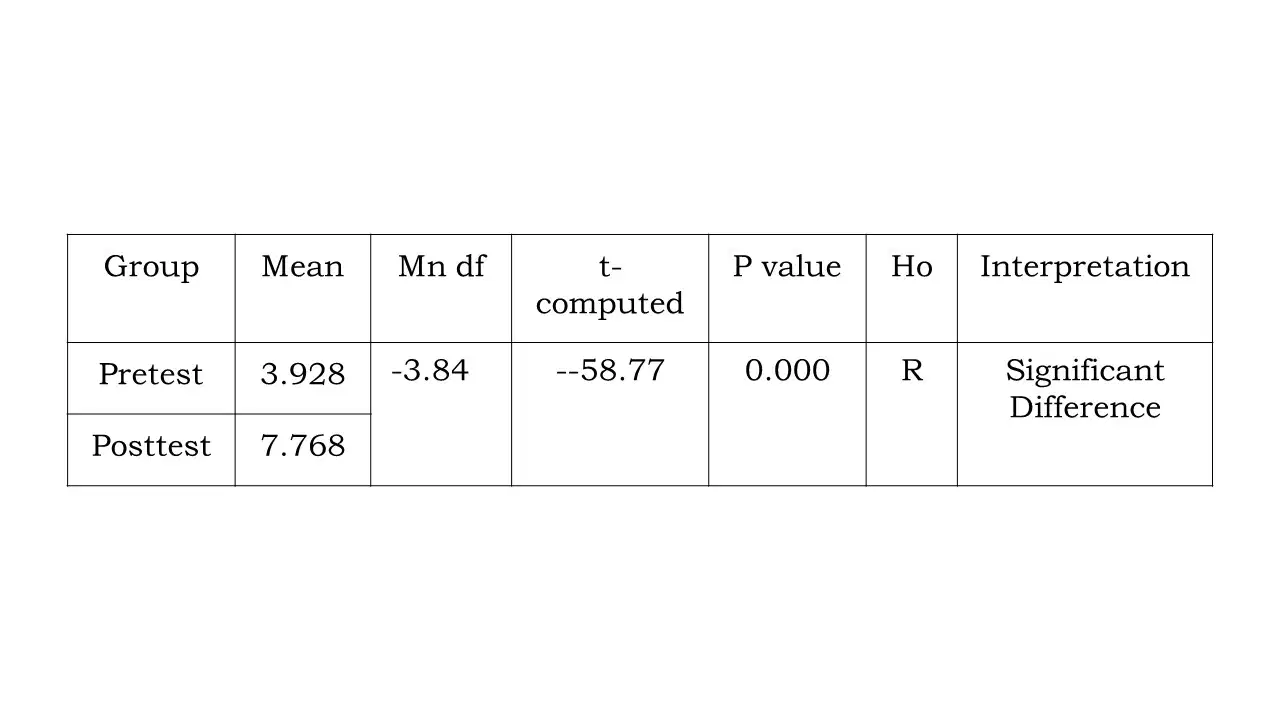
What would be the best interpretation of the table
From the table it can be gleaned that pretest and posttest has a P value of 0.00 lower than 0.05 level of significant, thus the null hypothesis is rejected and there is significant difference on the results of exam for pretest and posttest
From the table it can be gleaned that pretest and posttest has a P value of 0.00 lower than 0.05 level of significant, thus the null hypothesis is accepted and there is significant difference on the results of exam for pretest and posttest
From the table it can be gleaned that pretest and posttest has a P value of 0.00 lower than 0.05 level of significant, thus the null hypothesis is rejected and there is no significant difference on the results of exam for pretest and posttest
From the table it can be gleaned that pretest and posttest has a P value of 0.00 lower than 0.05 level of significant, thus the null hypothesis is accepted and there is no significant difference on the results of exam for pretest and posttest
Which is not an appropriate tool for identifying the problem for research?
Gap analysis
Critical thinking
Prediction
What is the correct ratio of grading system science of K-12 curriculum
Written works- 40%
Performance Task- 40%
Quarterly Assessment- 20%
Written works- 30%
Performance Task- 50%
Quarterly Assessment- 20%
Written works- 50%
Performance Task- 30%
Quarterly Assessment- 20%
Written works- 35%
Performance Task- 35%
Quarterly Assessment- 30%
John learns well through active interplay with others. His learning increases when engaged in activities that has meaning in him. Which philosophy can describe this?
Realism
Empiricism
Idealism
Progressivism
The teacher should provide for shared experiences in the classroom that fosters cooperative learning rather than competitive learning. Scientific means of inquiry complements such atmosphere. Which theory advocates this view?
Naturalism
Realism
social constructivism
Pragmatism
The physical sciences includes physics, chemistry, and astronomy. What facet of science is illustrated here?
Science as a broad body of knowledge
Science as a set of skills
Science as a social activity
Science as a global human endeavor

