wayground logo

Free Printable Worksheets

Font size

S
M
L
XL
Worksheets

Lesson 2a/2b Measurement and Sig Figs

Total questions: 83

Worksheet time: 21hrs 45mins

Name
Class
Date
1.
Steve wanted to see if the type of fertilizer made sunflowers grow larger. What is the independent variable 
a)
Type of fertilizer
b)
Size of sunflower
c)
type of sun flower
2.
Steve wanted to see if the type of fertilizer made sunflowers grow larger. What is the independent variable 
a)
Type of fertilizer
b)
Size of sunflower
c)
type of sun flower
3.
Molly investigated if the age of students caused them to be better drivers. What is the independent variable?
a)
Type of car
b)
Skill of driving
c)
Age of student
4.
Sam wanted to know if the color of the chair you sat in when taking a test affected your test grade. What is the dependent variable.
a)
Color or chair
b)
Grade on test
c)
Age of students
5.
Robert wanted to know if the type of phone you used gave you better or worse service. What is the independent variable. 
a)
Location of phone call
b)
Type of phone
c)
How good the service was
6.
Sarah wanted to find out if the size of a car tire made it a smoother ride over bumps. What is the independent variable?
a)
Size of tire
b)
How smooth the ride was over bumps
c)
Type of car
7.
Penelope wanted to see if the temperature of the oven made cookies softer or harder. What is the independent variable.
a)
Hardness of cookie
b)
Type of oven
c)
Temperature of oven
8.
Dilcia wants to know how drinking milk affects how tall a Monica grows. Which is the independent variable?
a)
Monica's growth
b)
drinking milk
9.
Ramone wants to know: does the distance a person kicks a soccer ball effect how well they will do on their math test.  What is the dependent variable?
a)
How far they kick the soccer ball
b)
who the person is
c)
how well they do on the math test
d)
Type of soccer ball.
10.
What would the INDEPENDENT variable be in an experiment testing which types of paper airplane goes furthest?
a)
the paper used
b)
the type of paper airplane
c)
the distance of each plane's flight
d)
how hard the plane is thrown
11.
Marcos wants to know: Does the type of gasoline put in a car effect how fast the car can drive? What is the independent variable?
a)
Type of gasoline
b)
which car the gas is put into
c)
how fast the car can drive
d)
how much gas is put into the car
12.
An experiment is performed on plants to see how different liquids affect plant growth. Each plant in the experiment is given a different liquid; water, apple juice, or milk. Each plant has the same amount of soil, sunlight, and listens to the same music. In this investigation, the independent variable is ...
a)
The type of plant
b)
The amount of sunlight
c)
The type of music
d)
The type of liquid
13.
Angelina set up an experiment to see how the mass of a ball affects the distance it rolls off a ramp. Identify the independent variable.
a)
Distance traveled by the ball
b)
Height of the ramp
c)
Mass of the ball
d)
Who set up the experiment (Ms. S, etc)
14.

A variable that you change or manipulate to affect the results in an investigation is the __________________?

a)

control variable

b)

dependent variable

c)

independent variable

d)

research variable

15.

The variable in an investigation that you are measuring is the _________________?

a)

control variable

b)

independent variable

c)

dependent variable

d)

research variable

16.
How many variables can be tested in a controlled experiment?
a)
one
b)
two
c)
three
d)
as many as possible
17.
Scientific questions have to be...
a)
Measurable 
b)
Easy
c)
Interesting
18.
Choose the best-written hypothesis that answers the question:
Question: Why is my room warmer during the day than at night?
a)
Sunlight is making my room warmer.
b)
Mr. Rivas has the heat turned on in the morning.
c)
If I close my blinds during the day, then my room will be cooler because sunlight cant get in.
d)
Sunlight actually cools down a room.
19.
What step does every scientific experiment begin with?
a)
hypothesis
b)
question/problem
c)
procedures
d)
conclusion
20.

What is a test/independent variable?

a)

The variable that is changed/manipulated in the experiment

b)

The variable that is being observed/measured in the experiment

c)

Elements that are kept constant/unchanged in the experiment

d)

The group that does not receive the manipulation; used to compare

e)

The groups that do receive the manipulation

21.

What is a control group?

a)

The variable that is changed/manipulated in the experiment

b)

The variable that is being observed/measured in the experiment

c)

Elements that are kept constant/unchanged in the experiment

d)

The group that does not receive the manipulation; used to compare

e)

The groups that do receive the manipulation

22.

What is an experimental group?

a)

The variable that is changed/manipulated in the experiment

b)

The variable that is being observed/measured in the experiment

c)

Elements that are kept constant/unchanged in the experiment

d)

The group that does not receive the manipulation; used to compare

e)

The groups that do receive the manipulation

23.

What is a outcome/dependent variable?

a)

The variable that is changed/manipulated in the experiment

b)

The variable that is being observed/measured in the experiment

c)

Elements that are kept constant/unchanged in the experiment

d)

The group that does not receive the manipulation; used to compare

e)

The groups that do receive the manipulation

24.

What is a control variable/constant?

a)

The variable that is changed/manipulated in the experiment

b)

The variable that is being observed/measured in the experiment

c)

Elements that are kept constant/unchanged in the experiment

d)

The group that does not receive the manipulation; used to compare

e)

The groups that do receive the manipulation

25.

Which word is associated with the test/independent variable?

a)

Change

b)

Measure

26.

Which word is associated with the outcome/dependent variable?

a)

Change

b)

Measure

27.

What is the test/independent variable in this experiment?

a)

The height of the plants

b)

The color of the lightbulbs

28.

What is the outcome/dependent variable in this experiment?

a)

The height of the plants

b)

The color of the light bulbs

29.

What is the control group in this experiment?

a)

The group with the red light

b)

The group with the white light

c)

The group with the blue light

d)

The group with the green light

30.

Which of the following is a control variable/constant in this experiment?

a)

The color of the light

b)

The type of plant

31.
Which of the following numbers has three significant figures?
a)
1014 miles
b)
101 feet
c)
1000 yards
d)
all of the choices
32.
How many significant figures does the following number have: 0.002040
a)
6
b)
4
c)
3
d)
2
33.
How many significant figures does the following number have: 0.998005
a)
9
b)
10
c)
6
d)
5
34.
How many significant figures does the following number have: 100.00210
a)
7
b)
5
c)
10
d)
8
35.
Round 0.010229 to four significant figures
a)
1022
b)
1023
c)
0.01023
d)
0.01022
36.
What is 0.658 rounded to 1 significant figure?
a)
0
b)
0.66
c)
0.7
d)
0.658
37.
How many significant figures does the measurement in 10.0 grams have>
a)
1
b)
infinite
c)
3
d)
2
38.
How many significant figures are in the measurement 48032 m?
a)
5
b)
4
c)
3
d)
2
39.

What is the length of the object in centimeters?

a)

3.40 cm

b)

4.3 cm

c)

3.5 cm

d)

1 1/4 inches

40.

What is the volume of the liquid in this graduated cylinder?

a)

19 mL

b)

35 mL

c)

24.0 mL

d)

26.0 mL

41.

Which answer best approximates the metric temperature reading on the thermometer?

a)

82.9 F

b)

86 C

c)

30 C

d)

30.0 C

42.

Read the graduated cylinder to the appropriate precision. Which answer is most appropriate?

a)

6.3 mL

b)

6 mL

c)

6.61mL

d)

6.31 mL

43.

Which is the correct temperature for this thermometer?

a)

58.4 oC

b)

57.4 oC

c)

50.74 oC

d)

57 oC

44.

What is the length of the screw?

a)

5.0cm

b)

5.1cm

c)

5.11cm

d)

51mm

45.
What tool do scientists use to measure volume of a liquid?
a)
graduated cylinder
b)
meter stick
c)
spring scale
d)
triple-beam balance
46.
What do we use a meter stick to measure?
a)
volume
b)
distance/length
c)
mass
d)
weight
47.
When measuring the temperature, what SI unit(s) do we use?
a)
Celsius only
b)
Fahrenheit, Celsius
c)
Kelvin, Fahrenheit
d)
Kelvin, Celsius
48.
What tool do we use to measure weight?
a)
electronic scale
b)
triple-beam balance
c)
spring scale
d)
thermometer
49.
Tom put water in a graduated cylinder and looked at the lowest point of the meniscus.  What unit should he use?
a)
meter
b)
kilometer
c)
liter
d)
milliliter
50.
Jamal put a block of wood on a triple-beam balance and read the amount in grams.  What was he measuring?
a)
temperature
b)
mass
c)
weight
d)
volume
51.
Cori took a ruler and measured the length x width x height of a block of wood.  What measurement was she getting?
a)
weight
b)
mass
c)
volume
d)
length
52.
William measured the distance from the door knob to the floor and got 1 meter.  What tool did he use?
a)
meter stick
b)
thermometer
c)
graduated cylinder
d)
electronic scale
53.

Roni measured the weight of her agenda. The unit she used was ____________.

a)

liter

b)

meter

c)

gram

d)

Newton

54.

Cassie measured the diameter of a quarter. What unit did she use?

a)

meter

b)

kilometer

c)

millimeter

d)

centimeter

55.
John measured the width of a quarter.  What unit did he use?
a)
meter
b)
kilometer
c)
millimeter
d)
centimeter
56.
Samantha got the volume of a block of wood.  Each side was 5 ___.  The volume was 125 ______.  What units did she use?
a)
cm, cm3
b)
meter, cm3
c)
gram, cg3
d)
mL, mL3
57.
Celia needed to get the mass of a beaker of sugar.  What tool should she use?
a)
electronic scale, triple-beam balance
b)
graduated cylinder, beaker
c)
meter stick, meter tape
d)
electronic scale, spring scale
58.
Mrs. Mathers ran from Jones to McDonald's.  She wanted to know how far she ran.  The units she would use would be _________.
a)
centimeters
b)
millimeters
c)
kilometers
d)
miles
59.
The distance from the Earth to the moon is 384, 400 ______.
a)
kilometers
b)
centimeters
c)
millimeters
d)
miles
60.

Toni put a cup of pennies on a triple beam balance and got 23 __________. What is the unit he should use?

a)

liter

b)

meter

c)

gram

d)

Newton

61.

Sheri put some water in a graduated cylinder and then looked at it at eye level at the meniscus and saw it was 25 mL. What measurement did she get?

a)

mass

b)

volume

c)

weight

d)

length, distance

62.

Density has the following formula? (Remember that we love density - NOT) - draw it out if you don't remember

a)

mass divided by volume

b)

volume divided by mass

c)

weight divided by mass

d)

mass times volume

63.

The variable that I change, like adding fertilizer to a plant, is what variable?

a)

independent variable

b)

dependent variable

c)

constant

d)

control

64.

The variable that is usually written on the y axis - the one that we measure to get our Data is -

a)

independent variable

b)

dependent variable

c)

control

d)

constant

65.

Round the following numbers to the number indicated: 345 (2 s.f.)

(a)  

66.
How many significant figures does the following number have: 0.002040
a)
6
b)
4
c)
3
d)
2
67.
How many significant figures does the following number have: 100.3
a)
4
b)
3
c)
5
d)
2
68.
Round 1047.78 to three sig figs
a)
104
b)
105
c)
1050
d)
1050.00
69.

Multiply and round to 3 significant digits.

23 X 12.4

a)

28

b)

285.20

c)

285

d)

285.2

70.

How close a measurement is to the accepted value is called..

a)

Accuracy

b)

Precision

c)

Significant

d)

Estimate

71.
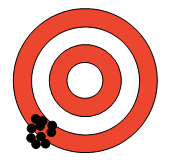
This bullseye demonstrates...
a)
High Accuracy & High Precision
b)
High Accuracy & Low Precision
c)
Low Accuracy & High Precision
d)
Low Accuracy & Low Precision
72.
The students measured length during a science experiement, they got 12 cm. But the actual measurement was 14.25 cm. What was the percent error?
a)
15.79%
b)
18.75%
c)
2.25%
d)
18%
73.

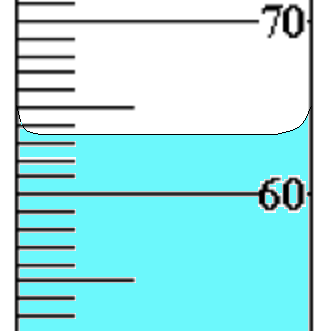
Volume?

a)

63.50 mL

b)

63.5 mL

c)

63.55 mL

d)

6 mL

74.

Measurements: 12.3, 14.5, 10.1, 16.9

True Value: 25.0

These measurements are…

a)

Accurate, but not precise

b)

Precise, but not accurate

c)

Both precise and accurate

d)

Neither precise nor accurate

75.
Convert 300 meters to centimeters:
a)
3000 cm
b)
0.3 cm
c)
30,000 cm
d)
3 cn
76.
Which lists metric units, in order, from smallest to largest?
a)
milligram, centigram, gram
b)
kilogram, gram, centigram
c)
decagram, hectogram, milligram
d)
kilogram, hectogram, decagram
77.

7,000 mL = ____ L

a)

70 L

b)

700 L

c)

7 L

d)

0.07 L

78.

When Joselyn went to the store she bought 2.7kg of salt water taffy. What does Joselyn need to do to find out how many grams she bought?

a)

Divide by 1000

b)

Multiply by 1000

c)

Divide by 100

d)

Multiply by 100

79.
The metric unit of measurement for mass is the: 
a)
gram
b)
liter 
c)
meter
80.
What is the abbreviation for milliliters?
a)
ML
b)
Ml
c)
mL
d)
ml
81.

What is the correct measurement of the red line?

a)

2 cm

b)

2.3 cm

c)

2.5 cm

d)

2.30 cm

82.

What kind of glassware is this?

a)

Beaker

b)

Burette

c)

Graduated Cylinder

d)

Flask

83.

What kind of glassware is pictured here?

a)

Flask

b)

Beaker

c)

Graduated Cylinder

d)

Pipette