wayground logo

Free Printable Worksheets

Font size

S
M
L
XL
Worksheets

TEST #3 Review

Total questions: 77

Worksheet time: 13hrs 45mins

Name
Class
Date
1.

Find the inverse of  f(x)=3x+2f(x)=3x+2  

a)

f1(x)=3x2f^{-1}(x)=3x-2

b)

f1(x)=2+3xf^{-1}(x)=2+3x

c)

f1(x)=x23f^{-1}(x)=\frac{x-2}{3}

2.

Find the inverse of  f(x)=x53f(x)=\frac{x-5}{3}  

a)

f1(x)=35+xf^{-1}(x)=\frac{3}{5}+x

b)

f1(x)=3x+5f^{-1}(x)=3x+5

c)

f1(x)=5x+3f^{-1}(x)=5x+3

3.

The inverse of  f(x)=x21f(x)=x^2-1  is f1(x)=(x+1)12f^{-1}(x)=(x+1)^{\frac{1}{2}}  .

a)

True

b)

False

4.

The notation for an inverse is

a)

f1(x)f^{-1}\left(x\right)

b)

g1(x)g^{-1}\left(x\right)

c)

All of the above

5.
What's the name of the inverse of g(x)?
a)
f(x)
b)
f-1(x)
c)
y
d)
g-1(x)
6.
What is the first step in finding the equation of the inverse of a function?
a)
get x by itself
b)
switch x and y
c)
solve for y
d)
write the function in inverse function notation
7.
The inverse has been reflected over which line?
a)
y = x
b)
y =1
c)
y = 0
d)
y = x + 1
8.
If the equation of f(x) goes through (1, 4) and (4, 6), what points does f-1(x) go through?
a)
(1, 4) and (4, 6)
b)
(-4, -1) and (-6, -4)
c)
(-1, -4) and (-4, -6)
d)
(4, 1) and (6, 4)
9.
f(x) = {(3, 7), (4, -2), (5, -1), (8, 7)}
Is f-1(x) a function?
a)
Yes
b)
No
c)
No way to tell
10.
Was the inverse function found correctly?
a)
no,
b)
yes
11.
Find the inverse of the function
f(x) = 3x − 5
a)
f-1(x)=3x +5
b)
f-1(x)=(x+5)/3
c)
f-1(x)=3y-5
d)
f-1(x)=3y+5
12.

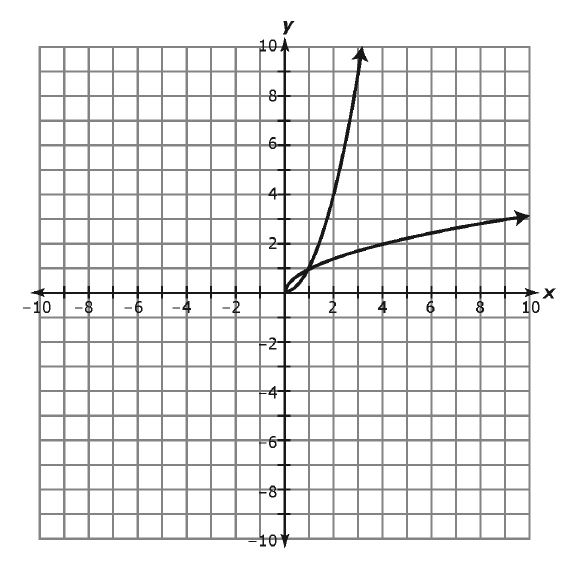
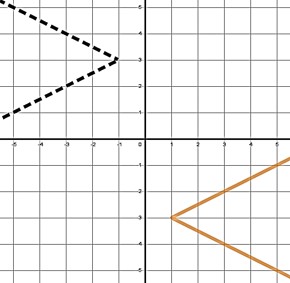
Which of the following best describes the graph?

a)

They are both functions, but not inverse functions.

b)

They are reflected over y=x, but they are not both functions.

c)

They are not reflected over y=x, and they are not both functions.

d)

They are inverse functions.

13.

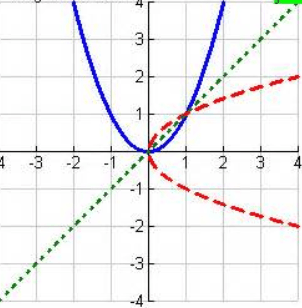
Which of the following best describes the graph?

a)

They are both functions, but not inverse functions.

b)

They are reflected over y=x, but they are not both functions.

c)

They are not reflected over y=x, and they are not both functions.

d)

They are inverse functions.

14.

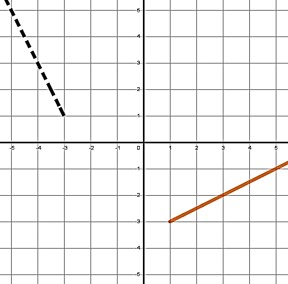
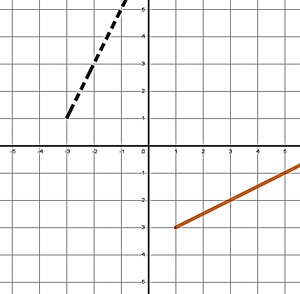
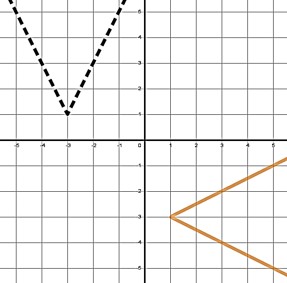
Which graph represents the functions f(x) and f-1(x)?
a)
b)
c)
d)
15.

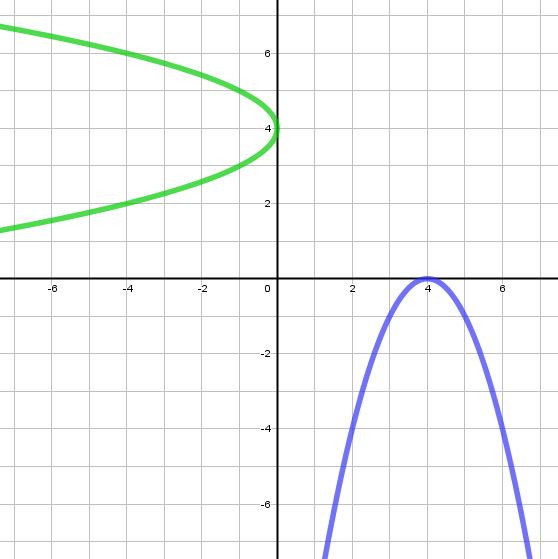
What is the inverse of the points (1,3)(2,4)(6,2)?
a)
(2,6)(3,1)(4,2)
b)
(-3,-1)(-4,-2)(-2,-6)
c)
(1,3)(2,4)(6,2)
d)
(-1,-3)(-2,-4)(-6,-2)
16.

Which of the following best describes the graph?

a)

They are both functions, but not inverse functions.

b)

They are inverse functions.

c)

They are reflected over y=x, but they are not both functions.

d)

They are not reflected over y=x, and they are not both functions.

17.
a)
Inverse Functions
b)
Not Inverse Functions
18.
a)
Inverse Functions
b)
Not Inverse Functions
19.

Which expression represents g(f(x)) if        

 f(x) = 2x - 8 and g(x) = 4x

a)
8x - 32
b)
8x2 - 32x
c)
8x - 8
d)
6x - 8
20.

If f -1 (-25) = 7 then what is f(7) = 

a)
25
b)
7
c)
No enough information. 
d)
-25
21.

If f(x) = x2 - 3x and g(x) = 4x + 2, which of the following is equal to f(g(3))?

a)

2

b)

-14

c)

154

d)

182

22.

If f(x) = 4x2 - 4 and g(x) = -3x + 2, what is g(f(-1))?

a)

96

b)

26

c)

2

d)

-1

23.
What is the equation that the inverse will reflect across?
a)
y = x
b)
y = 0
c)
x = 0
d)
Potato
24.
When finding the inverse of a relation, 
1st you replace f(x) with y
2nd switch the x's and y's
What do you do next?
a)
solve for y
b)
replace y with f-1(x)
c)
solve for x
d)
find the greatest common factor
25.

This graph shows a one-to-one function.

a)

True

b)

False

c)

Not enough information to be determined

26.

Find the domain of the inverse of

{(-2, 5), (-1, 3), (3, 7), (4, 12)}

Is it a one-to-one?

a)

{(5, -2), (3, -1), (7, 3), (12, 4)} - Yes

b)

{3, 5, 7, 12} - Yes

c)

{(5, -2), (3, -1), (7, 3), (12, 4)} - No

d)

{3, 5, 7, 12} - No

27.

If f(x) is an invertible function, and f(1)=2, f(0)=-1, and f(-1)=-2, then

f1(2)=??f^{-1}\left(-2\right)=??  


(a)  

28.

Suppose that f(x) is an odd function and the point (2, -3) lies on its graph. What is

f1(3)?f^{-1}\left(3\right)?  


(a)  

29.
a)

A

b)

B

c)

C

d)

D

30.

Which is the inverse of the table?

a)
b)
c)
d)
31.

The relation in the graph is..

a)

a function but not a one-to-one function.

b)

a one-to-one function.

c)

not a function

32.

The relation in the graph is..

a)

a function but not a one-to-one function.

b)

a one-to-one function.

c)

not a function

33.

The relation in the graph is..

a)

a function but not a one-to-one function.

b)

a one-to-one function.

c)

not a function

34.

The relation in the graph is..

a)

a function but not a one-to-one function.

b)

a one-to-one function.

c)

not a function

35.
Is this graph a function or not a function? 
a)
Function
b)
Not a Function
36.
Is this graph a function or not a function? 
a)
Function 
b)
Not a Function 
37.

Use the graph to determine whether the inverse of f(x) is a function. Explain your reasoning.

a)

The inverse is not a function because f(x) does not pass the horizontal line test.

b)

The inverse is a function because f(x) does not pass the horizontal line test.

c)

The inverse is not a function because f(x) passes the vertical line test.

d)

The inverse is a function because f(x) passes the vertical line test.

38.

Is the inverse of this a function?

a)

Yes

b)

No

39.

Determine if the function has an inverse function. If it does, then find the inverse function.

f(x)=x8f\left(x\right)=\frac{x}{8}  

a)

yes,  f1(x)=8xf^{-1}\left(x\right)=8x  

b)

yes,  f1(x)= x8f^{-1}\left(x\right)=\ x^8  

c)

yes,  f1(x)=x+8f^{-1}\left(x\right)=x+8  

d)

no inverse

40.

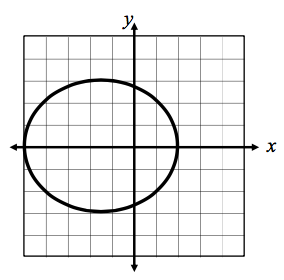
Is y a function of x?

a)

function

b)

not a function

41.
What is the domain of this graph?
a)
[-1,1]
b)
[-2,2]
c)
(-1,-2)
d)
(-∞,+∞)
42.
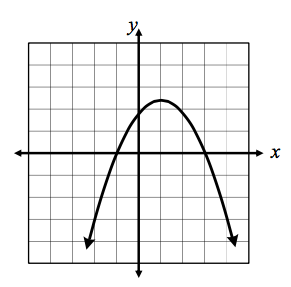
What is the range of this function?
a)
[-2,3]
b)
(-2,3]
c)
[-5,4]
d)
(-5,4]
43.

What is the range of this function?

a)

(-∞,+∞)

b)

[-3,+∞)

c)

(-∞,3]

d)

(-∞,3)

44.
Is this a function?  Why or why not?
a)
No, the domain numbers are repeated.
b)
No, it passes the Vertical Line Test.
c)
Yes, it passes the Vertical Line Test.
d)
Yes, the range numbers are not repeated.
45.

What is the domain?

a)

[-2, 3]

b)

[-2, 3)

c)

(-2, 3]

d)

[-3, 4]

e)

(-3, 4]

46.

What is the range?

a)


(0, )\left(0,\ \infty\right)

b)

[0, )\left[0,\ \infty\right)

c)

(, )\left(-\infty,\ \infty\right)

d)

None of the answer choices

47.

What is the domain?

a)

(, 3]\left(-\infty,\ -3\right]

b)

[3, )\left[3,\ -\infty\right)

c)

(,3]\left(-\infty,3\right]

d)

(,)\left(-\infty,\infty\right)

e)

None of the answer choices

48.

What is the domain?

a)

(-8, 4]

b)

(-8,-3) U [-1, 4]

c)

[-8,-3) U [-1, 4]

d)

(-8,-4] U [-1, 4]

e)

(-2, 6]

49.

Given f and g in the graph,

what is f(g(2)) ?

a)

3

b)

8

c)

1

d)

4

50.

Given f and g in the graph,

what is f(f(3)) ?

a)

3

b)

2

c)

4

d)

1

51.
Find (f + g)(x)
a)
2x2 - 3
b)
9
c)
x4 - 3x2 - 18
d)
(x2 + 3)/(x2 -6)
52.
Find (f - g)(x)
a)
x2 - 3
b)
9
c)
x4 - 3x2 - 18
d)
(x2 + 3)/(x2 - 6)
53.
Find (fg)(x)
a)
x2 - 3
b)
9
c)
x4 - 3x2 - 18
d)
(x2 + 3)/(x2 - 6)
54.
Find (f/g)(x)
a)
x2 - 3
b)
3/-6
c)
x4 - 3x2 - 18
d)
(x2 + 3)/(x2 - 6)
55.
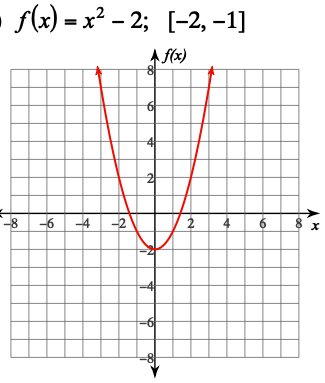
Find f-1(x)
a)
2/(x+5)
b)
2/(x-5)
c)
(x-5)/2
d)
3/x
56.

From the table below calculate the quantities asked for:
Find (fg)(1)\left(f\cdot g\right)\left(1\right)  

a)

0

b)

-6

c)

6

d)

18

57.

For the function f(x) and g(x) given in the graph, Find the corresponding function value.

f(g(3))f\left(g\left(3\right)\right)  

a)

4

b)

2

c)

1

d)

0

58.

f(x) = 3x2 - 5 and g(x) = 2x. Then (fg)(-2) =

(a)  

59.

f(x)=x3+1f\left(x\right)=x^3+1  and  g(x)=1x1g\left(x\right)=\frac{1}{x-1}  Then  (gf)(3)=\left(g\circ f\right)\left(3\right)=  


(a)  

60.
When f(x) = 9-3x and g(x) = 5x-7 , find f(x)+g(x). 
a)
14x-10
b)
-8x+2
c)
2x+2
d)
2x-2
61.
When f(x) = x2+9 and g(x) = x-9, find f(x)-g(x). 
a)
x2+x+9
b)
x2-x+9
c)
x2-x
d)
x2-x+18
62.

All of the x values or inputs are called what?

a)

Domain

b)

Range

c)

Relation

63.
Given f(x) = 3x2 - 2x + 1 and           g(x) = x - 4, find (f*g)(x). 
a)
3x3 - 10x2 - 7x - 4
b)
3x3 - 14x2 + 9x - 4
c)
3x2 - x - 3
d)
3x3 + 14x2 - 9x - 4
64.

f(x)= x+3

g(x)= x-2

Find (g(x) / f(x))

Be careful!!

a)

(x + 3)/(x - 2)

b)

(x - 2)/(x + 3)

c)

-2/3

d)

3/2

65.

Complete the operation and evaluate.

a)
b)
c)
d)
66.

Perform the indicated operation and evaluate for the given value.

a)
b)
c)
d)
67.
Factor:
x2 - 5x
a)
1(x - 5)
b)
x(x - 5x)
c)
x(x - 5)
d)
x2(1 - 5)
68.
Factor:
10x + 15
a)
100x + 150
b)
10(x + 5)
c)
1(10x + 15)
d)
5(2x + 3)
69.
w3 + 3w
a)
3w(1)
b)
w(w2 + 3)
c)
w3(w + 3)
70.
When f(x) = 4x+8 and
g(x) = x+3, find
f(x) * g(x). 
a)
4x2+24
b)
4x2+20x+24
c)
4x2+12x+24
d)
4x2+4x+24
71.

Use the given function or the graph to find the average rate of change

a)

3

b)

-3

c)

3/2

d)

-1/3

72.
f(x) = 2x2 + 12x + 16
What is the average rate of change of f(x) on the interval [-3, -2].
a)
2
b)
1/2
c)
-2
d)
-1/2
73.
Find the average rate of change over the given interval. 
a)
4
b)
7
c)
7/3
d)
3/7
74.
What is the average rate of change of [1, 5]?
a)
-0.65
b)
-0.75
c)
3.75
d)
4
75.

Calculate the average rate of change from 20 to 40 minutes.

a)

-2 minutes per gallon

b)

-20 minutes per gallon

c)

-2 gallons per minute

d)

-20 gallons per minute

76.
A climber is on a hike. After 2 hours he is at an altitude of 400 feet. After 6 hours, he is at an altitude of 700 feet. What is the average rate of change? 
a)
200
b)
150
c)
300
d)
75
77.

Which are better?

a)

DOGS!!!!

b)

cats

c)

fish

d)

people