
 Worksheets
Biotechnology
Total questions: 67
Worksheet time: 38mins
Who is dolly the sheep?
A cloned sheep
A ordinary sheep
I don't know
Which are most closely related to biotechnology?
medicine and agriculture
construction and engineering
water treatment and electricity generation
communication and information technology
What technique is used for separating DNA fragments?
Gel electrophoresis
Chromatography
Transformation
Transduction
Genomic library construction is concerned with ___________
Gene isolation
Protein production
Antibiotics
Regeneration
The first genomic libraries were cloned in _______________
Plasmid
Bacteria
Human
Plants
Chimeric DNA is
Gene clone
Recombinant-DNA
Transposon
Vector shuttle
Clones have the exact same:
Personalities
Physical appearances
Intelligence levels
Genetic material
A technique for making millions of copies of a specific region of DNA.
DNA ligase
restriction enzymes
gel electrophoresis
polymerase chain reaction
What is the best definition for "primer"?
An oligonucleotide of unknown sequence that is used to amplify the target gene.
An oligonucleotide of known sequence that is used to amplify the target gene.
An oligonucleotide of known sequence that is annealed to the target gene, allowing Taq polymerase to bind.
A section of DNA on the target gene that is the binding site for Taq polymerase.
Some yeast genes can be replaced by human genes that then continue to produce the same human proteins in the yeast cells. Which statement helps to explain this evidence?
The DNA of yeast and humans is identical.
Yeast and humans have the same number of chromosomes.
The genetic code is universal.
Yeast and humans are both eukaryotes.

What does PCR stand for?
Polymerase Cytoplasmic Reaction
Polymerase Chromosomal Reaction
Polymerase Chain Reaction
Probably Cannot React
At what temperature does the Denature step of PCR occur?
95° C
50° C
72° C
Any temperature
What is the function of a primer in PCR?
To identify the particular region of DNA to be copied by PCR.
To copy DNA.
To create DNA nucleotides.
To maintain the temperature of the PCR reaction.
A technique for making millions of copies of a specific region of DNA.
DNA ligase
restriction enzymes
gel electrophoresis
polymerase chain reaction
From where does Taq polymerase come?
Bacteria that live in hydrothermal vents/hot springs.
Cambodia
The rain forest
The CDC

plasmid pBR322 is developed by
Beadle and Tatum
Watson and Crick
Bolivar and Rodriguez
Jacob and Monad
Some restriction enzymes produce "sticky ends". Sticky ends are . . .
double stranded DNA aligned with each other
single-stranded DNA aligned with host DNA
ends of a double stranded DNA strand
single-stranded DNA "overhangs" that can bind to complementary DNA
In cloning vector, the antibiotics resistant gene are used
As sequences from where replication starts
To keep the cultures free of infection
As selectable markers
To select healthy vectors
Restriction Enzymes were primarily used as....
defense by protozoa against antibiotics
tools by viruses to cleave bacterial genome
defense by bacteria against bacteriophages viruses
tools to cleave DNA during replication
A cloning vector is
An agent that transfers a DNA segment to a RNA molecule
An agent that transfers a RNA segment to a DNA molecule
An agent that transfers a foreign gene from one DNA molecule to another
An agent that transfers a pathogen
How do we name restriction Enzymes ?
First two letter in Cap for Genus, next one letter in small for species, next one letter for strain and roman numeral for order of discovery
First letter in Cap for Genus, next two letter in small for species, next one letter for strain and roman numeral for order of discovery
First two letter in Cap for Genus, next one letter in small for species, next one letter for strain and English numeral for order of discovery
First two letter in Cap for Genus, next one letter in capital for species, next one letter for strain and roman numeral for order of discovery
The term molecular scissors generally refers to
DNA polymerases
RNA polymerases
Restriction endonucleases
DNA ligases
What is transformation?
Procedure though which a piece of DNA incorporated into bacterium
Procedure though which a piece of carbohydrate incorporated into bacterium
Procedure though which a piece of lipid incorporated into bacterium
Procedure though which a piece of protein incorporated into bacterium
Commonly used cloning vector is/are
pBR322
pUC19
pUC18
all the above
In order to insert a human gene into plasmid, both must
code for the same gene product.
be cut by the same restriction enzyme.
originate from the same type of cell.
have identical sequences.
Restriction Enzymes . . .
cut DNA at precise locations
help bacteria to pick up DNA
move DNA through a gel
copy DNA

What is a palindrome?
A sequence that is complementary to the other
A sequence that reads the same forwards and backwards
A blunt end resulting from a restriction enzyme
A sticky end resulting from a restriction enzyme
What are selectable marker ?
a radium labelled marker
a type of sequence
a resistant gene
a type of protein
What is the importance of cos sites in cosmids?
to make cosmids infectious
to make cosmids competent
allow DNA to be packaged inside lambda phage heads
permit replication as plasmid in bacteria
How do you overcome vector religation problem?
Use polymerase enzyme
Use restriction enzymes
Use alkaline phosphatase enzyme
Use ligase enzyme
The restriction enzyme ECOR1 has the property of?
Endonuclease activity
Ligation activity
Correcting the topology of replicating DNA
Exonuclease activity
pBR322 is an __________________ vector
original
cosmid
artificial
natural
Which statement describes the most likely effect of transformation on bacteria such as E. coli?
Transformed bacteria express a new protein product.
Transformed bacteria have multiple chromosomes.
Transformed bacteria reproduce more quickly.
Transformed bacteria become a new species.
Which of the following represents the correct order of steps in transformation?
heat-shock bacterial cells, cut plasmid with restriction endonuclease, use ligase to seal human gene of interest and plasmid together, select for transformed bacteria
cut plasmid with restriction endonuclease, select for transformed bacteria, use ligase to seal human gene of interest and plasmid together, heat-shock bacterial cells
cut plasmid with restriction endonuclease, use ligase to seal human gene of interest and plasmid together, heat-shock bacterial cells, select for transformed bacteria
use ligase to seal human gene of interest and plasmid together, heat-shock bacterial cells, select for transformed bacteria, cut plasmid with restriction endonuclease
Which tool is correctly matched with its function?
endonuclease — seals a human gene of interest into a bacterial plasmid
ligase — isolates a human gene of interest
transformation — introduces a bacterial plasmid into a cell
gel electrophoresis — amplifies a human gene of interest
GAATTC IS RECOGNITION site for restriction endonuclease
Hind III
EcoR I
Bam I
Hae III
Which type of restriction endonuclease is used in recombinant DNA technology
(a)
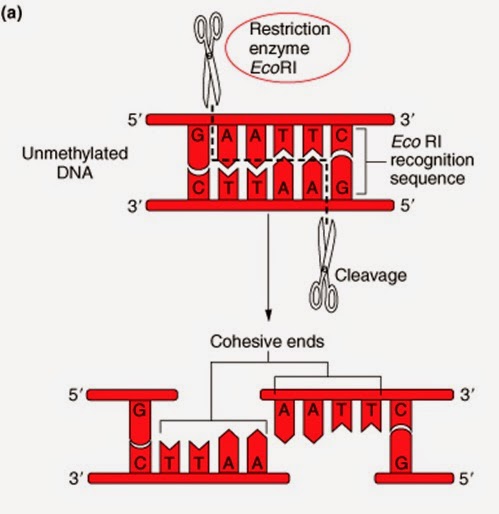
The recognition sites for restriction enzymes are :
a).Tautomer
b). Pallindrome
c).Metamere
d).Acronym
How do we name restriction Enzymes ?
a).First letter in Cap for Genus, next two letter in small for species, next one letter for strain and roman numeral for order of discovery
b). First two letter in Cap for Genus, next one letter in small for species, next one letter for strain and English numeral for order of discovery
c). First two letter in Cap for Genus, next one letter in capital for species, next one letter for strain and roman numeral for order of discovery
d). First two letter in Cap for Genus, next one letter in small for species, next one letter for strain and roman numeral for order of discovery
The sequence that that restriction Enzymes recognizes contains how many bases?
a).1
b). 3
c).6
d).12
Who discovered Restriction Enzymes?
a).Watson and Crick
b).Arber ,Natha, Linn
c).Jacob and Monod
d).Beadle and Tatum
Restriction endonuclease cuts DNA at
Restricted site
any site
non specific site
none
plasmid is present in ____
plant cell
virus
bacteria
none
(a) is used as host in gene cloning
cloning is
production of different copies
production of similar copies
both
none
what is a gene
DNA
RNA
PROTEIN
ALL THE ABOVE
In the laboratory all specimens should be treated as pathogenic.
True
False
High risk patients for infection “susceptible host” include cancer patients, transplant patients, and healthy athletes.
True
False
A microorganism that cannot live outside the cells of another living organism is called:
a flagella
parasitic
a spore
pathogenic
In Biosafety level 2, Special containment practices and devices are generally not required.
True
False
What is the classification of Biosafety level 1 laboratory
Involve with no infectious bacteria
The lab activities consider low risk to community
Involve any infectious disease bacteria but will not harm to community.
Involve any infectious disease bacteria and easily been spreading due to contact from one individual to another.
The use of nonpathogenic Escherichia coli, other non-infectious bacteria such as Bacillus subtilis fall under what biosafety level?
Level 1
Level 2
Level 3
Level 4
(a) enzymes are called molecular scissors.
Which would be a desirable trait scientists may want to create in a transgenic plant?
the ability to resist insects
the ability to grow less fruit
the ability to change color in the winter
the ability to use a lot of water
The site of production of ADA in the body is
erythrocytes
lymphocytes
blood plasma
osteocytes.
What is the most useful change biotechnology has made in agriculture?
Crops need more water
Crops need more nutrients
Crops need more time to grow
Crops resist more diseases
What term describes how humans created pure-bred dogs?
artificial selection
cloning
crossbreeding
selective breeding
What would be a positive reason to genetically alter Fraser Fir trees in North Carolina to make them more resistant to rot?
By producing crops that are frost resistant
By making robots to replace large farm machines
The population of fir trees would increase and grow healthier.
By increasing the use of wind farms that produce electricity
In what way is biotechnology useful to law enforcement agencies such as the police or FBI?
It can help identify who was present at the scene of a crime.
It can help undercover officers disguise themselves.
It might help determine who might be the victime of a future crime.
It can help determine who is most likely to become a criminal in the future.
This is the practice of inserting the DNA of another species into an organism's DNA so that the organism gains a new trait.
Cloning
Gel Electrophoresis
Genetic Engineering
DNA Fingerprinting
A company that creates hair dye would most likely employ a bio-technician for which job?
researching trends
developing new colors
creating cost effective packaging
developing a product that will be safe for consumers
This is the practice of producing a genetically identical cell or organism
Cloning
Gel Electrophoresis
Genetic Engineering
DNA Fingerprinting

