
 Worksheets
TOPIC 6_MOTION DESCRIPTORS.
Total questions: 31
Worksheet time: 13mins
What do we call a place or an object that is used for comparison to determine if something is in motion?
motion
speed
reference point
fast
Which of the following refers to the change in position of an object with respect to time?
motion
time
reference point
distance


The standard (SI) unit for measuring distance and displacement is ________ .
mile
foot
kilometer
meter
The change in an objects position from the final position to initial position.
displacement
distance
motion
reference point
Billy runs 400 meters to Andy's house, turns around, and runs 400 meters back home. What is Billy's distance?
0 meters
400 meters
800 meters
1600 meters
Billy runs 400 meters to Andy's house, turns around, and runs 400 meters back home. What is Billy's displacement?
0 meters
400 meters
800 meters
1600 meters
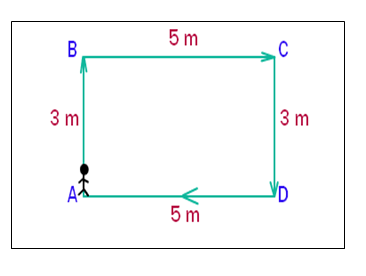


From the figure, what is the displacement?
20 meters
25 meters
15 meters
25 meters NE
What are you calculating when you divide the distance an object travelled by the amount of time it took for that object to travel that distance?
velocity
slope
motion
speed

Which statement is true about velocity?
Must have measurement of speed.
Must have a measurement of speed and direction.
Must have only direction.
Has neither a measurement of speed or direction.
The speedometer in a car gives the car's _________ speed.
average
instantaneous
speed
velocity
The SI unit for speed and velocity is_______.
meters per second
miles per hour
kilometers per second
meters per hour
What do you need to know about an object to calculate its velocity?
Speed and time
Speed and distance
Speed and direction
Time and direction
A cheetah runs 220 km in 2 hours. What is the cheetah's speed?
110 km/hr west
110 km/hr
440 km/hr
440 km/hr west
A train travels 500 km north in 2 hours. What is the train's velocity?
250 km/hr
250 km/hr north
500 km/s
500 km/s north
The Earth travels 900 km around the sun in 30 seconds. What is the Earth's velocity?
30 km/s
30 km/s around the sun
30 km/hr around the sun
30 km/hr
A Lego car travels 3 meters in 3.7 seconds. What is the car's speed?
0.81 m/s
0.81
1.23 m/s
1.23
Which of the following physical quantities is a vector?
speed
velocity
distance
displacement

A roller coaster accelerates from an initial speed of 6.0 m/s to a final speed of 70 m/s over 4 seconds. What's the acceleration?
24 m/s2
18 m/s2
16 m/s2
16 m/s

You toss a ball straight upward, in the positive direction. The ball falls freely under the influence of gravity.
At the highest point in the ball’s motion,
its velocity is zero and its acceleration is zero.
its velocity is zero and its acceleration is positive (upward).
its velocity is zero and its acceleration is negative (downward).
its velocity is positive (upward) and its acceleration is zero.
its velocity is positive (upward) and its acceleration is zero.
Suppose you are in a car that is going around a curve the speedometer reads a constant 30 km/h. Which of the following is NOT true?
Your speed is constant
Your direction is changing
You are not accelerating
You and the car are accelerating

