
 Worksheets
1D Motion Quiz 1
Total questions: 21
Worksheet time: 38mins
Imagine you're a pilot flying an airplane. You're currently heading East. In this scenario, would the Eastward movement of your airplane be considered to have a negative or positive velocity? Consider the standard conventions of a coordinate system.
Negative
Positive
Imagine you're a pilot flying a plane. You're currently heading North. Suddenly, you receive a command to change your direction and move South. In this scenario, would the Southward movement of your plane be considered as having a negative or positive velocity? Consider the standard conventions of a coordinate system.
Negative
Positive
Imagine you're a scientist conducting an experiment. You have an object at rest on a frictionless surface. When you start your experiment, what would be the original velocity of this object?
It depends on the specific conditions of the experiment
0
It is always positive, regardless of the conditions
It is always negative, regardless of the conditions
Imagine you're a scientist conducting an experiment. You've just dropped a ball from a certain height and it eventually comes to a stop after bouncing a few times. In this scenario, what would be the ball's final velocity?
It depends on the specifics of the experiment
0
It's always positive, regardless of the circumstances
It's always negative, regardless of the circumstances
Imagine you're a scientist conducting an experiment. You have an object that you've carefully placed at rest on a frictionless surface. If you let the object move freely without any external force, what would be its final velocity?
It depends on the specific parameters of the experiment
It remains at rest (0 velocity)
It accelerates downwards at -9.8m/s2
It always moves with a positive velocity
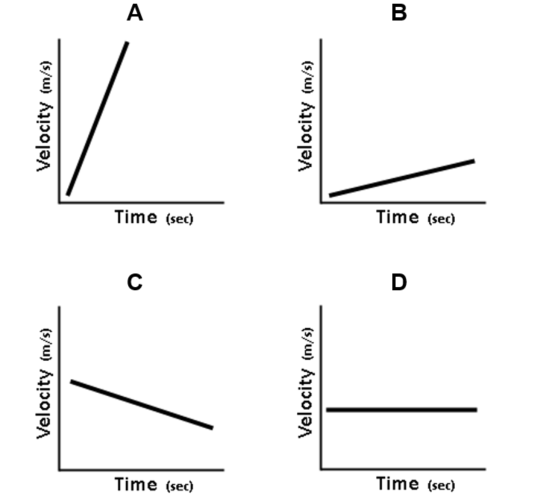
Imagine you're a physics student studying motion. You come across various types of graphs representing different types of motion. Can you identify which graph among the following represents zero acceleration, also known as constant velocity? Remember, a constant velocity means the object is moving at a steady speed in a straight line.
Graph A
Graph B
Graph C
Graph D
Imagine you're a scientist studying motion and you come across various measurements. Which of the following measurements would you classify as a velocity?
A car moving 35 meters towards East
A bird flying at a speed of 22 m/s
A train moving at 40 mph towards West
An object accelerating at 12 m/s2
Imagine you're a scientist studying the motion of objects. You come across a term 'Velocity'. Can you tell what it is? Velocity is...
The rate of change of acceleration
The rate of change of displacement
The rate of change of distance
The rate of change of speed
Imagine you're a physicist studying motion. You come across two types of quantities - vector and scalar. Can you distinguish between them? Specifically, what is the difference between a vector quantity and a scalar quantity?
A scalar has a magnitude and direction and a vector has only a magnitude
A vector has a magnitude and direction and a scalar has only a magnitude
A scalar has a direction and a vector has a magnitude
None of the above
Imagine you are a birdwatcher observing a rare species of bird in its natural habitat. The bird you are observing flies at a speed of 2.8 m/s. If the bird continues to fly at this speed for a full 4.33 minutes, how far would the bird have traveled in that time?
0.64 m
12.12 m
92.8 m
727.4 m
Imagine you're on a road trip. You're driving a car that travels at a steady speed of 40 mph. You've got 160 miles of beautiful countryside ahead of you. How long will it take you to cover this distance?
1 hour
2 hours
3 hours
4 hours
Imagine you're on a road trip. You've been driving your car non-stop and you notice that you've covered a distance of 100 miles in 2 hours. Based on this, can you calculate the speed at which your car is traveling?
2 mph
25 mph
50 mph
200 mph
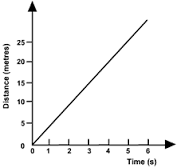
Imagine you are a scientist observing a moving object. You plot a graph based on your observations. What is this graph showing?
The object is moving away from the starting point at a constant speed
The object is moving back towards the starting point at a constant speed
The object is increasing its velocity
The object is decreasing its velocity
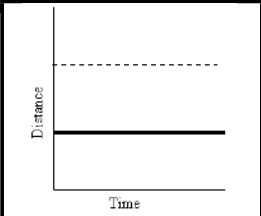
Consider a physics experiment where a car is moving on a straight road. A graph is plotted with time on the x-axis and distance on the y-axis. The graph is a straight line parallel to the x-axis. What does this graph represent?
The car is moving with a constant speed
The car is accelerating
The car is not moving

During the annual city marathon, three runners named Albert, Bob, and Charlie were competing fiercely. However, one of them decided to stop for a quick rest to regain his energy. Can you recall which runner stopped for a rest?
Albert
Bob
Charlie

Imagine you're a scientist studying the movement of a particle. You plot a position vs time graph and notice that the line is sloping downwards. What does this negative sloped line indicate about the particle's movement?
The particle is stationary and not moving at all.
The particle is slowing down in its movement.
The particle is retracing its path, moving back to its starting position.

Imagine you are observing a race between four different segments: A to B, C to D, B to C, and E to F. Each segment represents a different racer. Based on the data you have, which segment shows the faster speed?
A to B
C to D
B to C
E to F

What is happening in this velocity graph?
An object moves with constant velocity and the speeds up
An object slows down, stops, and then moves at a constant velocity
An object slows down, stops turns around, and then speeds up
An object slows down, stops, and then speeds up without turning around

What is happening in this velocity graph?
An object is at rest initially and then slows down
An object is at rest initially and then speeds up
An object moves at a constant velocity and then slows down
An object moves at a constant velocity and then speeds up
Car A, a sleek sports car, travels at a steady speed of 12 m/s to the East. On the other hand, Car B, a powerful muscle car, starts 10,000 meters away, and races West at a blistering speed of 16 m/s. What is the exact location in relation to Car A where these two speedsters will meet?
357m
625m
2500m
4286m
You ride your bike 1 km at 10 km/h and then another 1 km at 30 km/h. Its your average speed for the total 2-km trip greater than, less than or equal to 20 km/h?
Greater than
Less than
Equal to
None of the above

