wayground logo

Free Printable Worksheets

Font size

S
M
L
XL
Worksheets

Heating of the Earth

Total questions: 37

Worksheet time: 28mins

Name
Class
Date
1.
Students conducted an experiment to investigate how energy from the sun is distributed between Earth’s surface and its atmosphere by convection and radiation. They used a lamp, a jar filled with 100 mL of soil, a jar filled with 100 mL of water, and two thermometers to record the temperature of the jars. Students recorded the initial temperature of each jar, the temperature after the lamp has been on for ten minutes, and then the final temperature after the lamp has been turned off for ten minutes. Which conclusion is best supported by the data from this experiment?
a)
Water heats up and cools down faster than soil.
b)
  1. Water heats up and cools down slower than soil.
c)
Water heats up slower than soil but cools down faster than soil.
d)
Water heats up faster than soil but cools down slower than soil.
2.
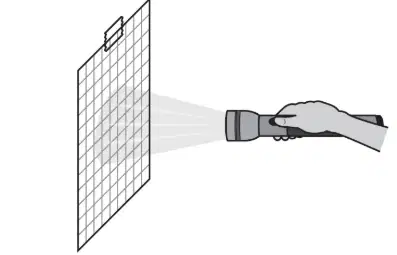
Julie and Devon are modeling how the Sun heats Earth. Julie hangs a sheet of graph paper on a wall. Devon holds a flashlight and shines it in a straight line toward the graph paper while Julie dims the lights in the classroom. The diagram shows their model of the Sun heating Earth at the equator. How can the students change their model to represent how the Sun heats Earth in places where the climate is cold all year?
a)
They can tilt the angle of the graph paper.
b)
They can use graph paper with larger squares.
c)
They can use a flashlight with a narrower beam of light.
d)
They can move the flashlight farther away from the graph paper.
3.
The direct transfer of heat from one substance to another substance that it is touching
a)
Conduction
b)
Convection
c)
Radiation
4.
The transfer of heat by the movement of a fluid such as air or water
a)
Conduction
b)
Convection
c)
Radiation
5.
Energy that is radiated or transmitted in the form of rays or waves or particles.
a)
Conduction
b)
Convection
c)
Radiation
6.
Boiling rice in water, the rice at the bottom heats and moves to the top
a)
Conduction
b)
Convection
c)
Radiation
7.
The coffee warming the cup
a)
Conduction
b)
Convection
c)
Radiation
8.
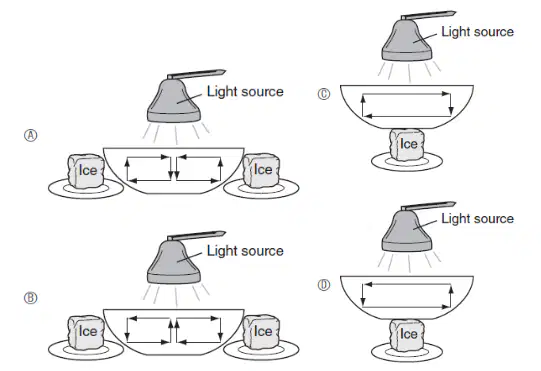
Tanisha has two different setups to model how the unequal heating of Earth results in ocean currents. Each setup has a large bowl full of water. She adds a small amount of dried leaf spice to each bowl so that any currents in the water are easily seen. Tanisha cannot decide which setup will best show how ocean currents form. The four diagrams show Tanisha’s two different setups. Which diagram accurately illustrates the flow of ocean currents between Earth’s poles and the equator?
a)
Diagram A
b)
Diagram B
c)
Diagram C
d)
Diagram D
9.
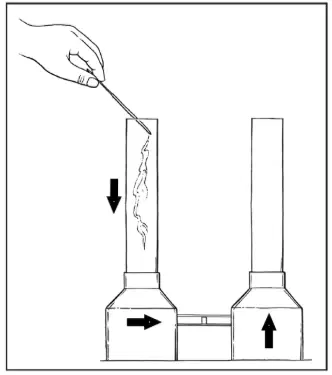
Tara connects two convection tubes. She adds smoke to one cylinder. The smoke immediately sinks to the bottom of the cylinder, moves into the second cylinder, and then rises. Arrows on the diagram below indicate the path that the smoke traveled. Which of the following statements best describes why the smoke followed this path?
a)
She connected two hot cylinders. She added smoke at the top of one hot cylinder.
b)
She connected two cold cylinders. She added smoke at the top of one cold cylinder.
c)
She connected one hot and one cold cylinder. She added smoke at the top of the hot cylinder.
d)
She connected one hot and one cold cylinder. She added smoke at the top of the cold cylinder
10.
The lamp warming the soil beaker in the lab
a)
Conduction
b)
Convection
c)
Radiation
11.
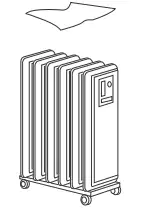
What type of heat transfer could keep the paper in the air?
a)
conduction
b)
radiation
c)
convection
d)
reflection
12.
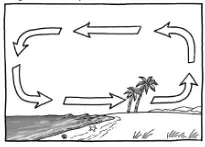
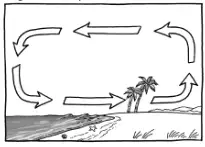
Look at the illustration, which shows air movement along a beach during the early summer. What type of wind pattern is shown in the diagram?
a)
Trade Wind
b)
Sea Breeze
c)
Land Breeze
d)
Doldrums
13.
Look at the illustration, which shows air movement along a beach during the early summer. Is it day or night? How do you know?
a)
It is day. I can tell because the air is rising above the land, and land warms quickly during the day.
b)
It is night. I can tell because the air is sinking above the water, and water loses its heat very quickly during the night.
c)
It can be either day or night, because land is always warmer than water. Air always blows from the sea to the land.
d)
I cannot tell whether it is day or night because there is not enough evidence in the illustration.
14.
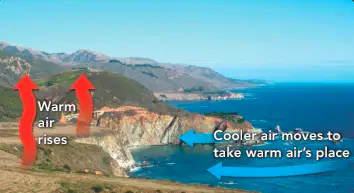
During the day the land warms faster than the water causing the warm air over the land to rise and the cool air over the water to move in its place. What type of wind is created?
a)
land breeze
b)
sea breeze
c)
trade winds
d)
easterlies
15.
Hot air balloon traveling in the air
a)
Conduction
b)
Convection
c)
Radiation
16.
Your hand burning from touching a hot stove
a)
Conduction
b)
Convection
c)
Radiation
17.
You are fishing on the beach at 2:00 PM. What would happen to the wind? You are facing the water.
a)
The wind would spiral.
b)
There would be no wind.
c)
The wind would blow at your back.
d)
The wind would blow on your face.
18.

What is the source of energy that heats our planet's atmosphere and oceans?

a)

the weather

b)

the wind

c)

the Sun

d)

the Earth's core

19.

Why does the Earth experience unequal heating?

a)

The oceans are not equally distributed around the Earth.

b)

The Earth's revolution brings it closer to the Sun at certain points during the year.

c)

The Earth's axis is tilted.

d)

The atmosphere is not equally distributed around the Earth.

20.

Ocean currents are the result of uneven heating of the water, which leads to

a)

conduction

b)

convection

c)

reflection

d)

condensation

21.

Which of the following statements is supported by the map of the ocean currents?

a)

Warm ocean currents bring cooler temperatures to the west coast of South Africa.

b)

Warm ocean currents bring warmer temperatures to the west coast of South America.

c)

Warm ocean currents bring warmer temperatures to the west coast of the United States.

d)

Cool ocean currents bring cooler temperatures to the west coast of the United States.

22.

Which of the following is true about the heating of land and water?

a)

During the day, the Sun's energy heats up the land faster, which makes the air above it warmer.

b)

During the day, the Sun's energy heats up the water faster, which makes the air above it warmer.

c)

At night, the land cools off slower, making the air above it warmer.

d)

At night, the water cools off slower, making the air above it cooler.

23.
Why is the Equator warmest?
a)
Because it is closest to the sun.
b)
Because it receives the most direct sunlight
c)
Because no clouds form here.
d)
Because it is far from the sun
24.

What causes wind?

a)

large fans

b)

uneven gravitational forces

c)

uneven levels of oxygen

d)

uneven heating of the Earth's surface

25.
What is responsible for warming the Earth’s surface and creating wind?
a)
The Moon
b)
Earth's interior (inside)
c)

Gravity

d)
The Sun
26.

Which statement correctly describes global wind patterns?

a)

Winds blow from North to South

b)

Winds blow from East to West

c)

Winds blow towards the oceans only during the summer

d)

Winds blow from the poles towards the equator near the Earth's surface

27.

The Coriolis Effect is caused by what?

a)

The wind blowing

b)

Earth's gravity pulling things down

c)

The rotation of the Earth

d)

The pull of the Moon

28.

what is the main cause of the coriolis effect?

a)

earth’s rotation

b)

trade winds

c)

the sun and ocean

d)

temperature

29.

The rotation of the Earth causes winds to bend due to the...

a)

coriolis effect

b)

doldrums

c)

trade winds

d)

westerlies

30.
In which direction do prevailing westerlies flow?
a)
from east to west
b)
from west to east
c)
from north to south
d)
from south to north
31.
Steady winds that flow from east to west between 30°N latitude and the equator and 30°S latitude and the equator.
a)
Prevailing westerlies
b)
Horse latitudes
c)
Trade winds
d)
Polar easterlies
32.
Cold winds that blow from east to west between latitude lines 60°N and the North Pole and 60°S and the South Pole.
a)
Prevailing westerlies
b)
Trade winds
c)
Horse latitudes
d)
Polar easterlies
33.
Which global winds have the greatest impact on the weather in the US?
a)
trade winds
b)
prevailing westerlies
c)
doldrums
d)
polar easterlies
34.
I am a fast-moving ribbon of AIR that moves from west to east in the Northern Hemisphere around the Earth.
a)
California Current
b)
Gulf Stream
c)
Jet Stream
d)
Atlantic Ocean
35.
What type of winds blow constantly, predictably, and over long distances?
a)
land breezes
b)
mountain breezes
c)
global winds
d)
land breezes
36.
The tropical winds running from 0 to 30 degrees latitude are called:
a)
subtropical westerlies
b)
polar westerlies
c)
trade winds
d)
polar winds
37.

Winds occur because hot air rises and cool air sinks in a process called...

a)

conduction

b)

convection

c)

radiation

d)

magnetism