
Font size
 Worksheets
First Six Weeks Review Quizizz - World History
Total questions: 74
Worksheet time: 1hrs 19mins
The Neolithic Revolution is...
When humans began migrating around the world
When humans discovered fire
When domestication of plants & animals began
Domestication is...
Breeding animals/plants for qualities you like
Migration from Africa to Asia
Cats & dogs
SOCIAL life changed in the Neolithic Revolution because...
Surplus of food led to social classes, but before everyone was the same
Food scarcity forced humans to be in small groups of hunter-gatherers
Everyone was egalitarian
POLITICAL life changed in the Neolithic Revolution because...
Kings were at the top of the Social Hierarchy afterward
Everyone remained equal
Farming made people sick and die
ECONOMIC life changed because of the Neolithic Revolution because...
women and men remained equal
People started to farm instead of hunt & gather
Women became more powerful than men
SEDENTARY life is...
settled life- as in farms & civilizations
nomadic life- as in migration from place to place
pastoral life- as in herders or cowboys
Specialization of labor is...
People have different jobs
Everyone farms so there is enough food
Migration
PASTORALISM is
Hunter-gatherers- they follow animals to hunt & gather food
Farmers- they stay in one place to harvest agriculture
Herders- they move their cattle or sheeps from place to place to graze
SURPLUS of food is...
Extra food that can be used for storage & allows large populations
Not enough food leading to starvation
Just the right amount of food for survival
Papyrus was used for _________.
keeping records
drawing pictures
making a fire
feeding the cattle
Scribes made ink out of ____________ and then mixed it with water.
colored minerals
colored plants
animal waste
animal skins
The purpose of writing on the walls in a pharaoh's temple is that __________________________________.
it helped the pharaoh get to the afterlife
it helped the pharaoh get more gold
it helped the pharaoh live longer
it helped the pharaoh gain power
The government kept records about ____________, which were written on papyrus.
taxes and grain production
birth dates
nothing important
pharaoh's only
Why did priests have to be scribes?
Needed to be able to read instructions for rituals.
Needed to be able to write down birth and death dates.
Needed to be able to impress people.
Needed to be able to communicate with the noblemen .
The _________ is the longest river in the world.
Nile
Euphrates
Tigris
Mount Everest
The Nile is located in ____________.
Africa
Antarctica
North America
South America
The natural barriers that surround the Nile are ______________.
seas, desert, and mountains
seas only
seas and desert
desert and mountains
The Nile provided many gifts to the people living nearby such as _____________.
transportation and food
food and hiking adventures
sky diving and food
transportation only
___________ grew along the Nile and were used to make papyrus.
Reeds
Wheat
Cattails
Palm Trees
Complete the phrase. The _______ of the Nile.
gift
ugliness
animals
population
King Menes is know for ____________________.
his crazy hair
uniting Upper and Lower Egypt
nothing
building the largest pyramids that ever existed in Egypt
How was the Nile river able to support life in the ancient Egyptians?
providing water
a way to irrigate
fine rich soil annually
a highway system
provide materials to make clothing
Why was Ancient Egypt a better place to live than in Mesopotamia?
better housing
more rain annually
cooler climate
predictable flooding patterns
How did the Ancient Egyptians irrigate their farms?


Shadufs and irrigation canals allowed Ancient Egyptians to:
grow more crops
change deserts into farms
build water parks
travel to the afterlife
Which of these are lapis lazuli?


The Egyptians believed that their pharaohs were living ________.
gods
mummies
statues
spirits
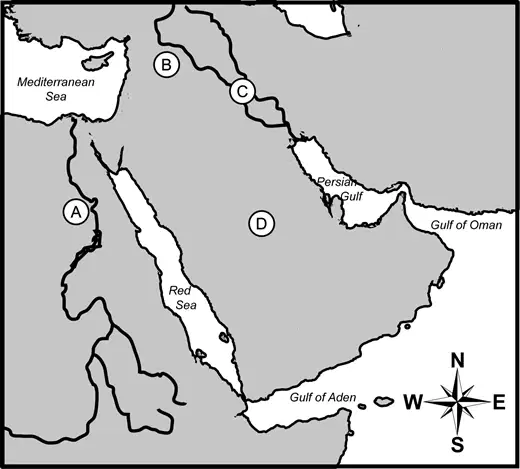
Which letter indicates the area of Mesopotamia?
A
B
C
D
Which letter indicates the area of Egypt?
A
B
C
D
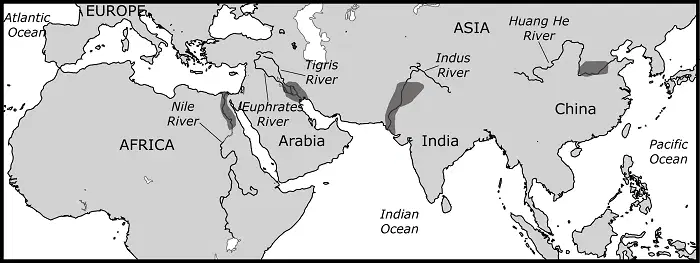
Which geographic pattern is illustrated on the map?
Early civilizations formed near fresh water sources.
Early civilizations settled close to the equator.
Early civilizations were vulnerable to invasions.
Early civilizations depended on trade with one another.


What is polytheism?
an amphibian with many legs
the worship of many gods
the worship of one god
the worship of no god/gods


People started to specialize in certain jobs and this led to the creation of __________ which were very strict/rigid.
ziggurats
social classes
religious ceremonies
kings
Egypt is surrounded by desert, what is a benefit of this?
The temperature is warm
The sand is soft
Protection
Easy to navigate
What is a NATURAL BARRIER?
A Man made wall that separates people
A wall or a door that separates you from others
a desert, mountain, or ocean that separates pieces of land
None of the above


_____ is a form of Government where the Nobles or the Nobility held the power
Bureaucracy
Democracy
Aristocracy
Polytheism
True or False: Under Hammurabi's Code, a slave would NOT be punished harshly for hurting a Noble
True
False
A complex human society with certain cultural and technological developments is a ________
Government
Aristocracy
Dictatorship
Civilization
The belief system of a civilization; one God or many Gods
Surplus Food
Cities and Infrastructure
Religion
Written Language and Learning
Creative and cultural expression such as music, dance, and painting
Trade
Arts
Written Language and Learning
Religion
Establish rules and laws to protect the people of the civilization.
Government
Trade
Infrastructure
Arts
Which characteristic describes the way a civilization gains knowledge?
Art
System of Tribute
Organized Religion
Accumulated Learning
Which characteristic describes exchanging one item for another item?
Trade
Organized Religion
System of Tribute
Government
Which characteristic describes the way a civilization makes or uses resources to gain wealth?
Economy & Job Specialization
Trade
Government
Surplus Food
Ancient civilizations had complex labor systems with each person performing a specific task or job. What is this an example of?
Writing System
Central Government
Job Specialization
Religion
Would "the society, culture and way of life of a particular area" be considered a definition of civilization.
YES
NO
The first of this characteristic was developed along rivers.
Advanced cities
Specialized workers
Advanced Technology
Record Keeping
Compex institutions

What characteristic does this image represent?
Advanced cities
Specialized workers
Advanced Technology
Record Keeping
Compex institutions
This characteristic allowed individuals to develop skills in a specific kind of work other than farming.
Advanced cities
Specialized workers
Advanced Technology
Record Keeping
Compex institutions
This characteristic allowed individuals to become artisans which are people who make goods by hand.
Advanced cities
Specialized workers
Advanced Technology
Record Keeping
Compex institutions
This characteristic includes religion and government.
Advanced cities
Specialized workers
Advanced Technology
Record Keeping
Compex institutions
This characteristic was used to document records.
Advanced cities
Specialized workers
Advanced Technology
Record Keeping
Compex institutions
This characteristic used scribes.
Advanced cities
Specialized workers
Advanced Technology
Record Keeping
Compex institutions
This characteristic marks the beginning of written history.
Advanced cities
Specialized workers
Advanced Technology
Record Keeping
Compex institutions
This characteristic was used to make individuals tasks easier.
Advanced cities
Specialized workers
Advanced Technology
Record Keeping
Compex institutions
An example of this characteristic is an ox-drawn plow.
Advanced cities
Specialized workers
Advanced Technology
Record Keeping
Compex institutions
This is the spread of cultural items such as ideas, styles, religions, technologies, and languages between individuals, whether within a single culture or from one culture to another.
Demography
Population Growth
Cultural Diffusion
Geology
People often fear what they do not understand...this can lead to labelling other cultural practices/beliefs as "weird" or "wrong."
True
False
Which cultural component is the one most cultural geographers focus on?
Religion
Sports
Language
Education
How does culture spread? (select THREE)
War
Food
Trade
Travel
Which of the following is NOT a part of culture?
History
Weather
Language
What statement is an example of cultural diffusion?
Venezuela has large reserves of oil
students in China learn Chinese in school
young people dance to American rock music in Japan
How has technology impacted cultural diffusion today?
Trading is more challenging with the different languages and cultures.
Innovations such as the airplane and engine have allowed for trade to increase.
There are not any impacts from technology.

