
 Worksheets
Spine and Thorax
Total questions: 45
Worksheet time: 23mins

Look at the picture. Which of these is the Spinalis?
A
B
C
Look at the picture. Which of these is longissimus?
A
B
C
Look at the picture. Which of these is iliocostalis?
A
B
C
Which actions are associated with the iliocostalis?
Laterally flex the vertebral column
Extend the vertebral column
Rotate the head and neck
This image shows muscles from which group?
Erector Spinae Group
Transversospinalis Group
SubOccipitals Group
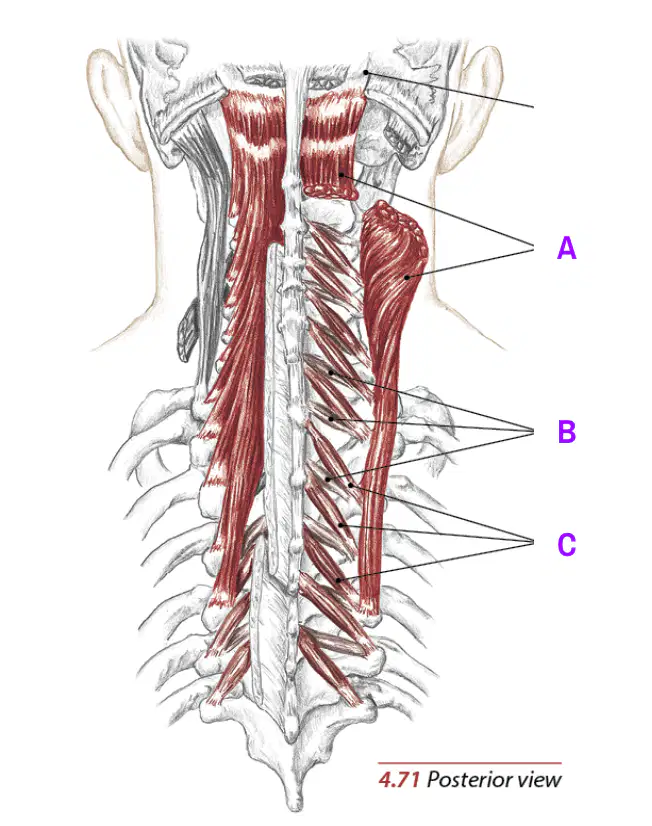
Look at the picture. Which of these is the multifidi?
A
B
C
Look at the picture. Which are rotares?
A
B
C

Which actions are associated with multifidi and rotatores?
Laterally flex the vertebral column
Extend the vertebral column
Rotate the vertebral column
Look at the picture. Which is semispinalis capitis?
A
B
C

This image shows muscles from which group?
Erector Spinae Group
Transversospinalis Group
SubOccipitals Group

Which is splenius capitis?
A
B
None of the above
Which is splenius cervicis?
A
B
None of the above

This image shows muscles from which group?
Erector Spinae Group
Transversospinalis Group
SubOccipitals Group
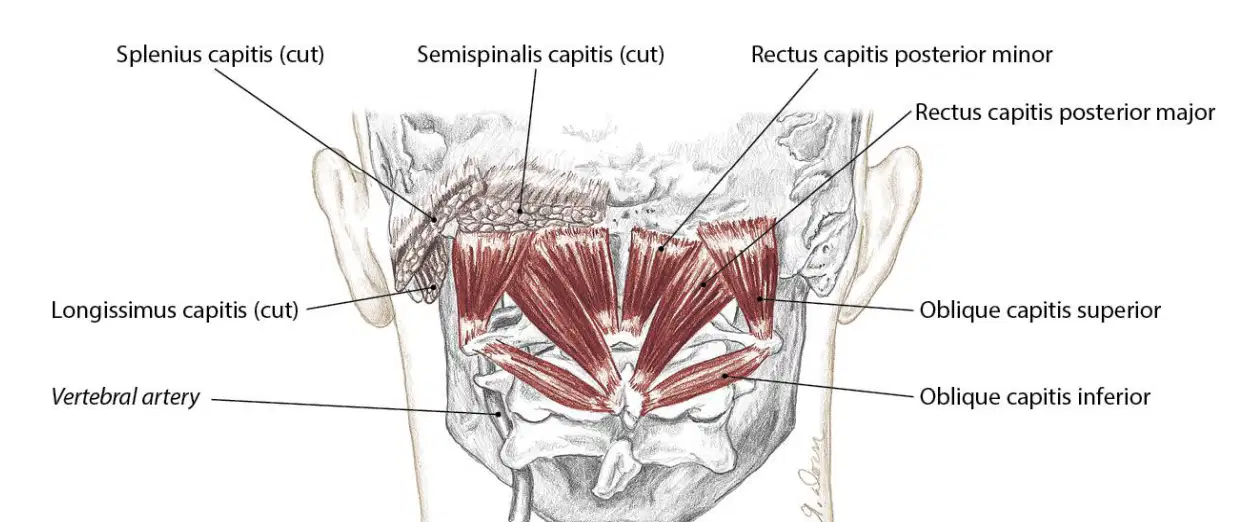
Which of the muscles of the suboccipitals group rotate the head?
Rectus capitis posterior major
Oblique capitus inferior
Oblique capitis superior

Which muscle is shown and what actions are associated with it?
Internal oblique; laterally flex, rotate, flex, compress
External oblique; laterally flex, rotate, flex, compress
Quadratus lumborum; laterally tilt, flex
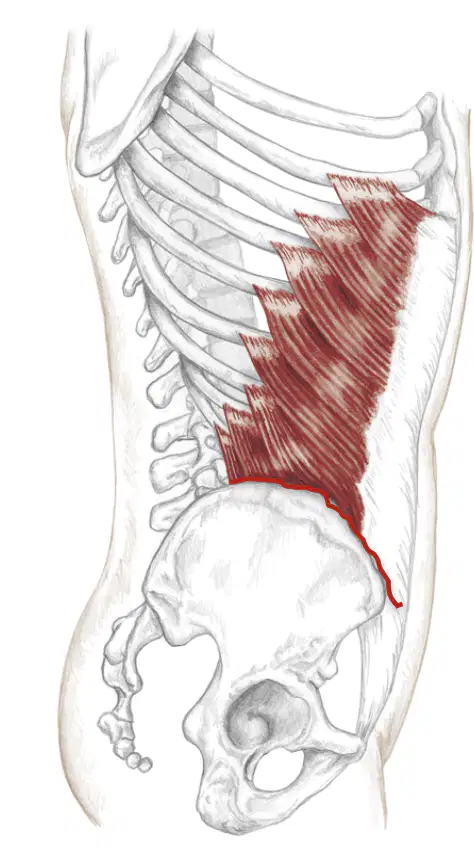
Which muscle is shown and what actions are associated with it?
Internal oblique; laterally flex, rotate, flex vertebral column, compress abdominal contents
External oblique; laterally flex, rotate, flex vertebral column, compress abdominal contents
Quadratus lumborum; laterally tilt, flex; assist to extend, fix

Which muscle is shown and what actions are associated with it?
Internal oblique; laterally flex, rotate, flex vertebral column, compress abdominal contents
External oblique; laterally flex, rotate, flex vertebral column, compress abdominal contents
Quadratus lumborum; laterally tilt, flex; assist to extend, fix

Which muscle is shown and what actions are associated with it?
Internal oblique; laterally flex, rotate, flex vertebral column, compress abdominal contents
External oblique; laterally flex, rotate, flex vertebral column, compress abdominal contents
Rectus abdominis; flex vertebral column, tilt pelvis
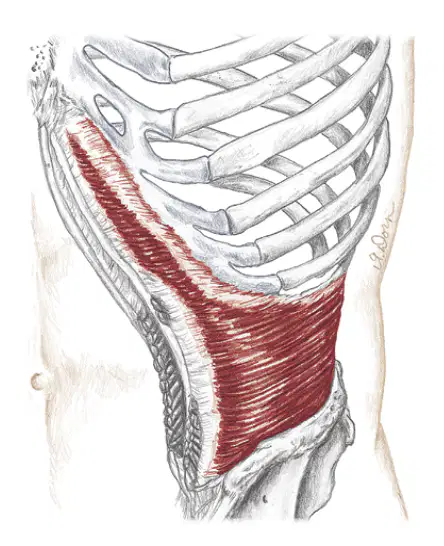
Which muscle is shown and what actions are associated with it?
Internal oblique; laterally flex, rotate, flex vertebral column, compress abdominal contents
Transverse abdominis; compress abdominal contents
Rectus abdominis; flex vertebral column, tilt pelvis
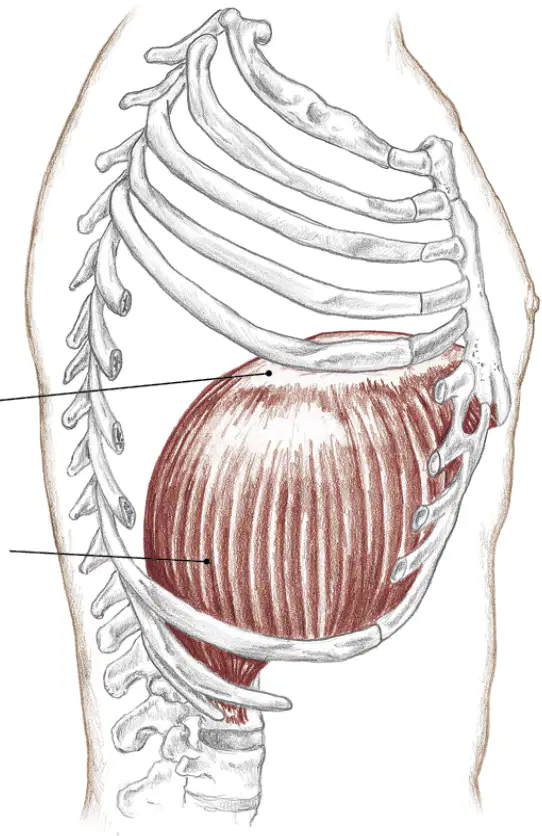
Which muscle is shown and what actions are associated with it?
Diaphragm; draw down central tendon, increase volume of thoracic cavity during inhalation
External intercostals; draw the ribs superiorly to assist with inhalation, increase space of thoracic cavity
Internal intercostals; draw the ribs inferiorly (decrease space of thoracic cav) to assist with exhalation

What is the name of muscle A in the image and what actions are associated with it?
Diaphragm; draw down central tendon, increase volume of thoracic cavity during inhalation
External intercostals; draw the ribs superiorly to assist with inhalation, increase space of thoracic cavity
Internal intercostals; draw the ribs inferiorly (decrease space of thoracic cav) to assist with exhalation
What is the name of muscle B in the image and what actions are associated with it?
Diaphragm; draw down central tendon, increase volume of thoracic cavity during inhalation
External intercostals; draw the ribs superiorly to assist with inhalation, increase space of thoracic cavity
Internal intercostals; draw the ribs inferiorly (decrease space of thoracic cav) to assist with exhalation

What is the name of muscle A in the image and what actions are associated with it?
Serratus Posterior Superior; elevate the ribs during inhalation
Serratus Posterior Inferior; depress the ribs during exhalation
Internal intercostals; draw the ribs inferiorly (decrease space of thoracic cav) to assist with exhalation
What is the name of muscle B in the image and what actions are associated with it?
Serratus Posterior Superior; elevate the ribs during inhalation
Serratus Posterior Inferior; depress the ribs during exhalation
Internal intercostals; draw the ribs inferiorly (decrease space of thoracic cav) to assist with exhalation
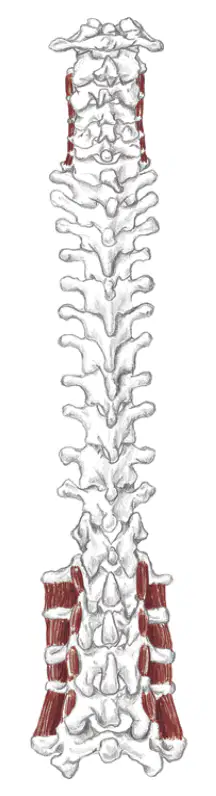
What is the name of this muscle and what actions are associated with it?
Serratus Posterior Superior; elevate the ribs during inhalation
Interspinalis; extend vertebral column
Intertransversarii; laterally flex, extend

What is the name of this muscle and what actions are associated with it?
Serratus Posterior Superior; elevate the ribs during inhalation
Interspinalis; extend vertebral column
Intertransversarii; laterally flex, extend

What's the name, actions and insertion?
Anterior scalene; laterally flex & rotate head and neck, elevate ribs during inhalation; 1st rib
Middle scalene; laterally flex & rotate head and neck, elevate ribs during inhalation; 1st rib
Posterior scalene; laterally flex & rotate head and neck, elevate ribs during inhalation; 2nd rib
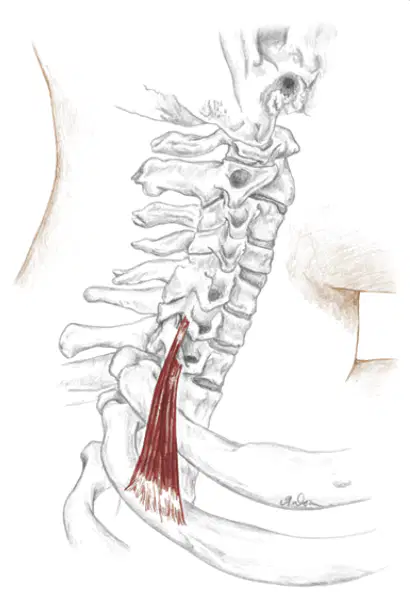
What's the name, actions and insertion?
Anterior scalene; laterally flex & rotate head and neck, elevate ribs during inhalation; 1st rib
Middle scalene; laterally flex & rotate head and neck, elevate ribs during inhalation; 1st rib
Posterior scalene; laterally flex & rotate head and neck, elevate ribs during inhalation; 2nd rib

During inhalation, the scalenes do what?
Elevate the 1st (middle, anterior) and 2nd ribs (posterior)
Depress the 1st (middle, anterior) and 2nd ribs (posterior)
Elevate the 2nd and 3rd ribs

Which ligament is the hand touching and what's true about this ligament?
Supraspinous ligament; continuation of the interspinous ligament, limiting the amount of flexion in the spine, goes all the way down
Interspinous ligament; continuation of the supraspinous ligament, limiting the amount of flexion in the spine
Ligamentum Nuchae; stabilizes the head during walking and running movements and limits the amount of flexion in the spine
Which ligament is the arrow pointing to that the hand doesn't touch?
Supraspinous ligament
Interspinous ligament
Ligamentum Nuchae
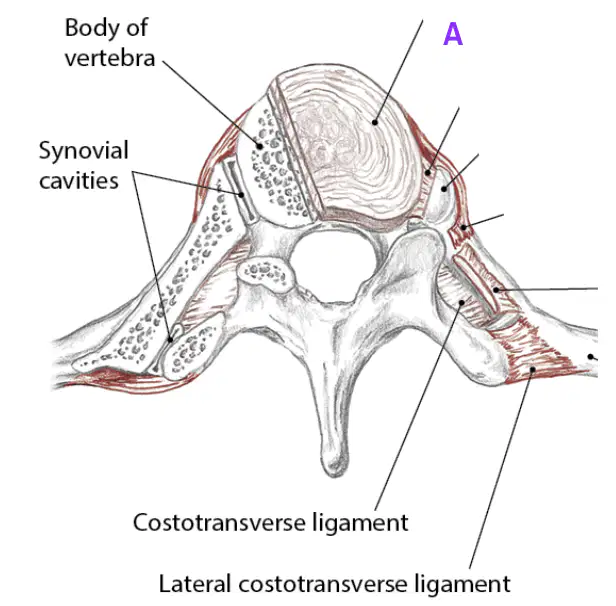
What's the name of A and what does it do?
Supraspinous ligament; continuation of the interspinous ligament, limiting the amount of flexion in the spine, goes all the way down
Intervertebral disks serve to cushion successive vertebral bodies and forms a tight fibrous joint between them. Functionally serves to resist compressive, tensile, and shear stresses.
Anterior longitudinal ligament limits the amount of extension of the spine.
Posterior longitudinal ligament limits flexion
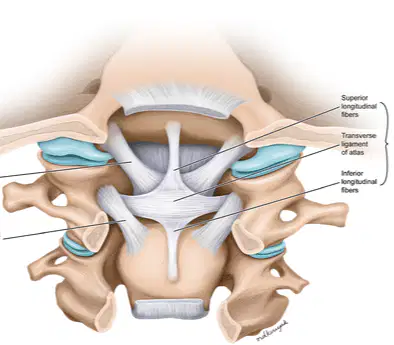
Which ligament is shown and what does it do?
Supraspinous ligament; continuation of the interspinous ligament, limiting the amount of flexion in the spine, goes all the way down
The cruciform ligament's main job is to hold the Dens (odontoid process) to the back of the C-1 vertebrae.
Anterior longitudinal ligament limits the amount of extension of the spine.
Posterior longitudinal ligament limits flexion

What is A and what does it do?
Anterior longitudinal ligament limits the amount of extension of the spine.
Ligamentum flavum, assists the vertebral column in returning to normal upright posture after flexion
Posterior longitudinal ligament limits flexion
What is D and what does it do?
Anterior longitudinal ligament limits the amount of extension of the spine.
Ligamentum flavum, assists the vertebral column in returning to normal upright posture after flexion
Posterior longitudinal ligament limits flexion
What is B?
Supraspinous ligament
Interspinous ligament
Intervertebral disk
What is C?
Supraspinous ligament
Interspinous ligament
Intervertebral disk
What is E?
Supraspinous ligament
Interspinous ligament
Intervertebral disk
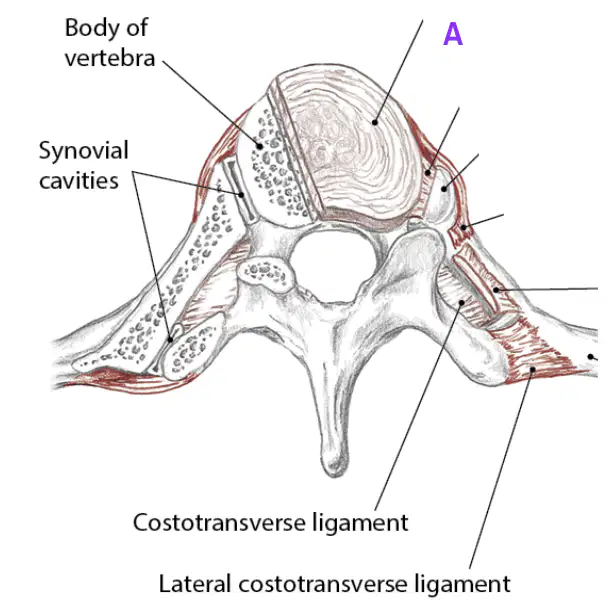
What are the actions of the intervertebral disk?
Flexion/extension, lateral flexion, rotation
Elevate, depress
Lateral flex, compress

Which group of muscles flex?
Rectus abdominis, external/internal obliques, Psoas major, illiacus
longissimus, iliocostalis, multifidi, rotatores, semispinalis capitis, spinalis, quad lumb, interspinalis, intertransversarii, lat. dor
ext/int obliques, multifidi, rotatores
Which group of muscles extend?
Rectus abdominis, external/internal obliques, Psoas major, illiacus
longissimus, iliocostalis, multifidi, rotatores, semispinalis capitis, spinalis, quad lumb, interspinalis, intertransversarii, lat. dor
ext/int obliques, multifidi, rotatores
Which group of muscles rotate?
Rectus abdominis, external/internal obliques, Psoas major, illiacus
longissimus, iliocostalis, multifidi, rotatores, semispinalis capitis, spinalis, quad lumb, interspinalis, intertransversarii, lat. dor
ext/int obliques, multifidi, rotatores

Which group of muscles laterally flex?
Rectus abdominis, external/internal obliques, Psoas major, illiacus
iliocostalis, ext/int obliques, longissimus, quad lum, psoas maj, intertransversarii, spinalis, lat dor
ext/int obliques, multifidi, rotatores

Which group of muscles elevate/expand the ribs with inhalation?
Ant./mid/post scalenes, ext intercostal, serrat post sup, serr ant, subclavius
internal intercostals, serratus posterior inferior
ext/int obliques, multifidi, rotatores
Which group of muscles depress/collapse the ribs with exhalation?
Ant./mid/post scalenes, ext intercostal, serrat post sup, serr ant, subclavius
internal intercostals, serratus posterior inferior
ext/int obliques, multifidi, rotatores

