
Font size
 Worksheets
5.03 Can you say it with symbols?
Total questions: 40
Worksheet time: 2hrs 31mins
Which reason justifies the statement below?
GH = GH
Congruence Theorem
Reflexive Property
Symmetric Property
Transitive Property

Which reason justifies the statement below?
If AB ⊥ MN, then <MNB is a right angle.
Complement Thereom
Definition of Complementary Angles
Definition of Right Anlge
Definition of Perpendicular
Which reason justifies the statement below?
BC + CD = EF and EF = GH + JK, then BC + CD = GH + JK
Segment Addition Postulate
Addition Property
Subtraction Property
Transitive Property

Find the length of the missing side. You need to use the Pythagorean Theorem to solve.
a2+b2=c2
The Pythagorean Theorem ONLY works on which triangle?
obtuse
scalene
isosceles
right


Find the length of the missing side. You need to use the Pythagorean Theorem to solve.
a2+b2=c2

Side Angle Side
(SAS)

Side Side Side
(SSS)

Angle Angle Side
(AAS)

Angle Side Angle
(ASA)

Hypotenuse Leg
(HL)
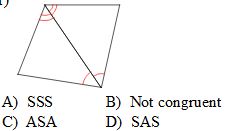
A
B
C
D
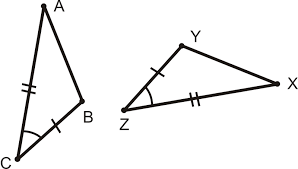


Which picture shows a reflection over y=x


A parallelogram must be a rhombus if its diagonals
are congruent
bisect each other
do not bisect its angles
are perpendicular to each other
A parallelogram is always a rectangle if
the diagonals are congruent
the diagonals bisect each other
the diagonals intersect at right angles
the opposite angles are congruent
Which of the following group of quadrilaterals have diagonals that are perpendicular to each other?
I. Parallelogram
II. Rectangle
III. Rhombus
IV. Square
All of the above
II, III and IV
II and IV, only
III and IV, only
Which of the following group of quadrilaterals have congruent diagonals?
I. Parallelogram
II. Rectangle
III. Rhombus
IV. Square
All of the above
II, III and IV
II and IV, only
III and IV, only

Which property is shown in the parallelogram that makes it a rectangle?
Diagonals are perpendicular
Adjacent sides are perpendicular
Diagonals bisect each other
Opposite angles are congruent

Which property is shown in the parallelogram that makes it a rectangle?
Diagonals are perpendicular to each other
Diagonals bisect each other
opposite sides congruent
Diagonals are congruent to each other

Which property is shown in the parallelogram that makes it a rhombus?
Opposite sides are congruent
Diagonals are perpendicular to each other
Adjacent sides are congruent
Diagonals are congruent

Which property is shown in the parallelogram that makes it a rhombus?
Diagonals are perpendicular to each other
Diagonals are congruent to each other
Diagonals are bsiect each other
Adjacent sides are perpendicular

Which property is shown in the parallelogram that makes it a rhombus?
Diagonals are perpendicular to each other
Diagonals bisect each other
Diagonals bisect their respective angles
Diagonals are congruent
The diagonals of a rectangle are
parallel
congruent
perpendicular
not congruent


In the rectangle shown, angle 1 has a measure of 35 degrees. Which statement about angles 1 and 2 is true?
They are supplementary angles.
They are complementary angles.
They are congruent angles.
They are right angles.

In parallelogram ABCD, AB≅?
BC
CD
DA
BE

A rectangle has
Opposite sides are equal
Opposite sides are parallel
Four angles that each measure 90 degrees
All four sides are equal

Which lines are parallel
AB and BC
AB and DC
AD and DC
AD and BC

Which lines are perpendicular?
AB and DC
AD and DC
BC and AD
AB and BC

State all the vertices
A, B, C and D
AE, AD, DE
A, B, C
A, E, C


Match the following triangles with their side classification.

Equilateral Triangle

Scalene Triangle

Isosceles Triangle
Match the following triangles with their angle classification.

Right Triangle

Acute Triangle

Obtuse Triangle

How would you classify this triangle by it's sides and angles?
Isosceles Acute
Scalene Right
Scalene Obtuse
Isosceles Obtuse
Isosceles Right

What is the best classification for this triangle?
Isosceles Acute
Scalene Acute
Isosceles Obtuse
Equilateral
Scalene Obtuse

Side Classification: (a)
Angle Classification: (b)

