
Font size
 Worksheets
Earthquake and Volcano Test Review
Total questions: 34
Worksheet time: 43mins
The point below the surface where rock begins to break and the first motion occurs
The seismic station closest to the earthquake
The place where the greatest damage occurs
The point on the surface directly above the focus


Many earthquakes happen along the borders of...
Countries
Tectonic Plates
Climate Zones
None of the above.

What type of boundary is shown in the diagram?
Divergent
Convergent
Transform
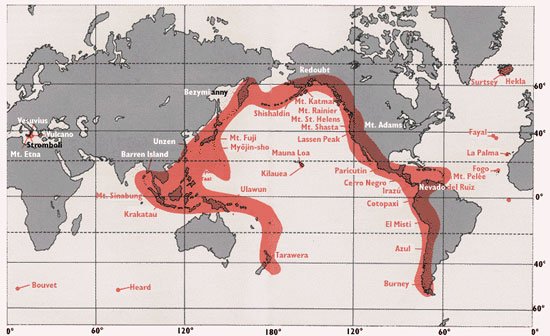
This is the name for the chain of volcanos around the edge of the Pacific Plate.
March Maddness
Earthquake Alley
Ring of Fire
Circle of Death
Smaller Vibrations that come after the initial earthquake is called
Primary wave
Secondary Wave
Surface Wave
Aftershock
A movement or trembling of the ground that is caused by a sudden release of energy
Hot spots
Plate boundary
Volcano
Earthquake

What kind of volcano is this?
Shield
Composite
Cinder Cone
Hone Comb

What kind of volcano is this?
Shield
Cinder Cone
Ice Cream cone
Composite
two types of magma are
Hot and Cold
Iron and Lithium
Mafic and Felsic
Basalt and Granite
Pyroclastic material is
fragments of rock that vaporize during a volcanic eruption
fiery rocks that come from earthquakes
vibrations from major zones
fragments of rock that form during a volcanic eruption
Low viscosity in magma will result in a _____ eruption
Quiet
violent
it makes no difference
A sign a volcano is about to erupt is
The ground swells
an increase in earthquake activity
Local temperatures rise
tornadoes are more frequent

What kind of eruptions do stratovolcanoes have?
Explosive eruptions.
effusive eruptions.
What kind of eruptions do shield volcanoes have?
Explosive eruptions.
Effusive eruptions.
Identify the magmas from High viscosity to low
Felsic, intermediate, mafic, ultramafic
ultramafic, mafic, intermediate, felsic
Mafic, intermediate, felsic, ultramafic
Intermediate, felsic, ultramafic, mafic

The place where an earthquake originates inside the Earth's surface is called...
Epicenter
Focus
Underground
Crust

The place on the Earth where the rock has broken
Epicenter
Focus
Surface
fault
Which of the following are surface waves?
P waves and S waves
P waves and Richter waves
Richter waves and S waves
love waves and rayleigh waves
If a tsunami is head to your area which of the following should you do?
Run towards it
Run towards land
Just stay and don't move from your area
Effusive volcanos generally have
thick slow lava flows
giant pyroclastic explosions
runny lava flows

Who is this?
Mulan
Moana
Elsa
Anna
What type of volcano is Eyjafjallajokull?
Stratovolcano
Shield
cone
supervolcano
What type of volcano is yellowstone?
Stratovolcano
Shield
cone
supervolcano
What type of eruption occurs at kilauea?
Effusive
Explosive
What type of eruption occurs at Krakatoa?
Effusive
Explosive
If the magma type is basaltic (ultramafic/mafic), the volcano will have a _____________ eruption.
Explosive
Effusive
If the magma type is rhyolitic (intermediate/felsic), the volcano will have a _____________ eruption.
Explosive
Effusive

