wayground logo

Free Printable Worksheets

NEW

Font size

S
M
L
XL
Worksheets

Unit 1 Quiz Practice

Total questions: 29

Worksheet time: 20mins

Name
Class
Date
1.

Not living, or produced by nonliving things

a)

Abiotic

b)

Biotic

2.

Living, or produced by living things

a)

Abiotic

b)

Biotic

3.

The maximum number of organisms an ecosystem can hold

a)

limiting factor

b)

carrying capacity

c)

biodiversity

d)

limit

4.

Biotic or Abiotic factor that restricts the growth of the population

a)

carrying capacity

b)

limiting factor

c)

abiotic factor

d)

biotic factor

5.

All the organisms of one species within a particular ecosystem.

a)

Community

b)

Biome

c)

Population

d)

Organism

6.

What type of growth is this graph representing

a)

Logistical Growth

b)

Exponential Growth

7.

What type of growth is this graph representing?

a)

Logistical Growth

b)

Exponential Growth

8.

Biotic or Abiotic factor that restricts the growth of the population

a)

carrying capacity

b)

limiting factor

c)

abiotic factor

d)

biotic factor

9.

In the graph to the right, what is the population of deer at the carrying capacity of the environment?

a)

3

b)

7

c)

70

d)

40

10.
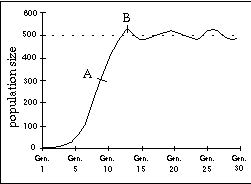
What is the carrying capacity of the graph?
a)
around 500
b)
more than 500
c)
less than 500
d)
around 600
11.
What is the carrying capacity of the following graph?
a)
1000
b)
8000
c)
800
d)
600
12.

What will happen if all of the frogs in a population die?

a)

The frogs' predators will decrease and the frogs' prey will increase

b)

The frogs' predators will increase and the frogs' prey will decrease

c)

We better all pray because there isn't anymore frogs.
13.
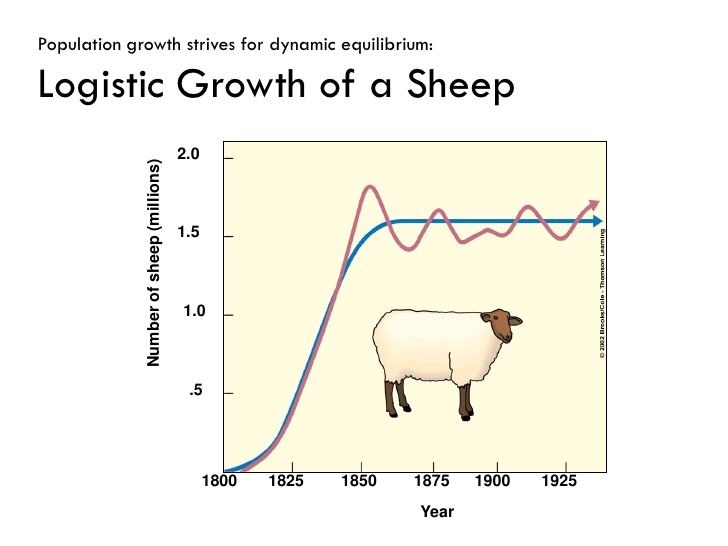
What is the carrying capacity for this sheep population?
a)
1.8 million
b)
1.25 million
c)
1.6 million
d)
1.o million
14.
What point on the graph represents the carrying capacity?
a)
A
b)
B
c)
C
d)
D
15.
Food, water, sunlight, shelter, and space are resources that are  __________.
a)
limiting factors
b)
wet
c)
messy
d)
found in rocks
16.

When resources are not available a population will _____________ in size.

a)

Increase

b)

Decrease

c)

Stay the same

17.

What happens if a population grows past its carrying capacity?

a)

The population keeps growing

b)

The population starts to die off

c)

The entire species will go extinct

d)

The carrying capacity just increases

18.

A community of organisms and their abiotic environment.

a)

Environment

b)

Biosphere

c)

Ecosystem

d)

Community

19.

An ecosystem comprising the ENTIRE EARTH and the organisms that inhabit it.

a)

Biosphere

b)

Biome

c)

Abiotic

d)

Ecoregion

20.

A living thing (one thing) that carry out life processes independently.

a)

organism

b)

abiotic

c)

community

d)

biosphere

21.
Emily correctly predicted that Dublin is located in the Northern hemisphere. How could she have done this with only a climate graph?
a)
The graph shows consistent precipitation all year. That only happens in the northern hemisphere. 
b)
The line graph shows the highest average temperatures June-September. 
c)
The line graph shows the lowest temperatures in December-February.
22.
What is the average amount of precipitation in the month of June?
a)
less than 50 mm
b)
about 125 mm
c)
about 100 mm
d)
about 200 mm 
23.
What is the average precipitation in January on the climate graph?
a)
approximately 100 mm
b)
approximately 10
c)
approximately 80
d)
approximately 40
24.
If the number of births in a population is the same as the number of deaths in a population, what will happen to the growth of the population?
a)
It will increase.
b)
It will decrease.
c)
It will stay the same.
d)
It will fluctuate.
25.
What growth pattern describes a population whose growth rate slows or stops following a period of exponential growth?
a)
logistic growth
b)
population growth
c)
exponential growth
d)
predator-prey cycle
26.
What do you call a period of rapid growth?
a)
exponential growth
b)
logistic growth
c)
emigration
d)
predator-prey cycle
27.
Which type of growth is best illustrated by this rabbit population?
a)
exponential
b)
logistic
c)
S-shaped
d)
predator-prey
28.
If the number of births in a population is the same as the number of deaths in a population, what will happen to the growth of the population?
a)
It will increase.
b)
It will decrease.
c)
It will stay the same.
d)
It will fluctuate.
29.
If the number of births is greater than the number of deaths in a population, what will happen to the growth of the population?
a)
It will increase.
b)
It will decrease.
c)
It will stay the same.
d)
It will fluctuate.