
 Worksheets
unit 2 biology study guide
Total questions: 24
Worksheet time: 16mins
Organelles in prokaryotic cells include the
a. Mitochondria
b. Endoplasmic reticulum
c. Golgi apparatus
d. None of the above
All cells have the following:
a. Cell membrane; cytoplasm; and ribosomes
b. Cell membrane; nucleus; and DNA
c. DNA; ribosomes; and cell wall
d. Cell membrane; cytoplasm; and nucleus
Which of the following best describes how the model below explains cell (plasma) membranes are
selectively permeable?
a. All molecules move through the plasma membrane.
b. Only lipid soluble molecules move through the plasma membrane.
c. Only specific non-lipid soluble molecules or ions move through the cellular membrane.
d. Specific molecules will pass through the plasma membrane, while other molecules cannot pass
through.
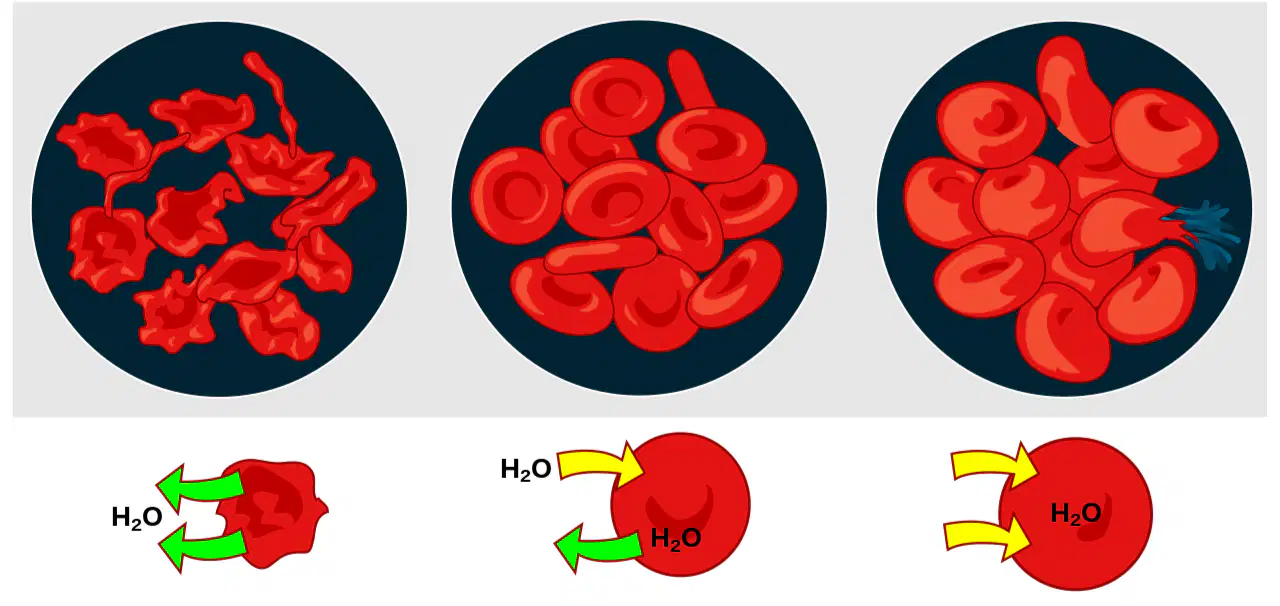
Red blood cells were placed in three types of solutions. Which of the cells were placed in an isotonic solution?
Cell B since water is moving out of the cell at a faster rate.
Cell B since water is moving in and out of the cell at the same rate.
Cell B since water is moving out of the cell at a faster rate.
Cell C since water is moving out of the cell at a faster rate
n an investigation on tonicity, a group of students drop salt water on this cell below. What will the students most likely observe?
The plant will [shrink/swell/stay the same]. This is because the salt water is a [hypotonic/hypertonic/isotonic] solution which causes the water to [enter/exit/stay in] the plant cell.
shrink
hypertonic
exit
swell
hypotonic
enter
stay the same
istonic
stay in
shrink
hypotonic
enter
Select all that apply: Why might a cell use endocytosis or exocytosis to transport molecules across the cell membrane?
Molecules are too small to be transported by passive transport at one time.
Molecules are too large to be transported by passive transport at one time.
There are too many molecules to be transported by passive transport at one time.
There are too few molecules to be transported by passive transport at one time.
When the concentration of molecules on both sides of a selectively permeable membrane is the same
this is called equilibrium. At equilibrium, __.
a. More Molecules move across the membrane to the outside of the cell.
b. Molecules stop moving across the membrane.
c. Molecules move across the membrane at the same rate in both directions.
d. More Molecules move across the membrane to the inside of the cell.
Which type of cellular transport would be most affected by damage to mitochondria?
Active transport
Osmosis
Diffusion
Facilitated diffusion
There are two types of cellular transport. In active transport, the molecules are moving [with/against] the concentration gradient and this movement [does/does not] require ATP energy. This is because the molecules are moving from an area of [low/high] concentration to an area of [low/high] concentration of molecules.
against
does
low
high
with
does not
high
low
against
does not
high
low
with
does
low
high
Why is an animal cell that is surrounded by fresh water likely to burst (lyse)?
Water moves into the cell via osmosis.
Water moves out of the cell via osmosis.
Solutes move into the cell via osmosis.
Solutes move out of the cell via osmosis.
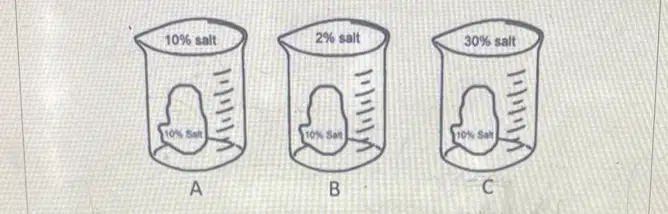
A solution concentration is the concentration of the solute and the concentration of the solvent. Each beaker contains a cell with 10% salt concentration. The concentration of the salt in each beaker is shown at the top of each beaker. Which beaker contains a hypotonic solution?
Beaker # 1
Beaker # 2
Beakers # 1 and # 2
Beaker # 3
Students are carrying out an osmosis experiment in Biology lab. They placed pieces of celery into two different solutions and let them sit for 2 days. Solution 1 is salt water. Solution 2 is pure water. After 2 days, the celery in Solution 1 shriveled, while the celery in Solution 2 looked the same.
What question are the students investigating in this experiment?
How much salt will the celery absorb from the solution?
How will the tonicity of a cell’s external environment affect the size of the celery cell?
How will salt move from the external environment into the celery cell?
How will salt move from the inside of the celery cell to the external environment?
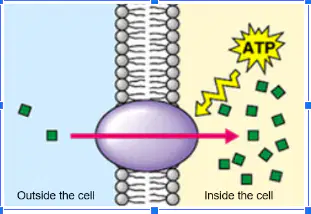
Use the diagram below to answer the question. Which of the following explanations describes what type of transport would move the green square molecule from the outside of the cell to the inside the cell?
Passive transport because molecules are moving against a concentration gradient.
Active transport because molecules are moving against a concentration gradient.
Passive transport because molecules are moving with a concentration gradient.
Active transport because molecules are moving with a concentration gradient.
Movement of molecules across the cell membrane with the help of a protein
Osmosis
Endocytosis
Exocytosis
Facilitated diffusion
B. Movement of water molecules across the cell membrane
Osmosis
Endocytosis
Exocytosis
Facilitated diffusion
C. Movement of large (or many) molecules out of the cell at the same time
Osmosis
Endocytosis
Exocytosis
Facilitated diffusion
Diffusion
E. Movement of small molecules directly across the cell membrane
Osmosis
Endocytosis
Exocytosis
Facilitated diffusion
Diffusion
true or false The water-hating hydrophobic tails of the phospholipid bilayer face the outside of the cell membrane.
(a)
true or false Ribosomes can be found attached to the endoplasmic reticulum.
(a)
true or false ATP (cell energy) is made in the mitochondria in a process called cellular respiration.
(a)
true or false Animal cells have chloroplasts, organelles that capture light energy from the sun and use it to make glucose.
(a)
true or false The smooth ER makes ribosomes and the nucleolus makes lipids.
(a)
true or falseThe cell is always trying to maintain a stable internal environment which is called homeostasis.
(a)
true or false The cell membrane contains the following macromolecules: proteins, lipids, and nucleic acids.
(a)

