
 Worksheets
bang marjo basic waves
Total questions: 100
Worksheet time: 3hrs 2mins

What is frequency measured in?
Milliseconds
Miles
Hertz
Kilograms

What is the number of complete waves passing a fixed point in a given amount of time?
Amplitude
Intensity
Wavelength
Frequency

What kind of wave is pictured below?
compressional wave
transverse wave
sound wave
mechanical wave

Electromagnetic waves include the following except
radio waves
X-rays
ocean waves
microwaves

Which type of wave moves parallel to the direction of the wave?
transverse
longitudinal
surface
electromagnetic

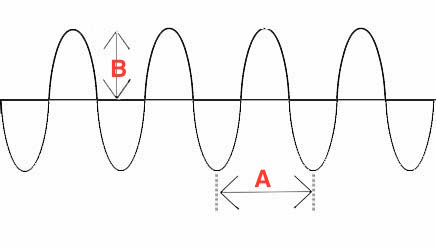
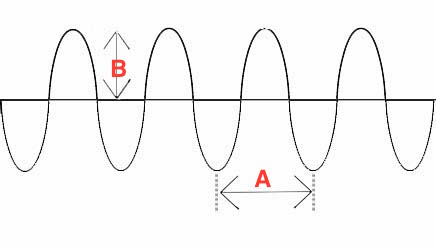
It is the high pressure part of the wave where the particles are close together. It is part A on this picture.
Compression
Amplituide
Rarefaction
Wavelength

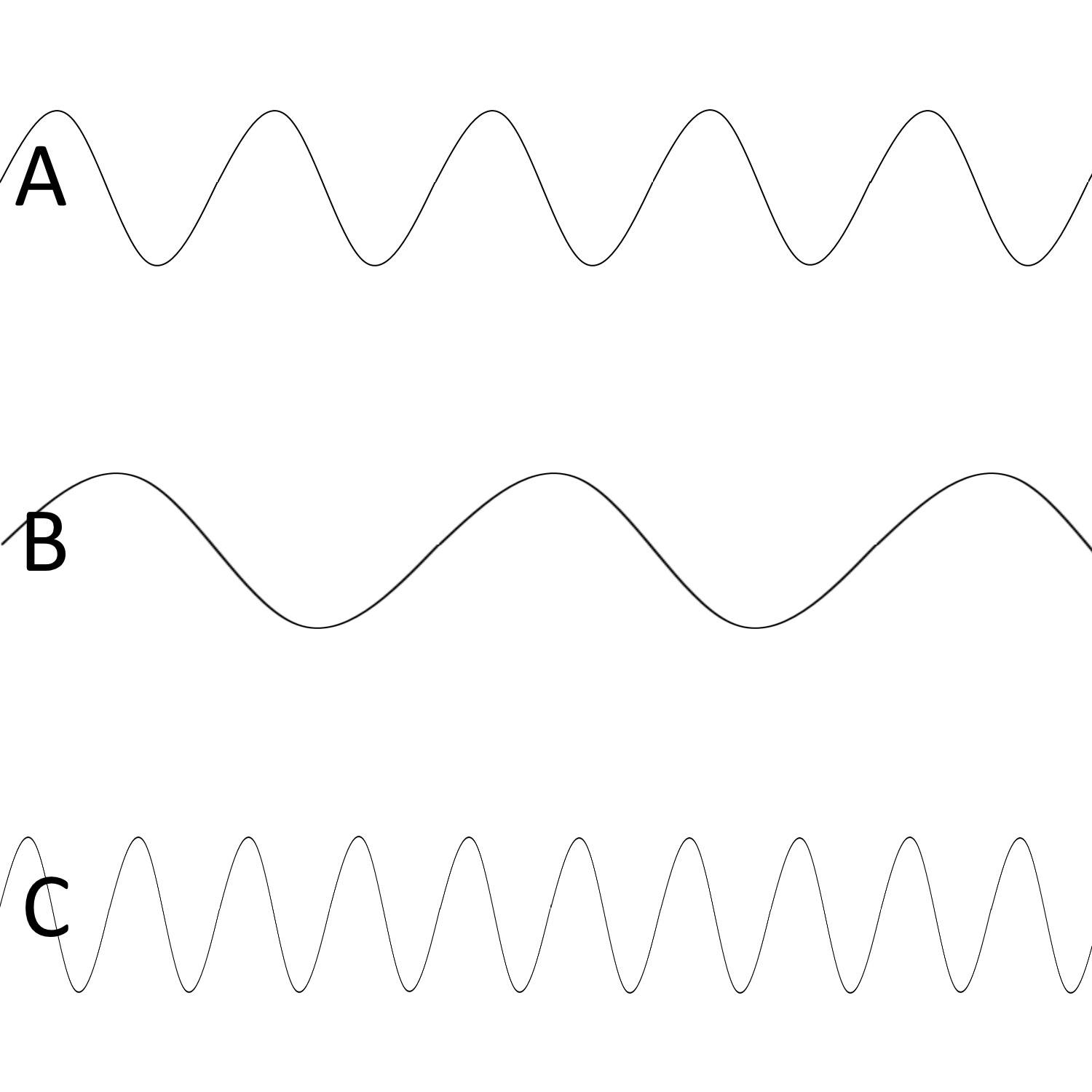

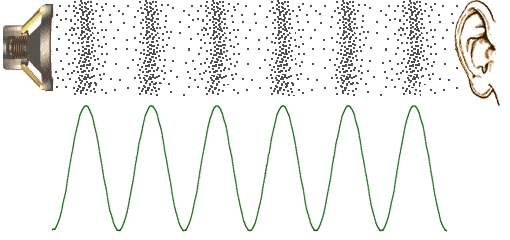
surface wave
transverse wave
electromagnetic wave
longitudinal wave


What is the phase difference between the two waves in the picture?
π rad
0 rad
2π rad
4π rad
The frequency of a certain wave is 500 Hz and its speed is 340 ms–1.What is the phase difference between the motions of two points on the wave 0.17 m apart?
π rad
π/4 rad
π/2 rad
3π/4 rad
What is the phase difference between two points 30cm apart if the wavelength is 1.5m?
1.26 rad
126 rad
1.25663 rad
31 rad

What is the phase difference between points O and D?
π/4 rad
2π rad
π rad
π/2 rad

choose correct statement related to the picture
Direction of vibration of particles is parallel to the direction of propagation of waves
Direction of vibration of particles is perpendicular to the direction of propagation of waves
The picture shown transverse wave

The phase difference for the two waves shown in the figure is
2π
π
2π/3
π/2
It is not possible to answer this question without additional information
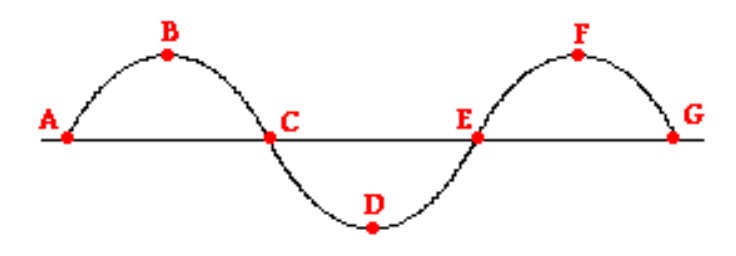
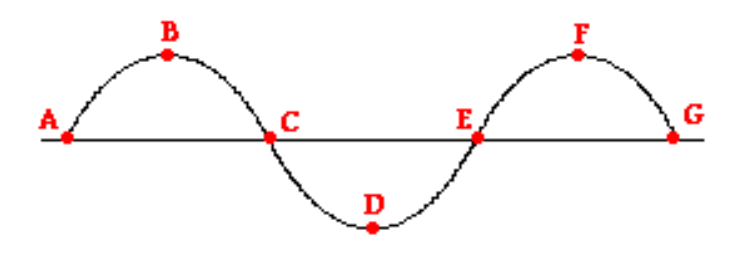

The speed of sound in air is 340 m/s. The frequency of the sound waves generated by my voice is 720 Hz. Calculate the wavelength of sound of my voice.
380 m
0.472 m
2.11 m
244,800
none of these are correct


1. Requires a medium to travel through
2. Cannot travel through a vacuum
3. Oscillating material does not move far from its original position
What can the student conclude about the wave from this information?
The frequency of a certain wave is 500 Hz and its speed is 340 ms–1.What is the phase difference between the motions of two points on the wave 0.17 m apart?
π rad
π/4 rad
π/2 rad
3π/4 rad

The diagram shows two sinusoidal waveforms.
At time t = 0 the waves are in phase. At the dotted line, t = 18 s.
At which time is the phase difference between the two oscillations ⅛ of a cycle?
8.0s
4.5s
4.0s
9.0s
What is the phase difference between two points 30cm apart if the wavelength is 1.5m?
1.26 rad
126 rad
12.6 rad
31 rad
2 points on a progressive wave are 1/3 of a wavelength apart. The distance between the two points is 2cm. If the speed of the wave is 10 ms-1 what is the frequency of the wave?
5Hz
20Hz
167Hz
1500Hz

What is the approximate phase difference between the waves shown?
2π
3 π/2
π
π/2

Six wavefronts are shown in the diagram. What is the wavelength of the wave?
5 cm
6 cm
7.5 cm
30 cm

From this picture determine the Periode and the Amplitude of the wave
A=2 cm ; T = 6 s
A=-2 cm ; T = 6 s
A=6 cm ; T = 36 s
A=2 cm ; T = 36 s

From these graphs, determine the speed of the wave
3 cm/s
3 m/s
6 m/s
-2 cm/s

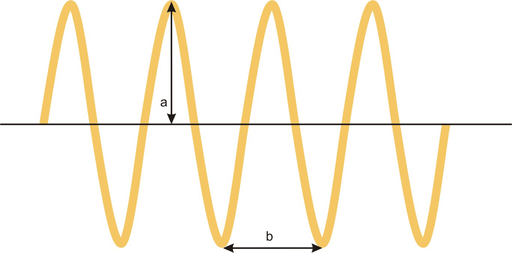
Choose the correct label (you can choose only one).
a= wavelength
b=trough and c=crest
d=amplitude
all of the choices given
Which of the following is a CORRECT statement?
Sound can travel through the vacuum of space
Sound can't travel through the vacuum of space
Sound is produced in the vacuum of space
Sound can travel between planets

the diagram below is a graph showing how the height of water at a point in marina varies with time t as the waves pass the point. what is the correct label for W and X?
W = amplitude
X = period
W = displacement
X = wavelength
W = amplitude
X = wavelength
W = displacement
X = period

The graph shows the variation of a quantity P with a quantity Q for a sound wave travelling in air. what is P and Q be?
P = amplitude
Q = intensity
P = frequency
Q = wavelength
P = speed
Q = frequency
P = wavelength
Q = period
A wave has period T, wavelength λ and amplitude A. The wave is shown on a graph of displacement x against distance d. Which graph is correctly labelled?


The four graphs represent a progressive wave on a stretched string. Graphs A and B show how the displacement d varies with distance x along the string at one instant. Graphs C and D show how the displacement d varies with time t at a particular value of x.
The labels on the graphs are intended to show the wavelength λ, the period T and the amplitude a of the wave, but only one graph is correctly labelled. Which graph is correctly labelled?


The graph shows the variation of displacement y with distance x along a progressive wave at one instant in time. What is the phase difference between points P and Q on the wave?
2πrad
23πrad
3π rad
27πrad

A sound wave passes through air.
The diagram shows the positions of the molecules of the air at one instant.
Which distance is equal to the wavelength of the wave?
PQ
PS
QR
QS
A sound has an intensity of 1.0 x 10⁻⁴ W/m2 at a distance of 2.0 m from the sound source. What is the intensity at a distance of 4.0 m from the sound source? (Take π = 3)
1.0 x 10⁻⁴ W/m2
1.5 x 10⁻⁴ W/m2
2.5 x 10⁻⁴ W/m2
1.5 x 10⁻⁵ W/m2
2.5 x 10⁻⁵ W/m2
At a distance of 3 m, the intensity of a sound will be .... the intensity it was at a distance of 1 m.
one-ninth
one-third
the same
3 times
9 times
Calculate the intensity of the sound waves from a car stereo at a distance of 50 cm when the sound has power output of 12 W! (Take π = 3)
0.0004 W/m2
0.02 W/m2
45 W/m2
2 W/m2
4 W/m2
Ocean waves crash on the beach at a velocity of 3.5 m/s. If the distance between the crests of each wave is 4 m, find the frequency of the waves.
0.88 Hz
1.14 Hz
0.0088 Hz
14.0 Hz
What is the velocity of a wave having a frequency of 25 Hz and a wavelength of 10 m?
250 m/s
2.5 m/s
35 m/s
0.4 m/s
Calculate the intensity of the sound waves from an electric guitar’s amplifier at a
distance of 5.0 m when its power output is equal to each of the following values:
a. 0.25 W
intensity=4πr2p
7.0 x 10⁻⁴ W/m2
8.0 x 10⁻⁴ W/m2
9.0 x 10⁻⁴ W/m2
8.8 x 10⁻⁴ W/m2
How much power is radiated as sound from a band whose intensity is
1.6 × 10⁻³ W/m2 at a distance of 15 m?
intensity=4πr2p
4.5 W
4.0 W
5.0 W
4.3 W
How can wavelength be measured?
Crest to crest
Trough to trough
Wavelength to wavelength
All of the above
A progressive radio wave in a vacuum has a frequency of 75 MHz. What is the phase difference between two points on the wave that are 50 cm apart from each
other?
23 degrees
45 degrees
90 degrees
180 degrees

A displacement-time graph for a transverse wave is shown in the diagram.
The phase difference between X and Y can be expressed as nπ.
What is the value of n?
3.0
1.5
2.5
6.0
teo sound waves have frequencies of 250 Hz and 300 Hz. The speed of sound is 340 m/s, What is the difference between the wavelenghts of the two waves?
0.23 m
1.1 m
1.4 m
6.8 m

The two waves shown come from a source where they were initially coherent. The path difference could be
⅓ λ
½ λ
¼ λ
λ
It is not possible to answer this question without additional information

The diagram shows a displacement-time graph for a progressive wave.
Amplitude: 5 mm; Frequency: 40 Hz
Amplitude: 5 mm; Frequency: 50 Hz
Amplitude: 10 mm; Frequency: 40 Hz
Amplitude: 10 mm; Frequency: 50 Hz

Two waves E and G are shown. The waves have the same speed.
Which statement is correct?
Wave E has a greater amplitude than wave G.
Wave E has a greater intensity than wave G.
Wave E has a smaller frequency than wave G.
Wave E has a smaller wavelength than wave G.

What is the amplitude of this wave?
3cm
-3cm
6cm
4cm

What is the wavelength of this wave?
3cm
10cm
4cm
8cm

The graph shows the variation with time of the displacement of two separate waves X and Y.
Wave X has frequency f and amplitude A. What is the frequency and what is the amplitude of wave Y?
frequency 1/2 f and amplitude 1/2 A
frequency 1/2 f and amplitude 2A
frequency 2f and amplitude 1/2 A
frequency 2f and amplitude 2A
A wave of frequency 15 Hz travels at 24 m/s through a medium. What is the phase difference between two points 2.0 m apart?
There is no phase difference.
They are out of phase by a quarter of a cycle.
They are out of phase by half a cycle.
They are out of phase by 0.80 of a cycle.

How could you make this wave louder?
keep the amplitude to 4 cm
decrease the amplitude to 3 cm
increase the frequency of this wave
increase the amplitude to 5 cm

Which wave has the greatest amplitude?
C
D
E
The speed of sound in steel is 6000ms–1. The wavelength of an ultrasound wave of frequency 50 kHz travelling through a steel girder is...
0.0083 m
0.12 m
8.3 m
120 m

A cathode ray oscilloscope can be used to show how the displacement of a wave varies with time. Each square in the horizontal direction represents 5.00 ms.
The frequency of the wave is...
25 Hz
50 Hz
250 Hz
500 Hz

Which of the points A to D, marked on the graph, has a phase difference of 270° with point X?
A
B
C
D

Consider a sinusoidal wave travelling in the positive x direction. What is the phase difference between the two points shown in the diagram below?
a) 0
b) π
c) π/2
d) 2π
The amplitude of a wave was tripled, how many times did the energy transferred increase?
2 times
4 times
9 times
16 times

What is the amplitude of the wave in the diagram below?
0.030 m
0.040 m
0.050 m
0.060 m

What are the amplitude and frequency of the wave?
amplitude = 5mm; frequency = 40 Hz
amplitude = 5mm; frequency = 50 Hz
amplitude = 10mm; frequency = 40 Hz
amplitude = 10mm; frequency = 50 Hz

150o
220o
260o
330o

What is the phase difference between X and Y?
45o
135o
180o
270o
High-frequency sound waves with frequency 2.0 MHz travel with a speed of 2.0 kms-1 through a liquid.
What is the shortest distance between a compression and a rarefaction (expansion) in the liquid?
0.5mm
1.0mm
5.0mm
10.0mm

