
 Worksheets
PHYSICS-M3 SMEP FINAL EXAM
Total questions: 31
Worksheet time: 47mins
Which of the following statements are true about potential energy?
Both gravitational and elastic potential energy are dependent upon the speed of an object.
Moving objects cannot have potential energy.
None of these
Potential energy is the energy stored in an object due to its position.
What are the units for Work?
Newtons
Kilograms
Joules
Moles
The energy of motion is...?
Mechanical
Potential
Kinetic
Infinite
A force exerted over a distance to move an object is the definition of _________.
power
work
momentum
Watt
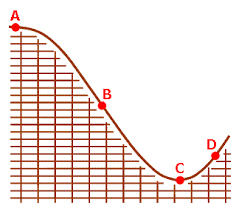
At which point on the roller coaster is the kinetic energy at its maximum?
A
B
C
D
A person is pushing a 10 kg shopping cart at a velocity of 5 m/s. They increase their speed to 7 m/s to get around someone and then keep going that velocity. Overall, was work done on the shopping cart?
Yes
No
A simple machine is (a)
Which is not a type of simple machine?
spring
screw
pulley
wedge
How does a driver use a steering wheel as a simply machine?
The driver is using a wheel and axle to reduce the amount of force.
The driver is using a lever to steer the vehicle.
The driver is using a pulley and lever to steer the vehicle.
The driver is using a wheel and axle to reduce the amount of work needed to steer the vehicle.
How does a movable pulley make lifting objects easier?
The amount of force needed is doubled.
the amount of force needed is increased.
the amount of force needed is reduced.
the amount of force needed stays the same.


An example of a lever is a ________.
car wheels
drill
staircase
hammer

A simple machine that splits an object apart is a _______.
inclined plane
fulcrum
wedge
lever
If you push a cart with a force of 60 N for 2 m, how much work have you done?
120 J
30 J
120 N
30 N
What is the formula needed to solve for work?
w = f/d
w = f*d
w = f+d
In a wheel and axle, the wheel travels a longer ________ but takes ____ force
Force, work
Distance, more
Energy, less
Distance, less
When you eat fruits and vegetables, chemical bonds are releasing stored energy, this is...
a. thermal energy
b. sound energy
c. electrical energy
d. chemical energy
The ability to do work
A. chemical energy
B. Friction
C. electrical energy
D. Energy
A student is holding the end of a pendulum. The student releases the pendulum. What energy transfers are taking place?
potential energy is transferred to kinetic energy
chemical energy to thermal energy
mechanical energy to chemical energy
kinetic energy is tranferred to potential energy


What energy transformation occurs in the chameleon as it quickly launches its tongue to catch an insect?
Radiant --> Chemical
Thermal --> Chemical
Chemical --> Mechanical
Mechanical --> Chemical
What energy transformation occurs in the chameleon as it quickly launches its tongue to catch an insect?
Radiant --> Chemical
Thermal --> Chemical
Chemical --> Mechanical
Mechanical --> Chemical

