
 Worksheets
Living Environment Unit 1- Scientific Inquiry/ Graphing/ Safety
Total questions: 41
Worksheet time: 33mins

What variable in an experiment is measured? - it is also called the responding variable.
For example: measuring the amount of mold on bread
Dependent variable
Operational Definition
Independent Variable
Control Variable

If plants are exposed to sunlight, then they will grow taller.
What part of the scientific method is this an example of?
Procedure
Hypothesis
Question
Results

What variable in an experiment is measured? - it is also called the responding variable.
For example: measuring the amount of mold on bread
Dependent variable
Operational Definition
Independent Variable
Control Variable

Factor that you keep the same in an experiment
Independent Variable
Dependent Variable
Controlled Variable
Operational Definition
How should the control group be treated differently than the experimental group?
The control group gets double the variable.
Both groups should be exactly the same EXCEPT for the variable. The control group doesn’t get the variable.
The control group gets half the variable.
The height of bean plants depends on the amount of water they receive.
A study was done to find if different tire treads affect the braking distance of a car.
The one factor that a scientist changes during an experiment.
Controlled Variable
Dependent Variable
Independent Variable
An apple’s freshness will last longer if they are refrigerated. If you did an experiment to test this, the freshness would be the...
independent variable
dependent variable
How does adding cardio to one’s daily schedule affect their heart rate? The heart rate is the...
independent variable
dependent variable
How does the amount of sunlight affect how many tulip flowers a plant grows? The sunlight is the...
independent variable
dependent variable
Does changing the scent of a brand of dog food affect how much the dog eats? How much the dog eats is the...
independent variable
dependent variable
How does watching TV during studying affect a student’s test grades? Student's grades are the....
independent variable
dependent variable
What effect does decreasing the temperature of a room have on a lifespan of a battery? The temperature of the room is the...
independent variable
dependent variable
How does increasing the slope of a ramp affect how far a marble travels? Increasing the slope is the...
independent variable
dependent variable
Does the type of shoe worn during a 30 meter dash affect the speed of the runner? The speed of the runner is the...
independent variable
dependent variable
Does the flavor of ice cream effect how fast the ice cream melts? The flavor of ice cream is the....
independent variable
dependent variable
What is the INDEPENDENT variable? You are testing which type of paper airplane goes furthest?
the paper used
the type of paper airplane
the distance of each plane's flight
how hard the plane is thrown

The data table below shows that as the pressure of a gas sample was changed, the volume of the gas changed. The pressure was measured in atmospheres (atm) and the volume was measured in milliliters (mL).
According to the data table, as the pressure of the gas increases, the volume of the gas:
decreases
increases
remains the same

What type of graph is this?
line plot
line graph
bar graph
frequency table

What is the main purpose of a line graph?
to compare two things
To show change over time
to have an independent variable
so you don't have to read words
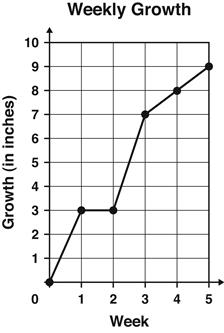
The graph shows the number of inches a plant grew each week.
Between which 2 weeks did the plant grow the MOST?
Week 1 and Week 2
Week 2 and Week 3
Week 3 and Week 4
Week 4 and Week 5

A scientist wanted to see if the amount of garbage that Americans threw away changed over time. He collected information and then showed his results in the graph below.
Based on this graph, what could the scientist say about the amount of garbage that each person threw away?
It increased over time
it decreased over time
it increased the most in 1980
It decreased the most in 1990

Examine the population curves for wolves and moose in the graph below.
Which statement correctly describes the population relationship between the wolves and moose from 1968 to 1973?
As the moose population increased the wolf population increased.
As the moose population increased the wolf population decreased.
As the wolf population decreased the moose population decreased
As the wolf population increased, the moose population decreased.
When heating a test tube, it is important to point the test tube
towards your partner
towards yourself
away from you and others
downward
If you do not understand a step in the lab procedure, what should you do?
walk across the room and ask another lab group
try different methods until you get it right
ask the teacher
Before starting an investigation or lab procedure, you should
try an experiment on your own
open all containers and packages
read all directions and make sure you understand them
handle all the equipment to become familiar with it
If you get hurt or injured in any way, you should
tell your teacher immediately
find bandages or a first aid kit
go to the principal's office
get help after you finish the lab
If your glassware is chipped or broken, you should
use it for only solid materials
give it to your teacher
put it back in the materials area
increase the damage so that it is obvious
If you need to determine the odor of a chemical or a solution, you should
use your hand to bring fumes from the container to your nose
bring the container under your nose and inhale deeply
tell your teacher immediatly
When working with materials that might fly into the air and get into your eyes or someone else's eyes, you should wear
goggles
an apron
gloves
a hat
When working with a flame or heat source, you should
tie back long hair that hangs in front of your eyes
heat substances or objects inside a closed container
touch an object with your bare hand and see how hot it is
throw hot objects into the trash when you are done with them

