
Font size
 Worksheets
Skyline Unit 1-2 Math Vocabulary (8th)
Total questions: 25
Worksheet time: 25mins
What are alternate interior angles?
Angles formed by a transversal intersecting two perpendicular lines
Angles formed by a transversal intersecting two parallel lines
Angles formed by a transversal intersecting two lines
Angles formed by a transversal intersecting two intersecting lines
What is the center of dilation?
A fixed point on a plane
The point where two lines intersect
The point where two angles intersect
The point where two segments intersect
What does clockwise mean?
Moving in a straight line
Moving in the opposite direction as the hands on a clock move
Moving in a random direction
Moving in a straight lineMoving in the same direction as the hands on a clock move
What does congruent mean?
Two figures have the same shape but different size
Two figures have the same size but different shape
Two figures have the same size and shape
Two figures have different size and shape
What are corresponding parts?
Parts of a figure that are congruent
Parts of a figure that match up with parts of a copy
Parts of a figure that are parallel
Parts of a figure that are perpendicular
What does counterclockwise mean?
Moving in the opposite direction as the hands on a clock move
Moving in the same direction as the hands on a clock move
Moving in a random direction
Moving in a straight line
What is a dilation?
A transformation that rotates a figure around a point
A transformation that flips a figure over a line
A transformation that slides a figure along a line
A transformation in which each point on a figure moves along a line and changes its distance from a fixed point
What is an image?
The result of translations, rotations, and reflections on an object
The original object before any transformations
The point where two lines intersect
The point where two angles intersect
What is a reflection?
A transformation that rotates a figure around a point
A transformation that moves every point on a figure to a point directly opposite of the line
A transformation that slides a figure along a line
A transformation that changes the size of a figure
What is a rigid transformation?
A move that does not change any measurements of a figure
A move that changes the size of a figure
A move that changes the shape of a figure
A move that changes the orientation of a figure

Which pair are alternate interior angles
AB
CD
DC
CB
Which pair are alternate interior angles
AB
CD
AD
DC
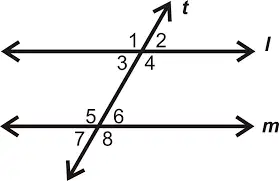
Choose a pair of alternate exterior angles
2,4
1,8
5,8
2,5
Choose a pair of alternate exterior angles
2,7
2,4
5,8
2,5
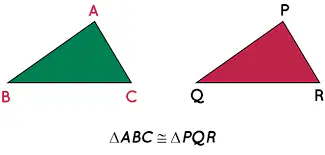
Point Q corresponds to______
Point R
Point B
Point P
Point A
Segment PR corresponds to______
Segment AC
Segment BC
Segment QR
Segment AB
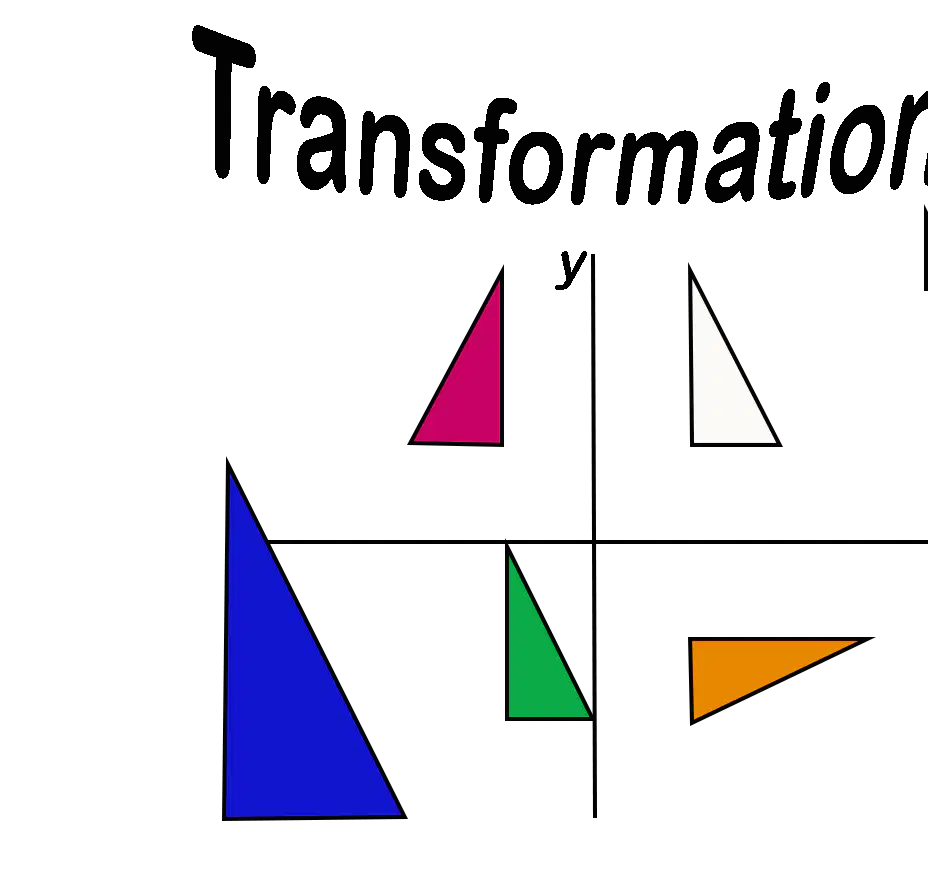
What type of transformation happened from the Blue Triangle to the white Triangle?
Translation
Reflection
Rotation
Dilation
What type of transformation happened from the Pink triangle to the white Triangle?
Translation
Reflection
Rotation
Dilation
What type of transformation happened from the White triangle to the Orange Triangle?
Translation
Reflection
Rotation
Dilation
What type of transformation happened from the Pink triangle to the Orange Triangle?
Translation, rotation
Reflection, rotation
Rotation, translation
Dilation, translation
What type of transformation happened from the Green Triangle to the Pink Triangle?
Translation, rotation
Reflection, rotation
Reflection, Translation
Dilation, translation
Triangle angles add up to_______ degrees.
100
300
150
180

Vertical Angles add up to _________.
270
360
180
250
Which option is a pair of vertical angles?
1,4
2,3
1,3
4,3
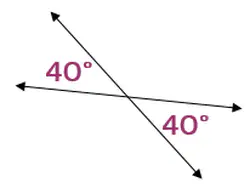
What does the missing vertical angles measure EACH?
280
25
50
140

