Wayground logo

Free Printable Worksheets

Font size

S
M
L
XL
Worksheets

Unit 3 Recovery

Total questions: 40

Worksheet time: 1hrs 16mins

Name
Class
Date
1.
A slide is also called a _________.
a)
Translation
b)
Reflection
c)
Rotation
d)
Transformation
2.
A turn is also called a ___________.
a)
Translation
b)
Reflection
c)
Rotation
d)
Transformation
3.
 Describe the Transformation
a)
Translation
b)
Rotation
c)
Reflection
4.
Identify the transformation.
a)
Reflection across y axis
b)
Reflection across x-axis
c)
180 Rotation
d)
Translation 2 units down
5.
Write a rule for the translation.
a)
 (x -1, y  + 2)
b)
 (x -2, y  + 1)
c)
 (x +2, y  - 1)
d)
(x +1, y  -  2)
6.

The figure shows two perpendicular lines, and , intersecting at a point P in the interior of a trapezoid. Line is parallel to the bases and bisects both legs of the trapezoid. Line bisects both the bases of the trapezoid. Which transformation will carry the figure onto itself?

a)

a reflection across line rr .

b)

a reflection across line ss .

c)

a rotation of 90°90\degree about point PP .

d)

a rotation of 180°180\degree about point PP .

7.

Zach and Naomi are studying geometric transformations. Zach is able to move the triangle AA to  A′A'  using the following sequence of basic transformations:

        1. Reflection across the x-axis.
        2. Reflection across the y-axis.
        3. Translation two units to the right.
Naomi claims that the same three transformations, done in any order will always produce the same result. Zach disagrees. Who is correct?

a)

Zach

b)

Naomi

c)

Both are correct

d)

Both are incorrect

8.

ΔABC\Delta ABC  is shown the coordinate plane. It will be rotated 90 degrees clockwise about the origin to form  ΔA′B′C′\Delta A'B'C'  . What will be the coordinates of  A′, B′A',\ B' and  C′C' ?  

a)

A′(1,−2),  B′(3,−3), C′(2,−5)A'\left(1,-2\right),\ \ B'\left(3,-3\right),\ C'\left(2,-5\right)  

b)

A′(2,−1), B′(3,−3), C′(5,−2)A'\left(2,-1\right),\ B'\left(3,-3\right),\ C'\left(5,-2\right)  

c)

A′(−1,2), B′(−3,3), C′(−2,5)A'\left(-1,2\right),\ B'\left(-3,3\right),\ C'\left(-2,5\right)  

d)

A′(−1,−2), B′(−3,−3), C′(−2,−5)A'\left(-1,-2\right),\ B'\left(-3,-3\right),\ C'\left(-2,-5\right)  

9.

Octagon PQRSTVWZPQRSTVWZ is a regular octagon with its center at point  CC  . Which transformations will map octagon  PQRSTVWZPQRSTVWZ   onto itself? Select ALL that apply.

a)

reflection over  QV‾\overline{QV} . 

b)

reflecting over  RW‾\overline{RW}  

c)

reflecting over  TZ‾\overline{TZ}  

d)

rotating  45°45\degree  clockwise around point  ZZ  

e)

rotating  90°90\degree  counterclockwise around point  CC  

10.
Point (-5,2) is reflected over the y axis.  Where is the new point located?
a)
(5,2)
b)
(-5,-2)
c)
(-5,2)
d)
(5,-2)
11.
Which of the following describes the sequence of transformations shown?
a)
Reflect across the x-axis and then rotate -90 degrees around the origin
b)
Rotate -90 degrees around the origin and then translate down.
c)
Reflect across the x-axis and then reflect across the y-axis.
d)
Translate up and then rotate 90 degrees about the origin.
12.
Which answer shows a reflection across the y-axis?
a)
a
b)
b
c)
c
d)
d
13.
Find K' if the figure is reflected across the x-axis
a)
(4, 1))
b)
(-1, -4)
c)
(1, -4)
d)
(1, 4)
14.
What is the algebraic notation of a figure is Translated 9 units right and 3 units down?
a)
(x, y) --> (x - 9, y + 3)
b)
(x, y) --> (x + 9, y - 3)
c)
(x, y) --> (x + 3, y - 9)
d)
(x, y) --> (9x, 3y)
15.
The dashed figure is the image of the solid figure.  What is the Algebraic Notation for the Translation?
a)
(x, y) --> (x - 7, y + 4)
b)
(x, y) --> (x + 7, y - 4)
c)
(x, y) --> (x + 4, y - 7)
d)
(x, y) --> (7x, 4y)
16.
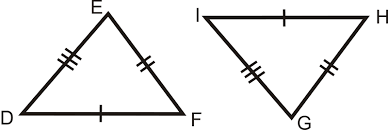
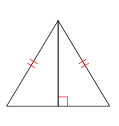
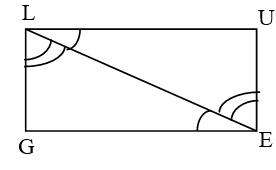
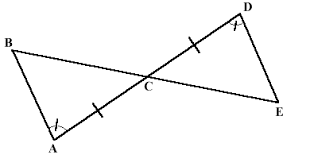
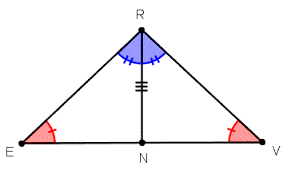
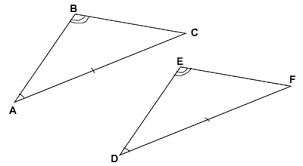
Which triangle congruence theorem can be used to prove the triangles are congruent?
a)
SAS
b)
SSS
c)
ASA
d)
HL
17.
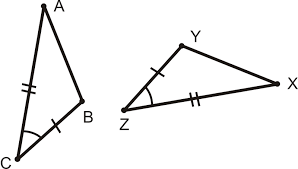
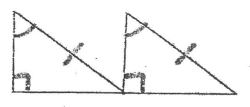
Which triangle congruence theorem can be used to prove the triangles are congruent?
a)
SSS
b)
ASA
c)
AAS
d)
SAS
18.
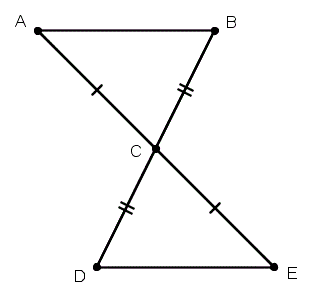
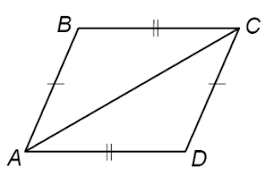
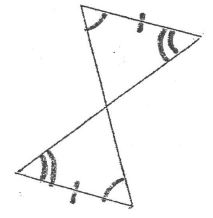
Which triangle congruence theorem can be used to prove the triangles are congruent?
a)
AAS
b)
SSS
c)
SAS
d)
SSA
19.

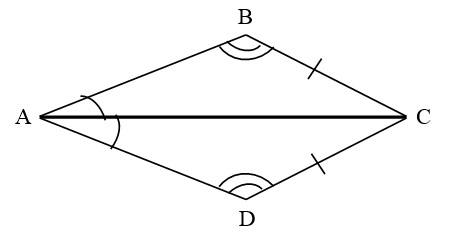
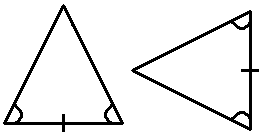
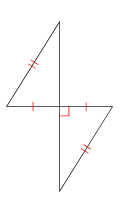
Name the postulate that makes the triangles congruent.

a)

SAS

b)

ASA

c)

AAS

d)

SSS

20.
How are the triangles congruent?
a)
HL
b)
SSS
c)
SAS
d)
AAS
21.

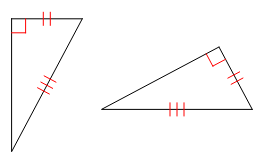
State if the theorem you would use to determine that the two triangles are congruent. 

a)

SAS

b)

SSS

c)

HL

d)

AAS

22.
Which triangle congruence theorem can be used to prove the triangles are congruent?
a)

SAS

b)

HL

c)

SSS

d)

AAS

23.
a)

Congruent by ASA

b)

Congruent by SAS

c)

Congruent by SSS

d)

Congruent by AAS

24.

Name the postulate that makes the triangles congruent.

a)

SAS

b)

ASA

c)

AAS

d)

HL

25.

Name the postulate that makes the triangles congruent.

a)

SSS

b)

SAS

c)

ASA

d)

AAS

26.

Identify the correct triangle congruence theorem.

a)

ASA

b)

AAS

27.

Identify the correct triangle congruence theorem.

a)

ASA

b)

AAS

28.
How are the triangles congruent?
a)
SAS
b)
ASA
c)
HL
d)
SSS
29.
Which triangle congruence theorem can be used to prove the triangles are congruent?
a)

ASA

b)

SAS

c)

AAS

d)

SSS

30.
Which triangle congruence theorem can be used to prove the triangles are congruent?
a)
AAS
b)
SSS
c)
SAS
d)
SSA
31.
Which triangle congruence theorem can be used to prove the triangles are congruent?
a)
ASA
b)
AAS
c)
SAS
d)
AAA
32.
Which triangle congruence theorem can be used to prove the triangles are congruent?
a)
SAS
b)
SSA
c)
ASA
d)
AAS
33.

What is Reason C?

a)

Definition of Congruence

b)

Definition of Vertical Angles

c)

Reflexive Property

d)

Vertical Angle Theorem

34.

What is Reason B?

a)

Definition of Congruence

b)

Definition of Equality

c)

Definition of Midpoint

35.
What does CPCTC stand for?
a)
Corresponding Parts of Congruent Triangles are Congruent
b)
Congruent Parts of Congruent Triangles are Corresponding
c)
Colorful Pieces of Corresponding Triangles are Congruent
d)
Congruent Pieces of Congruent Triangles are Congruent
36.
What are the 2 missing pieces of information?
a)
Transitive Property, SAS(Side-Angle-Side)
b)
Reflexive Property, SAS(Side-Angle-Side)
c)
Transitive Property, SSS(Side-Side-Side)
d)
Reflexive Property, SSS(Side-Side-Side)
37.
What is the "statement" for step 2 of the proof?
a)
AD=AD
b)
AD=DA
c)
HD=DN
d)
HA = AN
38.
What is the "statement" for step 3 of the proof?
a)
HT=TA
b)
HA=AH
c)
MA=AM
d)
MA=MH
39.
What is always the 1st statement in reason column of a proof?
a)
Prove
b)
Given
c)
Reason
d)
Statement
40.
What is the "statement" for step 3 of the proof? 
a)
∡EDA≅∡DCB
b)
∡AED≅∡BEC
c)
DE=CE
d)
∡AED≅∡CED