
 Worksheets
Revision 30s
Total questions: 20
Worksheet time: 10mins
Name
Class
Date
1.
Which atom has the smallest number of neutrons?
a)
Carbon-14
b)
Neon-20
c)
Fluorine-19
d)
Nitrogen-14
2.
The oxygen element consist of three naturally occurring isotopes : ¹⁶O, O¹⁷ and O¹⁸. The atomic mass of oxygen is 16.0 u. What can be implied about the relative abundances of these isotopes?
a)
Almost all O atoms are O¹⁸
b)
The isotopes all have the same abundance
c)
The abundances of O¹⁷ and O¹⁸ are very small
d)
¹⁶O have lowest abundance
3.
The mass of bromine atom is about four times greater than that of neon atom. What is the relative numbers of bromine and neon atoms in 1000 g of
a)
1 : 4
b)
4 : 1
c)
1 : 1000
d)
1000 : 1
4.
Which of the following solutions with a concentration of 0.100 M contain the highest concentration of potassium ions?
a)
potassium iodide
b)
Ni
c)
potassium hypochlorite
d)
potassium phosphate
5.
How many nitrogen atoms are present in 28 L of nitrogen gas at STP?(Molar volume of gas = 22.4 L at STP ; Avogadro constant = 6.02 x 10²³)
a)
1.5 x 10²³ atoms
b)
7.5 x 10²³ atoms
c)
1.5 x 10²⁴ atoms
d)
3.0 x 10²⁴ atoms
6.
Which of the following equations does not represent a redox equation?
a)
2H₂O ⎯→ 2H₂ + O₂
b)
Cu(NO₃)₂ + Zn ⎯→ Zn(NO₃)₂ + Cu
c)
2NaI + Br₂⎯→ 2NaBr + I₂
d)
2NaCl + Pb(NO₃)₂⎯→ PbCl₂ + 3NaNO₃
7.
In the reaction, Zn + 2HCl→ ZnCl₂ + H₂, 25.0 grams of Zn are reacted with 17.5 g of HCl. How many grams of H₂ will be produced?
a)
0.479 g
b)
0.382 g
c)
0.765 g
d)
0.250 g
8.
An experiment was carried out and the product obtained was 122 grams. If the theoretical yield for the reaction was 156 grams, what is percentage yield of the product?
a)
78.2%
b)
72.8%
c)
19.0%
d)
18.6%
9.
Calculate the wavelength, λ, for the fourth line in Balmer series.
a)
410.0 nm
b)
432.0 nm
c)
486.0 nm
d)
654.0 nm
10.
Choose the highest energy involved when an electron makes a transition.
a)
n₃ to n₁
b)
n₂ to n₁
c)
n₄ to n₂
d)
n₄ to n₃
11.
Which of the following represents an electron in 3p orbital?
a)
n = 3, l = 0, m = 0, s = ± 1⁄2
b)
n = 3, l = 0, m = +1, s = + 1⁄2
c)
n = 3, l = 1, m = +1, s = + 1⁄2
d)
n = 3, l = 2, m = +2, s = ± 1⁄2
12.
Electronic configuration of copper atom is 1s² 2s² 2p⁶ 3s² 3p⁶ 3d¹⁰ 4s¹. Determine the number of electron in copper atom at its ground state if the azimuthal quantum number, l, is 0.
a)
7
b)
9
c)
8
d)
6
13.
The electronic configurations of element P and element Q are as follows : P: 1s² 2s² 2p⁶ 3s² Q: 1s² 2s² 2p⁵ . When P and Q combine to form a compound, determine the most possible formula of this compound and the type of bonding between them.
a)
Formula : PQ₂ Type of bonding : covalent
b)
Formula : P₂Q Type of bonding : covalent
c)
Formula : PQ₂ Type of bonding : electrovalent
d)
Formula : P₂Q₃ Type of bonding : electrovalent
14.
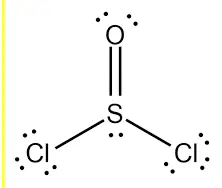
The Lewis structure of SOCl₂ is given as follows. The formal charges on sulphur, chlorine and oxygen are
a)
Sulphur : 0, Chlorine : 0, Oxygen : 0
b)
Sulphur : -1, Chlorine : +2, Oxygen : -1
c)
Sulphur : +2, Chlorine : -1, Oxygen : -1
d)
Sulphur : +2, Chlorine : -2, Oxygen : 0
15.
Choose the 𝐈𝐍𝐂𝐎𝐑𝐑𝐄𝐂𝐓 statement for the formation of ionic bonds between two atoms,
a)
the difference in their electronegativity must be large.
b)
one of the atoms must be a metal while the other must be a non-metal.
c)
each atom must achieve octet configuration.
d)
one of the atom share electron to the other atom
16.
Choose a species with dipole moment NOT equal to zero ( μ≠ 0 ).
a)
CCl₄
b)
SF₄
c)
I₃⁻
d)
NH₄⁺
17.
What is the hybridisation of carbon atom in hydrogen cyanide, HCN?
a)
sp³d²
b)
sp
c)
sp³d
d)
sp³
18.
The melting points of iron and chlorine are 1540 °C and -101 °C. Why?
a)
Covalent bonds are stronger than metallic bond
b)
Metallic bonds are stronger than covalent bonds
c)
Metallic bonds are stronger than van der Waals forces
d)
Covalent bonds are stronger than van der Waals forces
19.
Which of the following gases will have the greatest density at the same specified temperature and pressure?
a)
H₂
b)
CO₂
c)
C₂H₆
d)
CClF₃
20.
Which of the following molecular formulas is also an empirical formula?
a)
C2H6SO
b)
H2O2
c)
C6H6
d)
H2P4O6
100 %

