
 Worksheets
Industrial Revolution
Total questions: 40
Worksheet time: 30mins
Which invention played a crucial role in the Industrial Revolution by revolutionizing the textile industry?
steam engine
printing press
spinning jenny
telegraph
What was the impact of the Industrial Revolution on working conditions?
The Industrial Revolution worsened working conditions for the majority of workers.
The Industrial Revolution only affected working conditions for a small minority of workers.
The Industrial Revolution improved working conditions for all workers.
The Industrial Revolution had no impact on working conditions.
What were the social and economic changes brought about by the Industrial Revolution?
The Industrial Revolution brought about urbanization, the emergence of a working class, the decline of the traditional agrarian society, the growth of factories and mass production, the development of new industries, and the expansion of global trade.
The Industrial Revolution brought about the growth of traditional agrarian society and the decline of new industries.
The Industrial Revolution brought about a decrease in urbanization and the emergence of a leisure class.
The Industrial Revolution brought about a decrease in global trade and the decline of factories and mass production.
What role did women play during the Industrial Revolution?
Women had no role in the workforce during the Industrial Revolution.
Women only worked in domestic roles during the Industrial Revolution.
Women were primarily responsible for childcare during the Industrial Revolution.
Women played a significant role in the workforce during the Industrial Revolution.
Which system of production was introduced during the Industrial Revolution?
assembly line system
cottage industry system
artisanal system
factory system
Which invention revolutionized transportation during the Industrial Revolution?
steam engine
spinning jenny
telegraph
cotton gin
What was the impact of the factory system on production?
Decreased production efficiency and output.
Increased production efficiency and output.
Caused a decline in production.
Had no impact on production.
What was the main reason for the growth of cities during the Industrial Revolution?
Increased agricultural productivity.
Improved transportation systems.
Government policies promoting urbanization.
Expansion of industries and factories
What was the impact of the Industrial Revolution on the environment?
The Industrial Revolution had a negative impact on the environment.
The Industrial Revolution had no impact on the environment.
The Industrial Revolution had a positive impact on the environment.
The impact of the Industrial Revolution on the environment is still unknown.
Which industry saw the most significant growth during the Industrial Revolution?
textile industry
agriculture industry
steel industry
automotive industry
The shift, beginning in England during the 18th century, from making goods by hand to making them by machine
French Revolution
Scientific Revolution
American Revolution
Industrial Revolution
One of the fenced-in or hedged-in fields created by wealthy British landowners on land that was formerly worked by village farmers.
Urbanization
Enclosure system
Crop rotation
Putting-out system
The resources- including land, labor, and capital- that are needed to produce goods and services
Canal System
Factors of Production
Crop Rotation
Hedgerows
A fabric made by weaving, used in making clothing
Venture capitalist
Textile
Entrepreneur
Risk taker
A social class made up of skilled workers, professionals, business people, and wealthy farmers
Middle Class
Enclosure movement
Scarcity
Factory system
A social class broadly composed of people working in blue-collar, or manual, occupations.
Working Class
Mechanization
Industrialization
Entrepreneur
Idea that government should play as small a role as possible in economic affairs.
Adam Smith
Karl Marx
Robert Bakewell
Laissez-faire
An economic system based on private property and free enterprise - no government regulation in economics.
Socialism
Communism
Capitalism
Richard Arkwright
Which of the following became an important source of power during the Industrial Revolution?
The steam engine
Horses
The locomotive
Electricity
What is one result of the enclosure movements?
New crops were developed
Profits fell
Farm laborers lost their jobs
Farm output decreased
Who invented a new type of steam engine in 1781 that allowed the steam engine to be used in factories?
Thomas Edison
Henry Bessemer
Henry Ford
Elias Howe
James Watt
What invention was developed by Samuel Morse?
Telegraph
Spinning Mule
Steam Engine
Sewing Machine
Light Bulb
What process allowed steel to be mass-produced at a lower cost?
Edison Process
Assembly Process
Bessemer Process
Watt Process
Singer Process
What did Alexander Graham Bell Invent?
Elevator
Telephone
Railroad
Light Bulb
Sewing Machine
Who invented the first practiced incandescent light bulb?
Henry Ford
James Watt
Eli Whitney
James Hargreaves
Thomas Edison
RURAL means
City
Farmland
Suburb
Beach
URBAN means
City
Beach
Farmland
Suburb

What does the image above display?
Plow
Seed Drill
Tractor
Steam Engine
What are the factors of production?
Capital
Entrepreneur
Land
Labor
changes in manufacturing and transportation that began with fewer things being made by hand but instead made using machines in larger-scale factories.
Ford Forward
Labor Union
Socialism
Industrial Revolution

Which of the factors of production is this?
capital
entrepreneur
land
labor
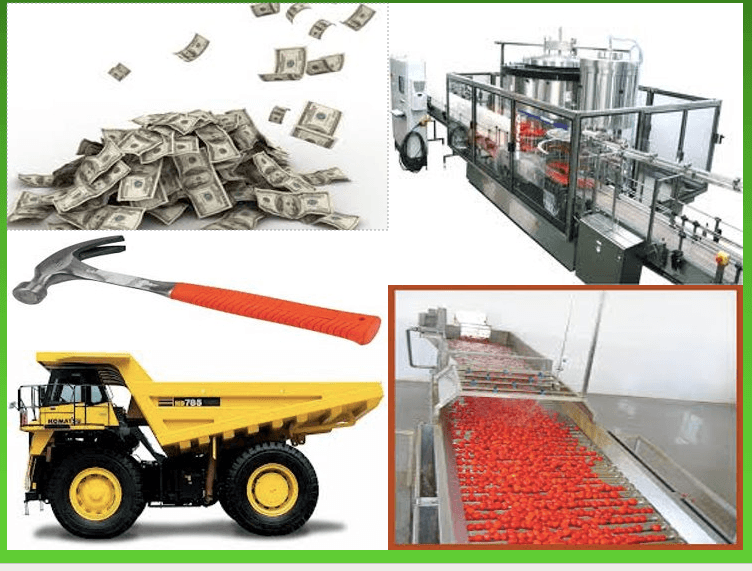
Which one of the factors of production is this?
capital
entrepreneur
land
labor

Steve Jobs the founder of Apple is holding up an I-phone. What is another name for someone who starts a business?
capital
entrepreneur
land
labor

Which factor of production is this?
capital
entrepreneur
Natural Resource
labor

Iron Ore
Natural Resource
Labor
Physical capital
Human capital
Entrepreneuership


