
 Worksheets
States of Matter
Total questions: 15
Worksheet time: 15mins
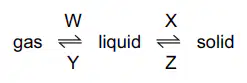
In which changes do the particles move further apart?
W and X
W and Z
X and Y
Y and Z
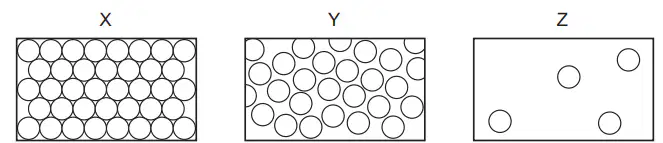
Diagram X, Y and Z represent the three states of matter.
Which change occurs during boiling?
X to Y
Y to Z
Z to X
Z to Y
Which change of state take place during evaporation?
gas to liquid
liquid to gas
liquid to solid
solid to gas
In which substance are the particles close together and slowly moving past each other?
Air
Ice
Steam
Water
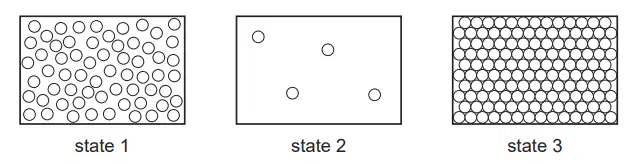
The diagrams show the arrangement of particles in three different physical states of substance X.
Which statement about the physical states of substance X is correct?
Particles in state 1 vibrate about fixed positions
State 1 changes to state 2 by diffusion
State 2 changes directly to state 3 by condensation
The substance in stage 3 has a fixed volume
The kinetic theory of matter explores the spatial relationship between the particles in solids, liquids, and gases.
Which of the following processes causes the distance between particles to increase by the most?
Melting
Freezing
Sublimation
Condensation
The following four statements describe the arrangement of particles in a substance.
1. Particles are moving in all directions
2. Particles are arranged in neat rows
3. Particles can move past each other
4. Particles vibrate about their positions
Which of the four statements describe the arrangement of particles in a solid?
1 and 2
2 and 4
1 and 3
2 only
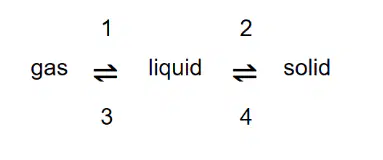
Matter exist in three states which are solid, liquid, and gas. Phase changes occur when matter changes from one state to another.
In which changes do the particles move closer together?
3 and 4
1 and 3
4 only
1 and 2
Which state of matter has a definite shape, a definite volume and cannot flow?
Liquid
Solid
Solids and gases
Gas
The boiling point of a substance is the temperature at which it changes from ........
a liquid to a solid
a gas to a solid
a solid to a liquid
a liquid to a gas
Which one of the following states of matter can easily be compressed?
Solid
Gas
Liquid
All states of matter can be compressed
When a beaker of water is heated its volume increases a little. What is happening to the particles in the liquid?
They are getting bigger
They are moving slower
They are moving faster
They are getting smaller
Which one of the following statements best describes the particles in a gas?
They are moving very fast and are far apart
They are very slow and are far apart
They are very close together and are able to vibrate
They are stationary and not able to vibrate
The change from liquid to solid, or the reverse of melting, is called .....
Condensation
Boiling
Sublimation
Freezing
Matter changing from a gas to a solid is called:
Evaporation
Sublimation
Deposition
Melting

