wayground logo

Free Printable Worksheets

Font size

S
M
L
XL
Worksheets

Unit 2 Test Review Adv Alg

Total questions: 81

Worksheet time: 6hrs 24mins

Name
Class
Date
1.

Find the inverse of f(x)=6xf\left(x\right)=6^x  .

a)

f1(x)=logx6f^{-1}\left(x\right)=\log_x6  

b)

f1(x)=log6xf^{-1}\left(x\right)=\log_6x  

c)

f1(x)=log6xf^{-1}\left(x\right)=\log_{6x}^{ }  

d)

f1(x)=log (6+x)f^{-1}\left(x\right)=\log\ \left(6+x\right)  

2.

Find the inverse function of f(x)=5xf\left(x\right)=5^x  

a)

f1(x) = log5xf^{-1}\left(x\right)\ =\ \log_5x  

b)

f1(x)=log5xf^{-1}\left(x\right)=\log_{5x}  

c)

f1(x)=5logxf^{-1}\left(x\right)=5\log x  

d)

f1(x)=log5xf^{-1}\left(x\right)=\log5x  

3.

Which equation is the inverse of the equation above?

a)
b)
c)
d)
4.

Which equation is the inverse of the equation above?

a)
b)
c)
d)
5.
Classify the model as Exponential GROWTH or DECAY.
A=1200(.85)6
a)
Growth
b)
Decay
6.
Classify the model as Exponential GROWTH or DECAY.
A=10(1.01)3
a)
Growth
b)
Decay
7.
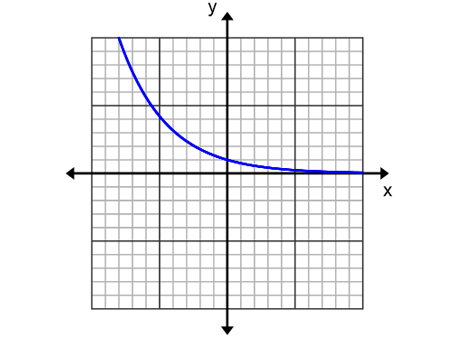
Is the pictured graph growth, decay, or linear or none?  
a)
Exponential Growth
b)
Exponential Decay
c)
Linear
d)
None
8.
Suppose a culture of bacteria begins with 5000 cells and dies by 30% each year. Write an equation that represents this situation.
a)
y=5000(0.7)x
b)
y=30(5000)x
c)
y=5000(1.3)x
d)
y=5000xx
9.
The number of mosquitoes at the beginning of the summer was 4,000. The population of mosquitoes is expected to grow at a rate of 25% a month. How many mosquitoes will there be after 4 months?
a)
9766
b)
9006
c)
9765
d)
5433
10.
What type of function is f(x)=2(1/7)x ?
a)
Exponential Growth
b)
Linear
c)
Exponential Decay
d)
None of the Abovee
11.

What is the asymptote of this function?

a)

y = 0

b)

y = 5

c)

y = 2

d)

y = 1

12.
To solve 8 = 25x+7, you would need to re-write 8 as what base?
a)
8
b)
4
c)
2
d)
Cannot be determined
13.
Solve for x:
9x+8 81
a)
2
b)
-6
c)
6
d)
8
14.
Convert log(x)=5 to exponential form
a)
15=x
b)
10x=5
c)
x5=10
d)
105=x
15.
Solve for x.
logx(64)=3
a)
x=8
b)
x=4
c)
x=3
d)
x=64
16.

log8log2+2logw\log8-\log2+2\log w  

a)

log4w2\log\frac{4}{w^2}  

b)

log6w2\log6w^2  

c)

log4w2\log4w^2  

d)

log6w2\log\frac{6}{w^2}  

17.

(15)(x2)=125(2x5)\left(\frac{1}{5}\right)^{\left(x-2\right)}=125^{\left(2x-5\right)}  
What would be the BEST first step in solving the equation?

a)

Divide by 125

b)

Use expansion to "bring the exponents down"

c)

Set the exponents equal to each other

d)

Rewrite the bases as powers of 5

18.

4log2(2x+24)17=94\log_2\left(2x+24\right)-17=-9  
Once you have isolated the log in the equation, what would be the next step?

a)

log both sides

b)

rewrite as an exponential

c)

nothing, you would not be able to solve it

d)

divide both sides by 2

19.

f(x)=2log3(x+1)+5f\left(x\right)=2\log_3\left(x+1\right)+5  
What is the domain of the function?

a)

(,)\left(-\infty,\infty\right)  

b)

(5,)\left(5,\infty\right)  

c)

(1,)\left(1,\infty\right)  

d)

(1,)\left(-1,\infty\right)  

20.

f(x)=2log3(x+1)+5f\left(x\right)=2\log_3\left(x+1\right)+5
What is the range of the function?

a)

(,)\left(-\infty,\infty\right)  

b)

(5,)\left(5,\infty\right)  

c)

(2,)\left(2,\infty\right)  

d)

(1,)\left(1,\infty\right)  

21.

g(x)=3ln(x4)2g\left(x\right)=-3\ln\left(x-4\right)-2  
What is the asymptote of the function?

a)

x=4x=-4  

b)

y=2y=2  

c)

x=4x=4  

d)

y=2y=-2  

22.
Use multiple log properties to write as a single log:
3log2x -  log2y + log2z
a)
log2(x/(yz))
b)
log2(x3yz)
c)
log2(x3z/y)
d)
log2(x3/(yz))
23.
Expand completely: log(2x5
a)
log 2 + 5log x
b)
5log 2 + 5log x
c)
5log 2 + log x
d)
log 10 + log x
24.
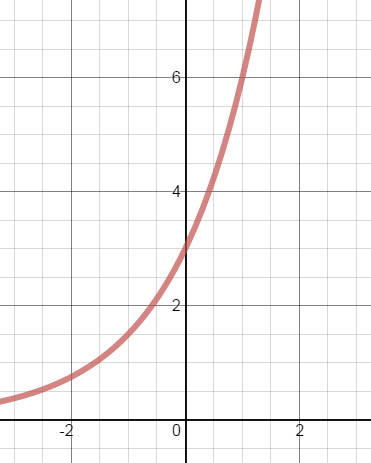
What is the equation that represents the exponential function in the image below?
a)
y=3(½)x
b)
y=3(2)x
c)
y=(2)x
d)
y=2(3)x
25.
Evaluate log8 8
a)
8
b)
-1
c)
0
d)
1
26.
Find the domain and range of:
f(x) = log2(x)
a)
D: all real numbers
R: y > 0
b)
Domain: all real numbers
Range: all real numbers
c)
Domain: x > 0
Range: all real numbers
d)
Domain: all real numbers
Range: y < 0
27.
Write the expression as a single logarithm.   Then simplify if possible.
log53 + log56 + log59
a)
log569
b)
log556
c)
log5162
d)
log598
28.
Condense
a)
A
b)
B
c)
C
d)
D
29.
a)
6log8(xyz)
b)
log8(x) - log8(y) - 6log8(z)
c)
log8(x) + log8(y) - log8(z)
d)
log8(x) + log8(y) + 6log8(z)
30.
a)
log(x) + log(z) + 4log(y)
b)
3log(x) − log(z) − 4log(y)
c)
3log(x) + log(z) + 4log(y)
d)
log(x) − 4log(z) − 3log(y)
31.
a)
log5(x2z2y10)
b)
log5(z2y2x10)
c)
log(zy2x10)
d)
log5(z2 + y+ x10)
32.
Solve:
log (4x − 5) = log (2x − 1) 
a)
0
b)
1
c)
2
d)
3
33.

Solve:

log (x - 1) - log (x - 2) = log 5

a)

7

b)

4/9

c)

9/4

d)

1/7

34.

Solve:

ln(x+8) - ln (8) = 3

a)

152.68

b)

188.77

c)

4.24

d)

8.01

35.

log4(3x-1)=log4(2x+3)

a)

4

b)

3

c)

1

d)

8

36.

Describe domain of the function shown: y=log2(x+1)

a)

(-∞,∞)

b)

(-1,∞)

c)

(-1,3)

d)

(∞, -1)

37.

Describe range of the function shown: y=log2(x+1)

a)

(-∞,∞)

b)

(-1,∞)

c)

(-1,3)

d)

(∞, -1)

38.
Where is the asymptote?
a)
x = 1
b)
y = 1
c)
x = -1
d)
y = -1
39.

This graph is _______________.

a)

increasing

b)

decreasing

40.
a)
A
b)
B
c)
C
d)
D
41.
a)
A
b)
B
c)
C
d)
D
42.
a)
A
b)
B
c)
C
d)
D
43.
log5 (2x - 3)2 = 6
a)
x = 128
b)
 x = 64
c)
x = 4
d)
x = 14
44.

2x - 5 = 12

a)

x = 8.5

b)

x = 4.1

c)

x = 6.2

d)

x = 3.9

45.

Use a LOG to solve the exponential function: 4x = 19

a)

x = 2.1

b)

x = 4.8

c)

x =5.2

d)

x = 1.4

46.
Solve the natural logarithm using LN.
ex = 12
a)
x=2.48
b)
x = 1.79
c)
x = 6
d)
x = 3.45
47.

You invest $1500 in an account that earns 5% interest compounded annually. Using algebra, find out how long will it take your money to reach 4500? Remember: p(1+ r)x = A

a)

20.8 years

b)

21.2 years

c)

22.5 years

d)

24.3 years

48.
Suppose you deposit $3000 in a savings account that pays interest at an annual rate of 4%. If no other money is added or withdrawn from the account, how much will be in the account after 10 years?
a)
$3122.18
b)
$4994.50
c)
$4440.73
d)
$86,776.40
49.
A population of fish starts at 8,000 and decreases by 6% per year. What is the population of fish after 10 years?
a)
14327
b)
4309
c)
839
d)
7680
50.
Is this exponential growth or decay?
a)
Growth
b)
Decay
51.
Pick the equation that is exponential decay
a)
y=2000(0.88)
b)
y=0.5(1.88)
52.

The city of Whoville has been much more stable since the Grinch turned his life around. The population of 900 is increasing at a rate of 7.5% per year. If the population continues growing at the same rate, how many people will there be in 11 years?

a)

424288

b)

1994

c)

10642

d)

900

53.
a)
about 7 years
b)
about 10 years
c)
about 18 years
d)
about 22 years
54.

What operation of function shall we use to determine if two functions are inverses of each other?

a)

multiplication

b)

division

c)

composition

d)

addition

55.
What is the equation that best represents the graph?
a)
y=2y
b)
y=2x
c)
y=2-x
d)
y=x2
56.

For f(x)=43xf\left(x\right)=4\cdot3^x , find the correct graph, asymptote, domain and range.

a)
b)
57.

For f(x)=3xf\left(x\right)=3^x , find the correct graph, asymptote, domain and range.

a)
b)
58.

For f(x)=(12)xf\left(x\right)=\left(\frac{1}{2}\right)^x  , find the correct graph, asymptote, domain and range.

a)
b)
59.

Given the function y=3(2)xy=3\left(2\right)^x  , fill in the blank in the table  when  x=5x=5  .

a)

96

b)

7776

c)

30

d)

30-30  

60.
Asymptote?
a)
y = 2
b)
y = -2
c)
x = 2
d)
y = 0
61.
Domain?
a)
(-∞, ∞)
b)
(0, ∞)
c)
(-∞, 0)
d)
[0, ∞)
62.
Range?
a)
(-8, ∞)
b)
[-8, ∞)
c)
(-∞, ∞)
d)
(∞, -8)
63.
Asymptote?
a)
y = 4
b)
y = 0
c)
x = 4
d)
y = 5
64.
Range?
a)
(-∞, 2)
b)
(-∞, 2]
c)
(2, ∞)
d)
(2, -∞)
65.

Which equation matches the graph?

a)

y = 4x + 3

b)

y = 4x - 3

c)

y = 4x + 3

d)

y = 4x - 3

66.
What is the domain of the function
y = -6x + 3 - 9
a)
(-∞, ∞)
b)
(-∞, -9)
c)
(-9, ∞)
d)
(∞, -∞)
67.
What is the  Vertical Asymptote?
a)
x=5
b)
x=0
c)
y=0
d)
x=1
68.
What is the Domain?
a)

(0, ∞)

b)

(-∞, ∞)

c)

(1, ∞)

d)

(-∞, 1)

69.
What is the Range?
a)

(0, ∞)

b)

(-∞, ∞)

c)

(1, ∞)

d)

(-∞, 1)

70.
What is the equation of the asymptote?
a)
x = -3
b)
x=5
c)
y= -3
d)
y=5
71.
What is the Domain?
a)

(-3, ∞)

b)

(5, ∞)

c)

(3, ∞)

d)

(-5, ∞)

72.
What is the range of this graph?
a)

(-∞, ∞)

b)

(1, ∞)

c)

(-1, ∞)

d)

(5, ∞)

73.

Write the equation for the graph.

a)

f(x) = log2 (x-3)

b)

f(x)= 3 log2(x)

c)

f(x) = log2(x+3)

d)

f(x) = log2(x) + 3

74.
Match the graph with its equation
a)
y = log6(-x) + 1
b)
y = log6(x − 2) + 1
c)
y = log6(x + 2) - 1
d)
y = log(x-8) + 1
75.
Match the graph with its equation
a)
y = log5 (x + 1) + 1 
b)
y = log5 (x - 1) + 1 
c)
y = log5 (x2) + 1 
d)
y = log5 (x)-1
76.
Match the graph with its equation
a)
y = log4 (x)+2
b)
y = log4 (x + 2) + 1 
c)
y = log4 (x - 1) + 2
d)
y = log4 (-x + 2)
77.
Which has a horizontal asymptote?
a)
exponential
b)
logarithm
c)
both
78.

f(x)=log5(x+4) - 2

Find the Domain and Range

a)

Domain: [-4, ∞)

Range: (-∞, ∞)

b)

Domain: (-∞, ∞)

Range: [-4, ∞)

c)

Domain: (-∞, ∞)

Range: (-4, ∞)

d)

Domain: (-4, ∞)

Range: (-∞, ∞)

79.

f(x)=2ln(x+2)

Describe the asymptote

a)

Horizontal asymptote x = -2

b)

Horizontal asymptote x = 2

c)

Vertical asymptote x = -2

d)

Vertical asymptote x = 2

80.

f(x)=2ln(x+2)

Find the Domain and Range

a)

Domain: (-∞, ∞)

Range: ( -2, ∞)

b)

Domain: (-∞, ∞)

Range: ( -∞, -2)

c)

Domain: ( -∞, -2)

Range: (-∞, ∞)

d)

Domain: ( -2, ∞)

Range: (-∞, ∞)

81.

f(x)=¼ ln(x - 2) + 3

Find the Domain and Range

a)

Domain: (-∞, ∞)

Range: (2, ∞)

b)

Domain: (-∞, ∞)

Range: (-2, ∞)

c)

Domain: (-2, ∞)

Range: (-∞, ∞)

d)

Domain: (2, ∞)

Range: (-∞, ∞)