wayground logo

Free Printable Worksheets

NEW

Font size

S
M
L
XL
Worksheets

Dating

Total questions: 40

Worksheet time: 44mins

Name
Class
Date
1.
The statement that the oldest layer will be at the bottom in an undisturbed sequence of rock layers is called the Principle of ....
a)
Inclusions
b)
Unconformities
c)
Cross-Cutting Relationships
d)
Superposition
2.
Relative age dating is used to determine the...
a)
actual age of an event
b)
length of time between two events
c)
age of one event in comparison with other events
d)
rate at which a gologic process occurs
3.
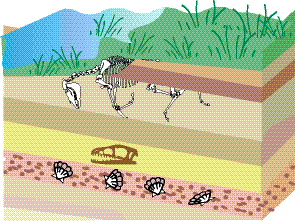
Which of the following correctly lists the layers in order from oldest to youngest?
a)
A, B, C, D, E
b)
E, B, C, D, A
c)
E, D, C, B, A
d)
C, B, A, D, E
4.
Traces or remains of organisms that lived long ago
a)
Fossil
b)
Unconformity
c)
Superposition
d)
Column
5.
The Geologic Time Scale is a record of what?
a)
old geologists
b)
sweet geology music
c)
the known history of rocks and fossils
d)
a list of every living thing ever
6.

The numerical age, in years, of any object.

a)

absolute age

b)

relative age

c)

space age

d)

old age

7.
How many LAYERS are there?
a)
6
b)
7
c)
5
d)
2
8.
Which layer is the oldest? 
a)
c
b)
a
c)
b
d)
d
9.
What fossil is the oldest?
a)
d
b)
b
c)
a
d)
c
10.
Where is the magma at in this picture?
a)
none of the above 
b)
c
c)
f
d)
d
11.
Scientists use ______ dating to figure out the exact age of something.
a)
relative
b)
chemical
c)
absolute
d)
rock
12.
The geologic time scale represents Earth's ________ year history.
a)
2.5 million
b)
9 million
c)
1 billion
d)
4.6 billion
13.
Scientists use ______ to help figure out geologic time.
a)
earthquakes
b)
plate tectonics
c)
rock layers
d)
erosion
14.
When sediment is moved around by wind or water it is called ________.
a)
erosion
b)
weathering
c)
relative
d)
fossils
15.
A ________ is a scientist that studies the composition of the Earth, including rock layers.
a)
biologist
b)
paleontologist
c)
chemist
d)
geologist
16.
________ are evidence of past life.
a)
Intrusions
b)
Fossils
c)
Meteorites
d)
Cells
17.
Dinosaurs lived in the ___________ era.
a)
Mesozoic
b)
Paleozoic
c)
Cenozoic
d)
Neozoic
18.

Look at the diagram.

Which fossil is the youngest?

a)

A

b)

B

c)

C

d)

D

19.
How many LAYERS are there?
a)
6
b)
7
c)
5
d)
2
20.
To be considered an index fossil, it had to have lived for a relatively short period of time.
a)
True
b)
False
21.
Which fossil makes the best index fossil?
a)
Fossil 1
b)
Fossil 2
c)
Fossil 3
d)
None follow all of the rules
22.

What is the best reason that fossil #4 is NOT a good index fossil?

a)

It is not widespread

b)

it is not short-lived (in numerous layers)

c)

It is in half of the outcrops

23.
How does absolute age differ from relative age?
a)
only absolute dating indicates which rock is older than another
b)
only absolute dating finds the age in years
c)
only relative dating finds the age in years
24.
If the half-life of a radioactive group of atoms is 100 years, then how old is the rock if there have been two half-lives?
a)
25 years
b)
200 years
c)
400 years
d)
800 years
25.
According to the law of superposition, the oldest fossils are found 
a)
At the top of the rock layers
b)
Near the bottom of the rock layers
c)
In the middle of the rock layers
d)
Somewhat near the surface
26.
The best index fossils have which two traits?
a)
widespread geographically, long lifespan
b)
widespread geographically, short lifespan
c)
specific place, long lifespan
d)
specific place, short lifespan
27.
The Law of Superposition helps scientists to determine what?
a)
The absolute age of rock layers
b)
The age of fossils
c)
The relative age of rock layers
d)
the super powers of rocks
28.
According to the law of superposition, which layer is the youngest?
a)
A
b)
B
c)
C
29.
Which of the following organisms formed last on Earth?
a)
Jellyfish
b)
Shark
c)
Lizards
d)
Horses
30.
Index fossils help determine relative age through correlating rock layers.
a)
True
b)
False
31.
Does the picture represent relative or absolute dating?
a)
relative
b)
absolute
32.
Geologists use radioactive dating to determine THE ABSOLUTE AGE OF ROCKS.
a)
True
b)
False
33.
Which fossil is relatively the oldest?
a)
Trilobite
b)
Ammonite
c)
Crinoid
d)
Gastropod
34.
The Earth is estimated to be how old?
a)
4.6 Million years old
b)
6,000 years old
c)
4.6 Billion years old
d)
Who knows
35.

What two methods are used for determining the age of rocks and fossils?

a)

Relative and Absent Dating

b)

Absolute and Resolute Dating

c)

Relative and Absolute Dating

d)

Carbon and Water Dating

36.
Geologists use radioactive dating to determine THE ABSOLUTE AGE OF ROCKS.
a)
True
b)
False
37.
__________________is the time it takes for half of the radioactive atoms in an element to decay.
a)
dating range
b)
half life
38.

the age of rock given the number of years since the rock formed

a)

index fossil

b)

relative age

c)

absolute age

d)

unconformity

39.

Earth elements decay and change into another element in a process called_____________.

a)

radiation

b)

isotope

c)

radioactive decay

d)

half-life

40.

Geologist use the time it takes for a radioactive isotope to decay to half its original mass called a___________.

a)

radioactive decay

b)

isotope

c)

half-life

d)

carbon dating