
 Worksheets
Bio 1st Nine Weeks Extra Credit
Total questions: 52
Worksheet time: 52mins
Four groups of biomolecules found in all living things are all of the following except:
Carbohydrates
Lipids
Glutamine
Protein
What are the elements found in carbohydrates?
CHO
CHON
CHONP
What is the main function of a carbohydrate?
Long term energy (ATP)
Short term energy (ATP)
Growth and repair
Store genetic information
The monomers of carbohydrates are:
Amino Acids
Monosaccharides
Fatty Acids
Nucleotides
The main function of lipids are:
Storage of genetic material
Growth and Repair
Long term energy (ATP) & Transport
Short term energy (ATP) & Transport
Food source examples of lipids are all of the following except:
Lard (Manteca)
Oils
Butter
Eggs
The following are all functions of proteins except:
Growth and repair
Control rate of reactions - enzymes
Fight disease - antibodies
Long term energy storage (ATP)
Proteins contain the following elements:
CHO
CHON
CHONP
Which of the following would be a food source of protein?
Oil
Lettuce
Strawberries
Poultry
The monomers of proteins are:
Fatty Acids
Monosaccharides
Amino Acids
Nucleotides
Select all the components of a nucleotide:
Phosphate
NItrogen Base
5-Carbon Sugar
Amino Acid
Which of the following is not a nucleotide:
DNA
Lipid
RNA
What is the main function of nucleic acid?
store and transmit hereditary, or genetic, information and help build proteins
growth and repair
energy storage
quick access to energy
Which biomolecule makes up cell membranes?
Protein
Carb
Lipid
Nucleic Acid
This organelle is a rigid outer layer that protects plant cells.
Cell Membrane
Cell Wall
Chloroplast
Nucleus
This organelle controls what goes in and out of plant and animal cells.
Cell Wall
Cytoplasm
Cell Membrane
Ribosomes
The _____________ stores food, water, wastes, and other materials in both plant and animal cells.
Ribosomes
Vacuole
Chromatin
MItochondria
This fluid in the cell is where the organelles are found. It contains water and chemicals the cell needs.
Blood
Plasma
Cytoplasm
Vacuole
These organelles convert the energy in food molecules to a form the cell can use.
Chloroplasts
Mitochondria
Lysosomes
Ribosomes
These tiny cell structures assemble protein molecules from amino acids.
Carbs
Nucleic Acids
Lipids
Ribosomes
What is the function of the lysosome?
site of digestive enzymes
site of photosynthesis
site of ATP (energy) production
site of protein production
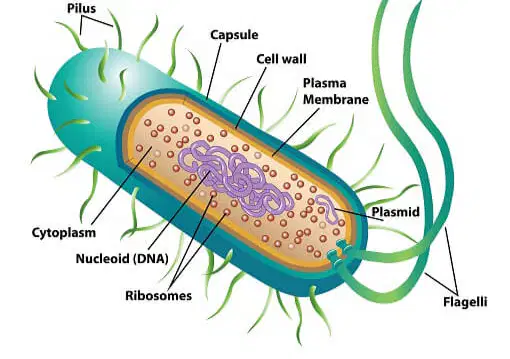
Is this a prokaryotic or eukaryotic cell?
(a)
What is the function of the mitochondria?
site of digestive enzymes
site of ATP (energy) production
site of photosynthesis
site of protein production
a category of classification below a phylum
Kingdom
Phylum
Species
Class
to arrange something into groups according to similarities
Classify
Kingdom
Organize
Family
the largest division used to classify living things
Class
Genus
Domain
Species
Which four kingdoms are eukaryotic?
Archaebacteria, Protist, Plant, Animal
Eubacteria, Fungi, Archaebacteria, Plant
Eubacteria, Fungi, Plant, Animal
Protist, Fungi, Plant, Animal
Which kingdom contains organisms that are able to live in extreme environments?
Eubacteria
Animal
Plant
Archaebacteria
Which kingdom contains organisms with cell walls made of cellulose who are autotrophs and non-motile?
Plant
Eubacteria
Protist
Animal
Which kingdom contains organisms whose cells never have a cell wall and are heterotrophs?
Plant
Archaebacteria
Animal
Fungi
Which kingdom contains organisms that are multicellular autotrophs?
Fungi
Plant
Animal
Archaebacteria
Which kingdom contains organisms that are unicellular, prokaryotic, and could live on a door knob?
Eubacteria
Protist
Archaebacteria
Fungi
Which kingdom would a pond living, unicellular, and eukaryotic organism belong to?
Protist
Animal
Archaebacteria
Plant
Which kingdom does the organism that lives in a hot spring belong to?
Plant
Protist
Animal
Archaebacteria
This tiny organism spends its day reproducing rapidly (about once every 20 minutes), often inside the bodies of other organisms. Its genetic material is not contained inside a nucleus.
Plant
Protist
Eubacteria
Archaebacteria
This very small, thin organism spends its day using its flagellum to propel itself through pond water. If sunlight is available, it can make its own food.
Plant
Eubacteria
Protist
Animal
This organism spends its day attached a hard underwater surface. Water currents flowing through it provide the organism with food and oxygen and remove its wastes. It has no organs, but some of its cells have specialized jobs.
Animal
Protist
Plant
Fungi
This organism spends its day roaming through the forest in search of food. Its hunting techniques require use of its keen sense of smell and hearing.
Plant
Fungi
Protist
Animal
I am eukaryotic and mostly multicellular. Occasionally, I can be unicellular but I cannot make my own food so I absorb nutrients from dead and decaying materials.
Animal
Plant
Protist
Fungi
I am eukaryotic, multicellular, and heterotrophic. Some include coral and others include birds, people, and reptiles.
Plant
Animal
Fungi
Protist
Viruses are considered:
Living
Nonliving
What is the outside protective coating of a virus made of?
lipids
proteins
nucleic acids
carbon
Viruses need a (a) to reproduce.
What happens if a cell is in a lysogenic cycle?
the virus will cause your cell to break open
the virus causes your cell to make copies of itself
the virus will become part of your cells DNA but it hides
all of the options listed
When a virus attaches to a host, what does it inject into the host?
Protein Coat
Capsid
DNA/RNA
Genetic Information
Envelope
The cell membrane is selectively permeable, which means...
All materials can enter and leave the cell
The cell manually sorts through all materials
Certain things can enter while others cannot
Only certain cells can interact with the cell.
Controlling what goes into or out of the cell without energy is called
Active Transport
Passive Transport
Osmosis
Diffusion
What is it called when molecules move across the cell membrane from an area of high concentration to an area of low concentration through a carrier protein?
Diffusion
Active Transport
Osmosis
Facilitated Diffusion
Solutes move against the concentration gradient, therefore energy is needed. This is an example of:
Active Transport
Passive Transport
A balance that an organism maintains by regulating what goes into and out of the cell.
Love
Peace
Happiness
Homeostasis
An animal cell placed in a hypertonic (salty) solution will
Stay the same
Swell - get bigger
Shrink - get smaller
If the volume of a cell increases when it is placed in a solution, that solution is said to be __________ to the cell
hypertonic
isotonic
hypotonic
subatomic

