wayground logo

Free Printable Worksheets

Font size

S
M
L
XL
Worksheets

Quarter 1 Exam Review

Total questions: 45

Worksheet time: 1hrs 17mins

Name
Class
Date
1.

Which (two) of these can cause a magnet to lose its magnetic properties?

a)
High Temperatures
b)
Getting wet
c)
Impacts
d)

Freezing

e)

Breaking in half

2.
What protects the Earth from charged particles from the sun?
a)
Jupiter
b)
Magnetic Field
c)
Earth’s Moon
d)
The oceans
3.

A magnet on your refrigerator drops on the floor. When you put it back on the door, it slides down. What has happened to the strength of the magnet?

a)

It has become stronger

b)

It has become weaker

c)

It has become larger

d)

The strength of the magnet has not changed

4.

Label the set of magnets that will attract each other and repel on another.

5.

Which of the following are common contact forces?

a)

Friction

b)

Buoyancy

c)

Gravitational

d)

Flight

6.

Why are non-contact forces referred to as fundamental forces?

a)

They are essential to the structure of the universe

b)

They are basic and easy to understand

c)

They were the first types of forces we learned about

d)

None of the above

7.

Match the following words to their definitions

a)

force

1.

a push or pull on an object

b)

net force

2.

the combination of all forces acting on an object

c)

normal force

3.

the force that pushed perpendicular to the object's surface

d)

noncontact force

4.

a force that one object applies to another without touching it

e)

contact force

5.

a push or a pull on one object by another that is touching it

8.
The measurement from the crest of one wave to the crest of the next wave is the__________.
a)
Wavelength
b)
Visible spectrum
c)
Frequency
d)
Trough
9.
In what type of wave is the vibration of the particles parallel to the direction in which the wave travels?
a)
Longitudinal Wave
b)
Transverse Wave
c)
Electromagnetic Wave
d)
Short Wave
10.
A rubber duck is floating in the water of a pond as a wave passes by raising the duck up and down. What is considered to the medium in this situation?
a)
The wave
b)
The rubber duck
c)
The water
d)
There is no medium
11.
In what type of wave is the vibration of the particles perpendicular to the direction the waves travel?
a)
Transverse wave
b)
Longitudinal wave
c)
Short wave
d)
Long wave
12.
All waves carry
a)
Light
b)
Sound
c)
Energy
d)
Heat
13.
Sound waves are an example of
a)
Waveform
b)
Electromagnetic waves
c)
Longitudinal waves
d)
Transverse waves
14.
The matter through which some waves travel.
a)
Medium
b)
Frequency
c)
Crest
d)
Trough
15.
A rainbow is often seen when the sun shines after rain. Which property of light does the formation of a rainbow demonstrate?
a)
Light rays get absorbed
b)
Light rays get refracted
c)
Light travels in a straight line
16.
Which parts of the Electromagnetic spectrum can be harmful to humans and other organisms? (Select all that apply)
a)
Ultraviolet Light
b)
Gamma Rays
c)
X-Rays
d)
Microwaves
e)
Radio Waves
17.
How are mechanical waves and electromagnetic waves different?
a)
Mechanical waves require a medium to move, electromagnetic waves do not.
b)
Electromagnetic waves carry energy and mechanical waves do not.
c)
Electromagnetic waves are not harmful to humans and mechanical waves are.
18.
In the image below, which wave has more energy?
a)
Wave A
b)
Wave B
c)
Both waves have the same amount of energy.
19.
What is the order of the electromagnetic spectrum from most to least energetic? (most energy to least energy)
a)
Radio waves, Microwaves, Infrared light, Visible light, Ultraviolet Light, X-rays, Gamma Rays
b)
Microwaves, Visible Light, Infrared light, Radio waves, Gamma Rays, Ultraviolet light, X-Rays.
c)
Gamma Rays, X-Rays, Ultraviolet light, Visible light, Infrared light, Microwaves, Radio Waves
20.

What is the process of creating a current in a circuit by changing a magnetic field?

a)

Electromagnetic induction

b)

Electromagnetism

c)

Magnetism

d)

Domain integrity

21.

What kind of energy transformation takes place in a generator?

a)

Electrical to Mechanical

b)

Mechanical to Electrical

c)

Electrical to Chemical

d)

Mechanical to Chemical

22.

What are the ways to adjust the strength of an electromagnet? (There is more than one correct answer.)

a)

Adjust the size of the iron core

b)

Adjust the number of coils

c)

Adjust the location of the electromagnet

d)

Adjust the amount of power coming from the power source

23.

Which of the following is true about the relationship between electricity and magnetism?

a)

Electricity can be used to create a magnet.

b)

Magnetism and electricity cannot be converted into one another.

c)

Magnetism is based on how gravity attracts electrical energy.

d)

Electrical energy and magnetism cancel each other out.

24.
A _______ is the coiled wire in an electromagnet.
a)
Battery
b)
Iron core
c)
Solenoid
25.

Christopher constructed four electromagnets, each with a different number of coils. He connected each of the electromagnets to a 9-volt battery and counted how many paperclips each magnet could pick up. He recorded his data in the table. Which of the following is a likely explanation of his observations?

a)

Big electromagnets pick up more metal than smaller ones.

b)

The more coils an electromagnet has, the stronger the magnetic field it produces.

c)

Adding coils to an electromagnet increases the number of paper clips it can pick up.

d)

The number of coils that an electromagnet has always determines its strength.

26.

What will occur when a magnet spins within a coil of wire?

a)

The coil becomes a permanent magnet

b)

The coil becomes very cold

c)

Electricity is produced

d)

The magnet will lose its strength

27.
Which law best explains why the coin sitting on top of the ring falls directly into the jar below because it wants to remain at rest?
a)
Newton's Law of Inertia
b)
Newton's Law of F=ma
c)
Newton's Law of Force Pairs
d)
Newton's Law of Science
28.
When a cannon fires a cannonball we observe Newton's third law. Which force is the reaction force?
a)
The cannon moving forward
b)
The cannonball moving forward
c)
The cannon moving backward
d)
The cannonball moving backward
29.

What will be the effect on the boy in the picture if the driver stops quickly?

a)

Because of inertia he will remain in the same position.

b)

He will be pushed back into the car seat.

c)

He will move from one side of the car seat to the other.

d)

He will move forward pressing against the seatbelt.
30.
Newton's First Law of Motion is known as the Law of ________.
a)
Accleration
b)
Velocity
c)
Inertia
d)
Mass
31.
An object at rest will stay at rest and an object in motion will continue in motion, with constant speed and direction, unless acted on by an unbalanced force. Which of the following best describes this statement?
a)
Newton's First Law of Motion
b)
Newton's Second Law of Motion
c)
Newton's Third Law of Motion
32.
When an unbalanced force is applied to an object it, it cause that object to accelerate. Which of the following best describes this statement?
a)
Newton's First Law of Motion
b)
Newton's Second Law of Motion
c)
Newton's Third Law of Motion
33.
When the air is released from a balloon and the balloon flies through the air this is an example of:
a)
Newton's First Law of Motion
b)
Newton's Second Law of Motion
c)
Newton's Third Law of Motion
34.
The gravitational force between two object ___________ as the distance between them increases.
a)
Decreases
b)
Increases
c)
Stays the same
35.
Newton's Second law is best expressed as:
a)
Speed = distance/time
b)
Acceleration = speed/time
c)
Force = mass x acceleration
d)
A = L x W
36.
Every action has an equal and opposite reaction and these pairs are known as ____________________.
a)
Action-reaction pairs
b)
Accleration
c)
Gravity
d)
Weight
e)
Non-contact forces
37.
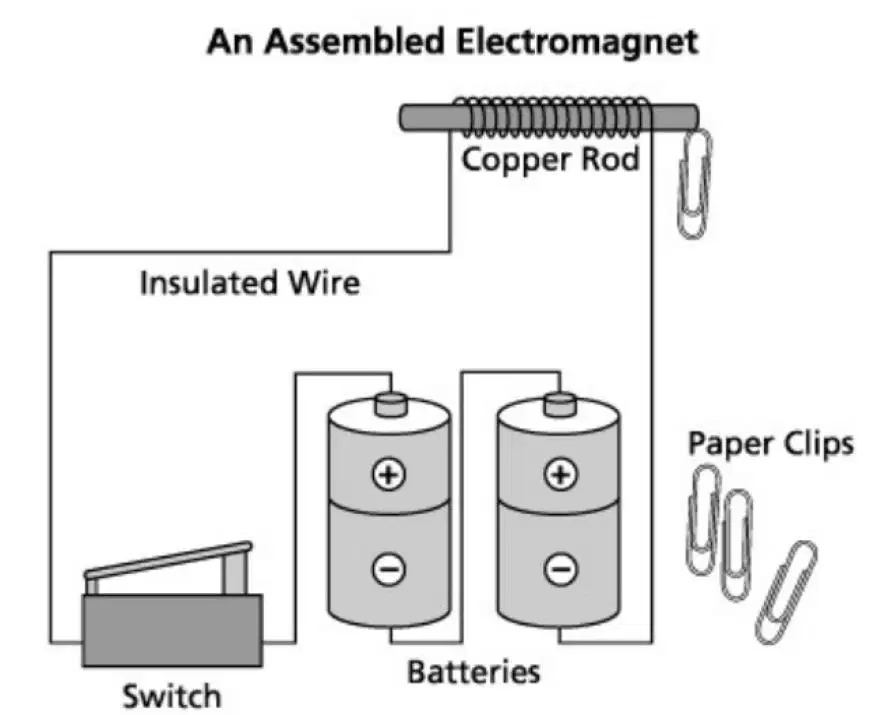
A student made an electromagnet out of common objects. Which change would weaken the electromagnet?
a)
Replace the copper rod with an iron nail.
b)
Remove some of the wire loops around the copper rod.
c)
Connect another battery between the switch and the copper rod.
d)
Use larger paper clips.
38.
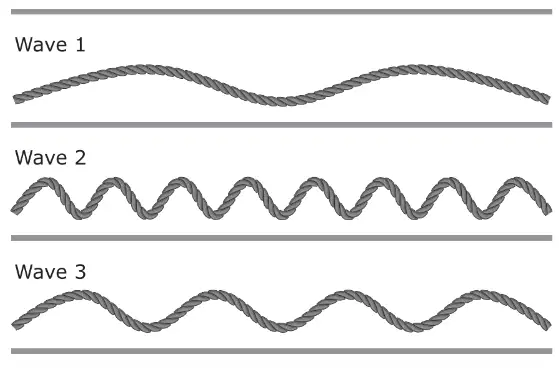
Waves were created on three identical ropes. Of the three waves shown, Wave 2 has the greatest...
a)
waves speed, because it has more crests than the other ropes.
b)
frequency, because it has a larger wavelength than the other ropes.
c)
wave speed, because the rope is moving up and down faster than the other ropes.
d)
frequency, because there are more crests in the same length of rope than there are in the other waves.
39.
A student stands in a school hallway. A wall separates a classroom from the student. The student in the hallway cannot see inside the classroom but hears noises from within the classroom. Which of these best explains why the student hears the noises but cannot see into the classroom?
a)
Sound waves are absorbed by the wall, and visible light waves are transmitted through the wall.
b)

Sound waves are transmitted through the wall, and visible light waves are reflected by the wall.
c)
Sound waves are reflected by the wall, and visible light waves are refracted by the wall.
d)
Sound waves are reflected by the wall, and visible light waves are absorbed by the wall.
40.
Students learned the objects can exert forces on other objects without touching. Which three investigations will provide evidence to support what they have learned?
a)
measuring how close a soda can must be before it rolls toward a balloon that has been rubbed on someone's hair
b)
counting the number of staples that are directly attached to a strong magnet
c)
dropping a rubber ball from a distance of 1.5 meters above the classroom floor
d)
placing a magnet against a jar containing a mixture of iron fillings and sand
e)
measuring how far a toy car travels across the floor before coming to a stop
41.
Gravity is a force that pulls two objects down toward Earth's surface. Which two statements explain why a student standing at the top of a step stool does not move downward?
a)
The students' mass is not large enough to be affected by gravity.
b)
The step stool exerts a force on the student in the opposite direction of gravity.
c)
The student exerts an upward force on the step stool equal to the gravitational force.
d)
The step stool is a barrier that blocks the gravitational force.
e)
The step stool exerts a force on the student equal to the force gravity exerts on the student.
42.
A student has a remote control for a television. The student points the remote at the television and presses a button on the remote labeled Volume. A small red light flashes on the front of the remote. The student observes that the sound from the television becomes lower. Which statement best describes how the remote control communicates with the television to change the volume of the sound?
a)
The remote control sends microwaves toward the television that are absorbed by the front to the television.
b)
The remote control sends low-energy infrared radiation to a light detector on the front of the television.
c)
The remote control sends radio waves in many directions, which bounce off the walls of the room toward the front of the television.
d)
The remote control sends sound waves in many directions, which bounce off the walls of the room toward a vibration detector on the front of the television.
43.
Satellite phones allow messages to be sent from one device to another by sending and receiving signals to and from satellites in space, instead of through cellular towers on land. Which statement correctly explains how waves allow satellite phones to communicate with other satellite phones?
a)
Mechanical waves produce more force than electromagnetic waves, so that mechanical waves are able to enter and exit the atmosphere.
b)
Mechanical waves transfer energy to particles without losing speed, so mechanical waves can communicate with particles in the satellites.
c)
Electromagnetic waves are able to move without a medium to travel through, so electromagnetic waves can travel to satellites and travel back from satellites.
d)
Electromagnetic waves travel faster than mechanical waves do, so that electromagnetic waves can reach satellites in space more quickly than mechanical waves can.
44.
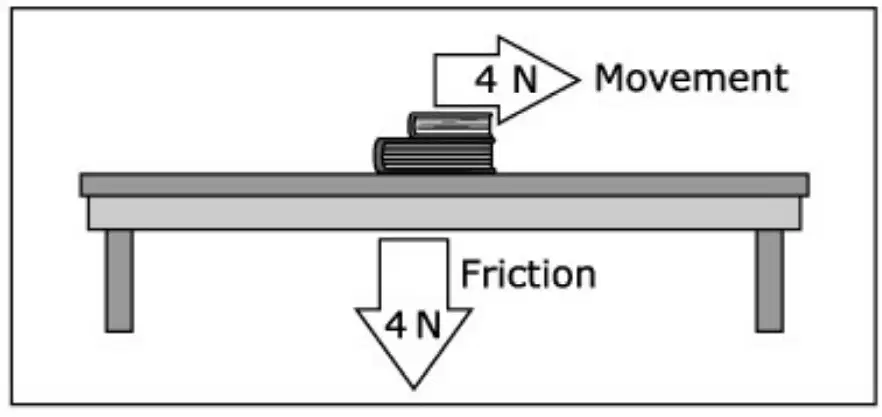
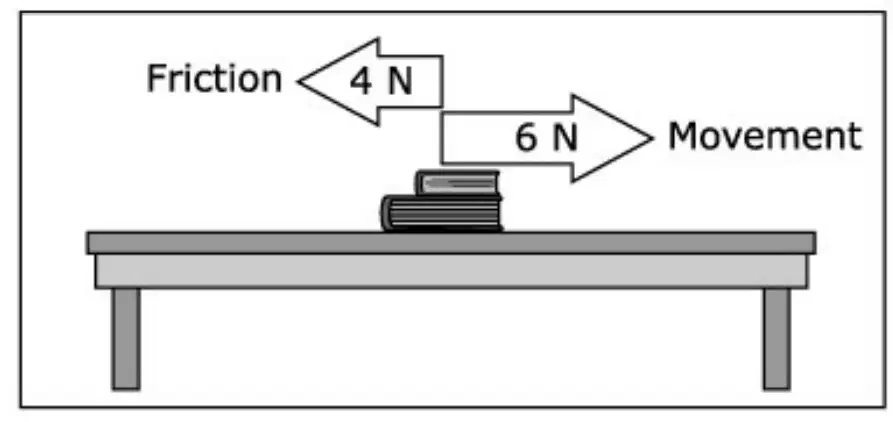
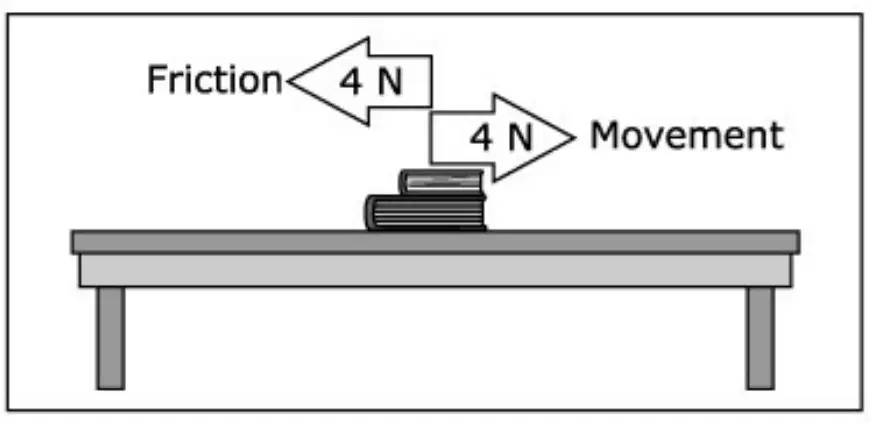
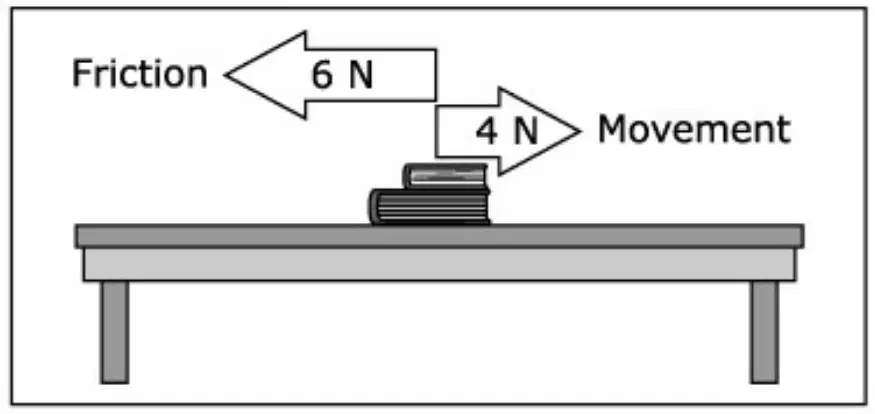
Books are on a table. A student pushes the books to the right side of the table. In which diagram do the arrows show the most likely forces acting on the books as they move to the right?
a)
Option 1
b)
Option 2
c)
Option 3
d)
Option 4
45.
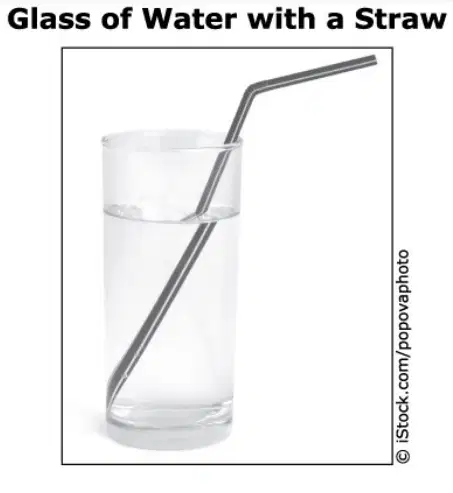
A student places a straw in a glass of water. The student observes that the part of the straw that is outside of the water looks different from the part of the straw that is in the water. Which statement best explains why the part of the straw that is out of the water appears different from the part of the straw that is in the water?
a)
The water causes visible light to reflect slowly, which causes the straw in the water to appear larger.
b)
Light travels through air and water at different speeds, which causes the straw to appear distorted in water.
c)
The water absorbs visible light, which causes the straw to appear in a different position than it does out of the water.
d)
Light is affected by the temperature difference between the air and water, which causes the straw to appear distorted in water.