
 Worksheets
Ch 2 Review
Total questions: 30
Worksheet time: 30mins
If M is the midpoint of AB, then AM = MB. Which of the following "reasons" fits for the statement?
Addition Property of Equality
Def. of Midpoint
Reflexive Property of Equality
Symmetric
If A = B, then 8A = 8B Which of the following "reasons" fits for the statement?
Multiplication Prop of Equality
Division Prop of Equality
Reflexive Prop of Equality
Addition Prop of Equality
If angle1 and angle2 are complementary, then m<1 + m<2 = 90
Addition Prop of Equality
Subtraction Prop of Equality
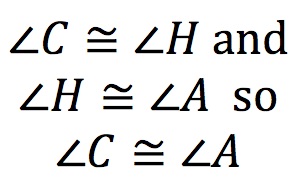
Reflexive Prop.
If PQ = RS then RS = PQ
Reflexive Property
Transitive Property
Symmetric Property
Distributive Property
What does this symbol mean: p → q
Conditional
Inverse
Converse
Contrapositive
Biconditional
What does this symbol mean: ∼p → ∼q
Conditional
Inverse
Converse
Contrapositive
Biconditional
What does this symbol mean: p ↔ q
Conditional
Inverse
Converse
Contrapositive
Biconditional
What does this symbol mean: ∼q → ∼p
Conditional
Inverse
Converse
Contrapositve
Biconditional
What does this symbol mean: q → p
Conditional
Inverse
Converse
Contrapositive
Biconditional
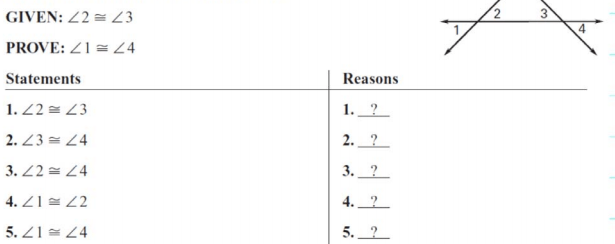
What is the Addition property of equality


Which of the following is the CONVERSE of the statement below?
If an object is a ring, then it is
made of gold.
If an object is made of gold, then it is a ring.
If an object is not a ring, then it is not made of god.
If an object is not made of gold, then it is not a ring.
There is no converse of the statement.
Which of the following is the INVERSE of the statement below?
If an object is a computer, then it
has a hard drive.
If an object is not a computer, then it does not have a hard drive.
If an object does not have a hard drive, then it is not a computer.
If an object has a hard drive, then it is a computer.
There is no inverse of the statement.

Which of the following is the CONTRAPOSITIVE of the statement below?
If a species walks on two feet, then
it is human.
If a species is not human, then it does not walk on two feet.
If a species is human, then it walks on two feet.
If a species does not walk on two feet, then it is not human.
There is no contrapositive of the statement.
Which of the following is the BICONDITIONAL of the statement below?
If there is lightning, then there is thunder.
If there is not lightning, then there is not thunder.
If there is thunder, then there is lightning.
There is lightning if and only if there is thunder.
There is no biconditional statement.
If the conditional statement was "If an angle is acute, then it has a measure less than 90°.", which type of statement is the following?
If an angle does not have a measure less than 90°, then it is not acute.
Contrapositive
Converse
Biconditional
Inverse
If the conditional statement was "If an angle is acute, then it has a measure less than 90°.", which type of statement is the following?
If an angle has a measure less than 90°, then it is acute.
Converse
Contrapositive
Biconditional
Inverse
If the conditional statement was "If an angle is acute, then it has a measure less than 90°.", which type of statement is the following?
If an angle is not acute, then it does not have a measure less than 90°.
Inverse
Contrapositive
Biconditional
Converse


Which property of real numbers was used to get from Step 3 to Step 4?
Addition Property of Equality
Subtraction Property of Equality
Symmetric Property
Substitution Property

