
 Worksheets
Bonding and Structure Quiz
Total questions: 20
Worksheet time: 10mins
Which type of bonding occurs between metals and non-metals?
Ionic Bonding
Covalent Bonding
Metallic Bonding
Van der Waals Forces
What is the example of an ionic compound?
Oxygen
Water
Sodium chloride
Graphite
Which type of bonding occurs between non-metal atoms?
Ionic Bonding
Covalent Bonding
Metallic Bonding
Dipole-Dipole Interactions
What is the example of a simple molecular substance?
Oxygen
Sodium chloride
Diamond
Iron
What is the structure of ionic compounds?
Giant ionic lattice
Small molecules
Giant covalent structures
Regular lattice structure
What is the structure of simple molecular substances?
Giant ionic lattice
Small molecules
Giant covalent structures
Regular lattice structure
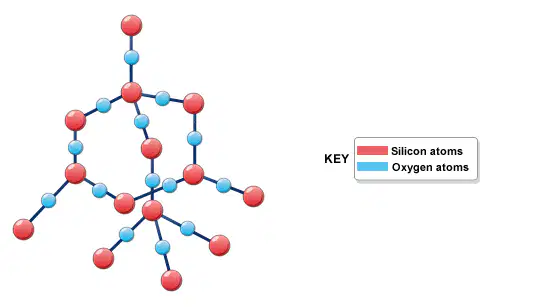
What is the structure of silicone dioxide?
Giant ionic lattice
Small molecules
Giant covalent structure
Regular lattice structure
What is the structure of metals?
Giant ionic lattice
Small molecules
Giant covalent structures
Regular lattice structure
Which type of molecules have an uneven distribution of electron density?
Polar Molecules
Non-Polar Molecules
Van der Waals Forces
Hydrogen Bonding
What is the example of a polar molecule?
Oxygen
Water
Sodium chloride
Graphite
Which intermolecular force is the weakest?
Van der Waals Forces
Dipole-Dipole Interactions
Hydrogen Bonding
Ionic Bonding
Which intermolecular force occurs between polar molecules?
Van der Waals Forces
Dipole-Dipole Interactions
Hydrogen Bonding
Ionic Bonding
Which intermolecular force is the strongest?
Van der Waals Forces
Dipole-Dipole Interactions
Hydrogen Bonding
Ionic Bonding
What are ionic compounds used for?
Table salt, tiles, and bricks
Water, oxygen supply, and diamond cutting tools
Construction, wiring, and machinery
None of the above
What are covalent compounds used for?
Table salt, tiles, and bricks
Water, oxygen supply, and diamond cutting tools
Construction, wiring, and machinery
None of the above
What is the primary type of bonding in organic compounds?
Ionic Bonding
Covalent Bonding
Metallic Bonding
Van der Waals Forces
What is the example of a giant covalent structure?
Water
Sodium chloride
Diamond
Iron
Which type of molecules have an even distribution of electron density?
Polar Molecules
Non-Polar Molecules
Van der Waals Forces
Hydrogen Bonding
What is the primary type of bonding in diamond?
Van der Waals Forces
Dipole-Dipole Interactions
Hydrogen Bonding
Covalent Bonding
Which of the following is not a property of ionic compounds?
High melting and boiling points
Conduct electricity when dissolved in water
Usually soluble in water
Conduct electricity in solid state

