wayground logo

Free Printable Worksheets

NEW

Font size

S
M
L
XL
Worksheets

Atoms, Molecules, Phase Changes, and Density

Total questions: 38

Worksheet time: 43mins

Name
Class
Date
1.

The phase of matter with a definite volume but no definite shape is a

a)
solid
b)
liquid
c)
gas
2.

The phase of matter with a definite shape and definite volume is a

a)

solid

b)

liquid

c)

gas

3.

Gases have ...

a)

a definite shape and definite volume

b)

no definite shape and no definite volume

c)

a definite shape and no definite volume

4.

The phase of matter in which the atoms are moving freely and are very far apart

a)

solid

b)

liquid

c)

gas

5.
What best describes the motion of atoms in a solid? 
a)
vibrating slowly in place
b)
sliding past each other
c)
moving rapidly in all directions
6.

What best describes the motion of molecules in a liquid? 

a)
vibrating slowly in place
b)

flowing past each other

c)

moving freely in all directions

7.
Adding heat energy causes the atoms to...
a)
move slower
b)
move faster
c)
get bigger
d)
get smaller
8.

Removing energy (cooling) causes the atoms to

a)

spread apart

b)

move closer together

c)

get larger

d)

get smaller

9.
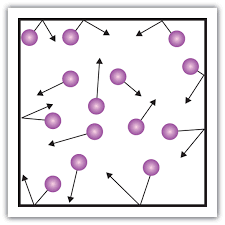
Which phase of matter is represented by the atoms in this diagram? 
a)
solid
b)
liquid
c)
gas
10.
Which phase of matter is represented by the atoms in this diagram? 
a)
solid
b)
liquid
c)
gas
11.

The water droplets on the outside of this glass of water is showing the following phase change

a)
melting
b)
evaporation
c)
freezing 
d)
condensation
12.
The water leaving the ocean in the water cycle is representing this phase change
a)
melting
b)
evaporation
c)
freezing 
d)
condensation
13.

What phase change is represented by the dry ice in this picture- which changes from a solid to a gas?

a)

evaporation

b)

condensation

c)

sublimation

d)

melting

14.
What two phase changes require heat energy to be absorbed?  
a)
melting and freezing
b)
melting and boiling
c)
freezing and boiling
d)
freezing and condensation
15.

What phase change occurs due to losing heat energy?

a)
melting
b)

freezing

c)
evaporation
d)
boiling
16.

Three containers with the same amount of the same material are shown below. Which container has the substance with the highest amount of energy?

a)

The container on the left

b)

The middle container

c)

The container on the right

d)

All have an equal amount of energy

17.

What state of matter?

a)

Solid

b)

Liquid

c)

Gas

18.

What is the phase change of a solid to a liquid?

a)

freezing

b)

melting

c)

boiling

d)

condensation

19.

Change from Liquid to Solid is called ...

a)

fusion

b)

Freezing

c)

sublimation

d)

evaporation

20.

Three containers with the same amount of the same material are shown below. Which container has the substance with the lowest amount of energy?

a)

The container on the left

b)

The middle container

c)

The container on the right

d)

All have an equal amount of energy

21.
Which liquid has the greatest density?
a)
lamp oil
b)
karo syrup
c)
water
d)
honey
22.
A pure substance containing only one kind of atom.
a)
element
b)
mixture
c)
compound
23.
What is matter?
a)
Any subtance that doesn't take up space or have mass.
b)
Any substance that takes up space or have mass.
c)
Any substance that exists on Earth.
d)
Any substance that exists in space.
24.
What is the formula for density?
a)
density = mass x volume
b)
density = mass / volume
c)
density = mass + volume
d)
density = mass - volume
25.
Frank has an eraser. It has a mass of 4g, and a volume of 2cm3. What is its density?
a)
8 g/cm3
b)
2 g/cm3
c)
1/2 g/cm3
d)
24 g/cm3
26.
If an object has a density of .6 g/mL and you put it into water, will it sink or float?  
a)
sink
b)
float
27.
I have two objects with the same volume but different masses.  Which object will be more dense?
a)
The object with less weight.
b)
The object with more weight.
c)
The object with more mass.
d)
The object with less mass.
28.

What happens to air molecules when they are heated?

a)

they come together

b)

they seperate

c)

they don't move

d)

they stay the same.

29.

What happens to air molecules when they are cooled?

a)

They spread apart

b)

they become compacted

c)

they stay the same

d)

they move quickly

30.

Warm air is _____ dense than cool air.

a)

more

b)

less

c)

the same

31.
What are the basic building blocks for all matter?
a)
atoms
b)
elements
c)
compounds
d)
chemicals
32.
What do we call a substance consisting of a single atom?
a)
coefficient
b)
element
c)
compound
d)
molecule
33.
All ____________ are made up of two or more atoms bonded together.
a)
atoms
b)
molecules
c)
electrons
d)
elements
34.
2H2O
This number tells how many molecules are in a chemical equation.
a)
coefficient
b)
subscript
c)
compound
d)
element
35.
H2O2← ?
This number tells the number of atoms present.
a)
coefficient
b)
molecule
c)
subscript
d)
atom
36.
 2H2O
How many Hydrogen atoms are present?
a)
2
b)
4
c)
1
d)
10
37.
2H2O
How many Oxygen atoms are present?
a)
2
b)
4
c)
1
d)
5
38.
2H2O
How many H2O molecules are present?
a)
1
b)
4
c)
2
d)
8