
Font size
 Worksheets
Energy and Matter in Ecosystems
Total questions: 20
Worksheet time: 12mins
Which of the following is the most important element of life because it makes up important molecules like glucose (the sugar that producers make as food)?
nitrogen
carbon
helium
phosphorus
Which kind of organism is an autotroph?
consumer
producer
decomposer
herbivore
Select all organisms that are heterotrophs.
decomposers
producers
herbivores
carnivores
Mushrooms release chemicals to break down organic matter and absorb the energy contained in it. Which two terms best describe mushrooms?
saprotrophs
producers
scavengers
decomposers
Which of the following best describes the shape of ecological pyramids?
Biomass pyramids are always upright, but energy pyramids are inverted.
Energy pyramids are always upright, but biomass pyramids can be inverted.
All ecological pyramids are always upright.
All ecological pyramids are always inverted.

Which organism is an omnivore in the food web shown?
bivalves
bald eagle
wading birds
phytoplankton

What might happen to the organisms in the food web below if the number of phytoplankton and vegetation drastically decreased?
The small fish and wading birds would be affected.
Only the small fish would be affected.
Only the osprey and bald eagle would be affected.
The entire food web would be affected.
Energy in the primary consumer level comes directly from which trophic level?
decomposer
tertiary consumer
secondary consumer
producer
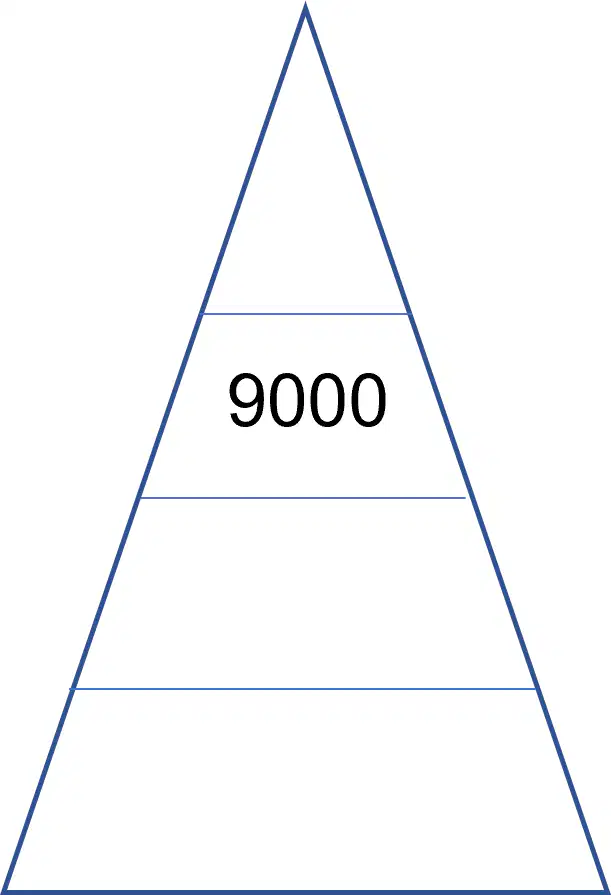
If there were 9000 kcal/m2/yr available in the trophic level shown in the image, how many kcal/m2/yr are predicted to be in the primary consumer level?
900
90
900,000

Calculate the percentage of energy transferred (units are kcal/m2/yr) from the secondary consumer level to the tertiary consumer level. (make your answer a whole number with % sign)
(a)
Which of the following best describes where producers get their energy?
All producers get their energy from the sun, there is no other source of energy for producers.
Most producers get their energy from the sun, but some can get energy from chemical compounds.
Most producers get their energy from chemical compounds, but some can get energy from the sun.
Producers get all their energy from decomposers.
Which of the following is true about the energy transfer in ecosystems?
On average, 10% of energy in one trophic level is passed to the next higher trophic level, most of the rest is lost as waste.
On average, 10% of energy in one trophic level is passed to the next lower trophic level, most of the rest is lost as heat.
On average, 10% of energy in one trophic level is passed to the next higher trophic level, most of the rest is lost as heat.
On average, 10% of energy in one trophic level is passed to the next lower trophic level, most of the rest is lost as waste.
Which organisms play the largest role in converting nitrogen gas into various usable forms and back to a gas form?
fungi
bacteria
plants
worms
What happens to carbon during the process of photosynthesis?
CO2 is released by plants into the atmosphere
CO2 from soil (geosphere) is taken up by plant roots
CO2 from the atmosphere is taken up by plants
carbon atoms from the sun are given to plants
All the land masses on Earth (soil, rocks, etc.) are known collectively as the...
hydrosphere
biosphere
atmosphere
geosphere
Which gas is most abundant in the atmosphere?
carbon dioxide
methane
nitrous oxide
nitrogen gas
Within the Nitrogen Cycle, ______________ releases nitrogen from dead organisms, while _________ converts nitrogen from the soil (or water) back into the atmosphere as nitrogen gas.
decomposition, denitrification
denitrification, decomposition
assimilation, decomposition
denitrification, assimilation
Which of the following describes a possible movement of nitrogen between reservoirs in the process of assimilation?
from the soil (geosphere) into plants
from the air (atmosphere) into plants
from the air (atmosphere) into soil (geosphere)
from the soil (geosphere) into animals
The process by which plants release water vapor into the atmosphere is...
evaporation
transpiration
condensation
precipitation
___________ model multiple paths of energy flow in an ecosystem, while ___________ model a single path.
trophic level, biogeochemical cycles
biogeochemical cycles, trophic level
food webs, food chains
food chains, food webs

