wayground logo

Free Printable Worksheets

Font size

S
M
L
XL
Worksheets

Evolution & Classification 2022-23

Total questions: 20

Worksheet time: 15mins

Name
Class
Date
1.
Which statement is true?
a)
Species with similar evolutionary histories are not classified together.
b)
Species with different evolutionary histories are classified more closely together.
c)
Species with similar evolutionary histories are classified more closely together.
d)
Species with similar evolutionary histories are classified in the same species.
2.
To determine whether two organisms are related, scientists may compare the ___________ of their cells.
a)
size
b)
nucleic acids
c)
shape
d)
number
3.
____________________ is the process by which individuals that are better adapted to their environment are more likely to survive.
a)
evolution
b)
natural selection
c)
branching tree diagram
d)
convergent evolution
4.
A(n) ____________ is usually a homologous structure that is shared by all organisms in a group.
a)
cell
b)
species
c)
branching tree diagram
d)
shared derived characteristic
5.
The theory of evolution was proposed by
a)
Carolus Linneus
b)
Albert Einstein
c)
Charles Darwin
d)
Darlis Charwin
6.
If two species have very similar structures, they may have evolved from
a)
the same parent
b)
a common ancestor
c)
a branching tree diagram
d)
similar offspring
7.
Branching tree diagrams tell you the order in which a specific set of characteristics may have evolved.
a)
True
b)
False
8.
Similar looking organisms that are NOT related are an example of
a)
natural selection
b)
convergent evolution
c)
divergent evolution
d)
common ancestor
9.
Two groups of organisms with similar characteristics may share
a)
a common ancestor
b)
an evolutionary history
c)
both a common ancestor and evolutionary history
d)
neither a common ancestor and evolutionary history
10.
Of the following, the best definition of evolution is
a)
a rapid change in species over time
b)
the adaptation of an organism to its environment
c)
the ability of an organism to survive and reproduce
d)
a gradual change in a species over time
11.

What do you call the traits shown on branching tree diagrams, such as "four limbs" or "amniotic egg"?

a)

shared derived characteristics

b)

Speedy Lambofeeties

c)

Branching elements

d)

Harmonious changes

12.

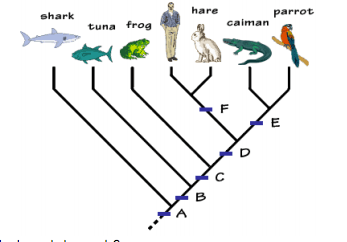
Based on the diagram, which organism has egg shells?

a)

Fish

b)

Amphibians

c)

Rodents

d)

reptiles

13.

True or False: Amphibians likely evolved before reptiles.

a)

True

b)

False

14.

Who is most closely related to Taxidea taxus?

a)

Lutra lutra

b)

Panthera pardus

c)

Canis latrans

d)

Canis lupus

15.
Two organisms that are closely related would have
a)
very similar DNA sequence
b)
exactly the same DNA sequences
c)
no proteins in common
d)
completely different DNA sequence
16.

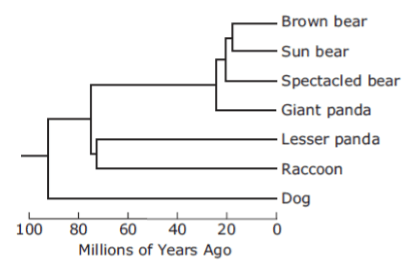
Which organism is the most distantly related to all the others?

a)

Raccoon

b)

Dog

c)

Giant Panda

d)

Sun Bear

17.

On the diagram, which organism is the closest relative of the parrot?

a)

Frog

b)

Hare

c)

Caiman

d)

Parrot

18.

Which of these animals does not have/produce an amniotic egg?

a)

Turtle

b)

Leopard

c)

Lamprey

d)

All three of these animals produce the amniotic egg

19.
The diagram below shows a phylogenetic tree for animals. Which two groups of organisms have the most genetic similarities?
a)
Mollusks and Roundworms
b)
Mollusks and Arthropods
c)
Echinoderms and Chordates
d)
Sponges and Flatworms
20.

Who is the closest relative to the brown bear?

a)

Giant panda

b)

Dog

c)

Lesser panda

d)

Sun bear