
 Worksheets
Cell Organelles and Transport
Total questions: 10
Worksheet time: 5mins
Name
Class
Date
1.
Which of the following structures is not found in a prokaryotic cell?
a)
Ribosomes
b)
Circular plasmid DNA
c)
Membrane bound organelles (nucleus, etc.)
d)
Cytoplasm
2.
What are four things that all cells contain?
a)
nucleus, ribosomes, cytoplasm, and DNA
b)
ribosomes, cytoplasm, DNA, and cell membrane
c)
cell wall, cytoplasm, ribosomes, and flagella
d)
cell membrane, RNA, cytoplasm, and ribosomes
3.
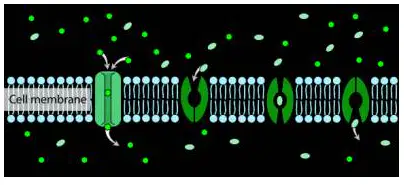
The cell is taking in substances through membrane proteins, without any energy expenditure of its own. The substances naturally follow their concentration gradient. However, they must go through the protein channels, because they are too large to squeeze through the cell membrane. This process is called
a)
osmosis
b)
endocytosis
c)
active transport
d)
facilitated diffusion
4.
Water moves into a cell when it is placed in a ________________solution because there is a low solute concentration and a high water concentration.
a)
isotonic
b)
hypertonic
c)
hypotonic
d)
osmotic
5.
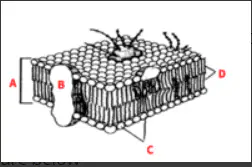
Which part of the bilayer in the image is hydrophobic?
a)
phosphate heads
b)
fatty acid tails
c)
phosphate tails
d)
protein
6.
When a cell forms a vesicle around unwanted particle and releases it OUT of the cell.
a)
endocytosis
b)
exocytosis
c)
receptor-mediated
d)
passive transport
7.
Large numbers of ribosomes are present in cells that specialize in producing which of the following molecules?
a)
lipids
b)
glycogen
c)
proteins
d)
cellouse
e)
nucleic acids
8.
If a solution is hypertonic, where will the water move?
a)
Into the cell
b)
out of the cell
9.
A patient is rushed to the hospital with severe symptoms of dehydration. A new ER nurse immediately hooks up an IV of distilled water to rehydrate the patient. Which of these would most likely occur to their red blood cells? (Remember that your body has small amounts of salt in your cells, hint hint!)
a)
Water would rush into the red blood cells, causing them to swell and possibly burst.
b)
Water would rush into the red blood cells, causing them to shrivel and become unable to transport oxygen.
c)
Water would rush out of the red blood cells, causing them to swell and possibly burst
d)
Water would rush out of the red blood cells, causing them to shrivel and become unable to transport oxygen.
10.
Which plant cell organelle is the MAIN structure that helps maintain the shape of the cell by helping to maintain turgor pressure as water moves in and out of the cell?
a)
cell membrane
b)
nucleus
c)
vacuole
d)
cytoskeleton
100 %

