Wayground logo

Free Printable Worksheets

Font size

S
M
L
XL
Worksheets

Geometry Mod 2 Review

Total questions: 88

Worksheet time: 3hrs 14mins

Name
Class
Date
1.
What are vertical angles?
a)
Angles that are adjacent to each other
b)
Angles that add up to 180°
c)
Angles that are opposite of each other when lines intersect
d)
Angles that add up to 90°
2.
What are vertical angles?
a)
Angles that are adjacent to each other
b)
Angles that add up to 180°
c)
Angles that are opposite of each other when lines intersect
d)
Angles that add up to 90°
3.
Which are pairs of vertical angles?
a)
∠COB & ∠COA
b)
∠AOD & ∠AOC
c)
∠COB & ∠AOD
d)
∠BOD & ∠AOD
4.
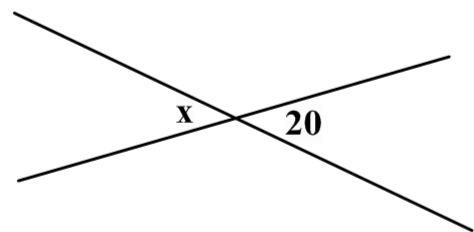
Find the missing angle.  Find x.
a)
20o
b)
70o
c)
160o
d)
180o
5.
Vertical angles are always
a)
acute
b)
total 180 degrees
c)
congruent (equal measures)
d)
adjacent angles
6.
If m∠1 = 30°, then m∠3 = 
a)
30°
b)
60°
c)
150°
d)
undetermined
7.
What is the value of x?
a)
37
b)
72
c)
108
d)
18
8.
Find the value of x.
a)
14
b)
60
c)
35
d)
180
9.

What are supplementary angles?

a)

Angles that add up to 180°

b)

Angles that add up to 90°

c)

Angles that are equal to each other

d)

Angles that are opposite of each other when lines intersect

10.
Find what the value of x.
a)
118
b)
108
c)
28
d)
58
11.
a)
15
b)
16
c)
18
d)
19
12.
Find the value of r
a)
46
b)
44
c)
43
d)
47
13.
Find the value of x
a)
16
b)
8
c)
32.8
d)
39.2
14.
Find the value of t
a)
-1
b)
5
c)
5.14
d)
7
15.
Name a pair of angles that form a linear pair.
a)
Angles 1 and 2
b)
Angles 2 and 4
c)
Angles 5 and 8
d)
Angles 9 and 10
16.
Name a pair of angles that are vertical.
a)
Angles 4 and 5
b)
Angles 7 and 9
c)
Angles 8 and 9
d)
Angles 5 and 7
17.
Two angles added together to produce 90 degrees
a)
Supplementary
b)
Complementary
c)
Right
d)
Vertical
18.
Find the missing angle.
a)
60
b)
70
c)
50
d)
140
19.
What type of angle is this? 
a)
acute
b)
obtuse
c)
right
20.
These angles are...
a)
Complementary
b)
Supplementary
c)
Neither
21.
These angles are...
a)
Complementary
b)
Supplementary
c)
Neither
22.
Find the missing angle.
a)
47
b)
37
c)
57
d)
137
23.
What kind of angles are shown?(45 + 135 = 180)
a)
complementary
b)
supplementary
c)
adjacent
d)
corresponding
24.
What type of angle is shown? (Less than 90 degrees)
a)
acute
b)
obtuse
c)
right
d)
straight
25.
∠1 and ∠3 can best be described as - (opposite angles formed by intersecting lines.)
a)
complementary angles
b)
supplementary angles
c)
vertical angles
d)
adjacent angles
26.
complementary, supplementary, or neither?
a)
Complementary
b)
Supplementary
c)
Neither
27.
complementary, supplementary, or neither?
a)
Complementary
b)
Supplementary
c)
Neither
28.
What is the measure of the missing angle?
a)
76
b)
66
c)
156
d)
154
29.
Solve
a)
50°
b)
58°
c)
115°
d)
226°
30.
Solve for x
a)
x = 77
b)
x = 7.5
c)
x = 8
d)
x = 18
31.
Angle JHG measures 161.
a)
m∠GHK=80.5, 
m∠KHJ=161
b)
m∠GHK=161, 
m∠KHJ=80.5
c)
m∠GHK=80.5, 
m∠KHJ=80.5
d)
m∠GHK=161, 
m∠KHJ=161
32.
Find HG.
a)
8
b)
9
c)
10
d)
11
33.
Find the value of ∠A.
a)
25 degrees
b)
30  degrees
c)
35 degrees
d)
90 degrees
34.
Find the value of ∠A.
a)
39 degrees
b)
49 degrees
c)
51 degrees
d)
59 degrees
35.
a)

12

b)

62

c)

35

d)

9

36.
RS is the segment bisector.  If OQ = 32 and PO = 4x, what does x equal?
a)
8
b)
28
c)
128
d)
36
37.
A single angle that measures between 0 and 90 degrees.
a)
Obtuse Angle
b)
Acute Angle
c)
Right Angle
d)
Adjacent Angles
38.
A single angle that measures between 90 and 180 degrees.
a)
Obtuse Angle
b)
Acute Angle
c)
Right Angle
d)
Linear Pair
39.
What type of angles are <1 and <2?
a)
Linear Pair
b)
Supplementary Angles
c)
Adjacent Angles
d)
All of these
40.
A single angle that measures exactly 90 degrees.
a)
Obtuse Angle
b)
Acute Angle
c)
Right Angle
d)
Supplementary Angles
41.
What type of angles are <1 and <2?
a)
Supplementary Angles
b)
Linear Pair
c)
Adjacent Angles
d)
Vertical Angles
42.
Name the angle with three arcs
a)
< FIE
b)
< IER
c)
< FIR
d)
< REF
43.
What is a ray?
a)
A part of a line that is straight, has 1 endpoint, and continues in 1 direction
b)
Another name for line segment
c)
A straight path that continues in both directions and does not end
d)
Points that are used to show segments of lines
44.
What is a line?
a)
An exact position or location
b)
A straight path that continues in both directions and does not end
c)
A straight path that has 2 endpoints
d)
A straight path that has only 1 endpoint
45.
Let B be between A and C.
a)
28
b)
4
c)
16
d)
12
46.
Find AB
a)
3
b)
4
c)
5
d)
2
47.
Given that R is between S and T.
RS=6, TR=4.5, TS= ______
a)
1.5
b)
10.5
c)
6
d)
4.5
48.
D is the midpoint of EF.
ED = 4x + 6
DF = 7x -9
 Find EF.
a)
5
b)
26
c)
52
d)
22
49.

​ (a)   : If two angles are right angles, then they are congruent.

​ (b)   : If two angles form a linear pair, then they are supplementary.

​ (c)   : If E is in ∠ABC, then m∠ABE+m∠EBC=m∠ABCIf\ E\ is\ in\ \angle ABC,\ then\ m\angle ABE+m\angle EBC=m\angle ABC

​ (d)   : Angles that have the same measure

​ (e)   : A ray that divides an angle into two congruent angles

Choose from the below words
Right Angle Postulate
Linear Pair Postulate
Angle Addition Postulate
Definition of Congruent Angles
Definition of Angle Bisector
50.

​ (a)   : If B is on AC‾, then AB+BC=ACIf\ B\ is\ on\ \overline{AC},\ then\ AB+BC=AC

​ (b)   : AB=ABAB=AB

​ (c)   : If AB=BC, then BC=ABIf\ AB=BC,\ then\ BC=AB

​ (d)   : If AB=BC and BC=CD, then AB=CDIf\ AB=BC\ and\ BC=CD,\ then\ AB=CD

​ (e)   : If K is the midpoint of JL‾, then JK‾=KL‾If\ K\ is\ the\ midpoint\ of\ \overline{JL},\ then\ \overline{JK}=\overline{KL}

Choose from the below words
Segment Addition Postulate
Reflexive Property of Equality
Symmetric Property of Equality
Transitive Property of Equality
Definition of Midpoint
51.

​ (a)   : a(b+c)=ab+aca\left(b+c\right)=ab+ac

​ (b)   : If a−2=7, then a=9If\ a-2=7,\ then\ a=9

​ (c)   : If a3=7, then a=21If\ \frac{a}{3}=7,\ then\ a=21

​ (d)   : If a+6=13, then a=7If\ a+6=13,\ then\ a=7

​ (e)   : If 4a=24, then a=6If\ 4a=24,\ then\ a=6

Choose from the below words
Distributive Property
Addition Property of Equality
Subtraction Property of Equality
Division Property of Equality
Multiplication Property of Equality
52.

What is the property?

a)

Definition of congruence

b)

Reflexive Property of Congruence

c)

Segment Addition Postulate

d)

Definition of Midpoint

53.

What is the property?

a)

Congruent Complements Theorem

b)

Definition of Perpendicular

c)

Definition of a Right Angle

d)

Definition of Complementary Angles

54.

What is the justification?

a)

Definition of Congruence

b)

Definition of Perpendicular

c)

Definition of Complementary Angles

d)

Definition of a Right Angle

55.
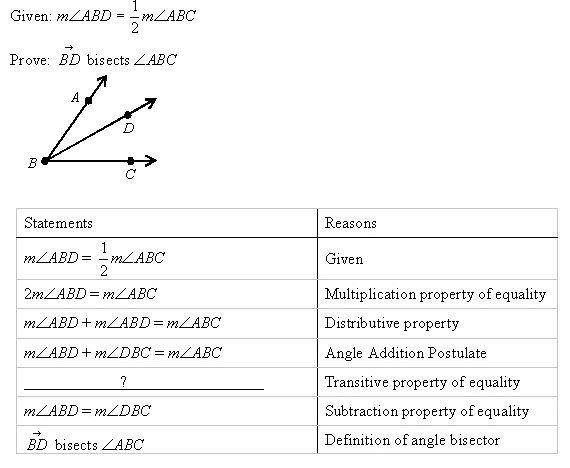
What is the missing statement in the proof?
a)
2m∠ABD=m∠ABD+m∠ABD
b)
m∠ABD=m∠DBC
c)
m∠ABC=m∠ABC
d)
m∠ABD+m∠ABD=m∠ABD+m∠DBC
56.
Step 2 is what
a)
Substitution property (simplify)
b)
Multiplication property of equality
c)
Division property of equality
d)
Distributive Property
57.

What is step 3

a)

Addition property of equality

b)

Combine Like Terms (simplify)

c)

Subtraction property of equality

58.

What is the Definition of Congruent Segments?

a)

If two segments are congruent, then they have equal lengths.

b)

If two lines are perpendicular, then they intersect to form right angles.

c)

If C is between A and B, then AC + CB = AB.

d)

A geometric figure that divides a segment at the midpoint.

59.

What is the Definition of Segment Bisector?

a)

If two segments are congruent, then they have equal lengths.

b)

A geometric figure that divides a segment at the midpoint.

c)

If two lines are perpendicular, then they intersect to form right angles.

d)

If C is between A and B, then AC + CB = AB.

60.

What is the definition of an angle bisector?

a)

A line that divides an angle in to two congruent angles.

b)
A line that cuts an angle into two unequal parts
c)
A line that is perpendicular to the angle
61.

What is the definition of a complementary angle?

a)
Angles that add up to 90 degrees
b)
Angles that add up to 180 degrees
c)
Angles that are equal
d)
Angles that are opposite to each other
62.

What is the definition of supplemenatry angles?

a)
Angles that add up to 90 degrees
b)
Angles that are opposite each other
c)
Angles that add up to 180 degrees
d)
Angles that are adjacent to each other
63.

Reflexive Property of Equality

a)

For any real number a, a = a

b)

If a = b, then a - c = b - c

c)

If a = b, then a · c = b · c

d)

If a = b, then (a/c) = (b/c)

64.

Symmetric Property of Equality

a)

If a = b, then b = a

b)

If a = b, then a - c = b - c

c)

If a = b, then a · c = b · c

d)

If a = b, then (a/c) = (b/c)

65.

Transitive Property of Congruence

a)

If A ≅ B and B ≅ C, then A ≅ C

b)

If A ≅ B, then B ≅ A

c)

If A ≅ B, then A ≅ C

d)

If A ≅ B, then B ≅ C

66.
What is always the 1st statement in reason column of a proof?
a)
Prove
b)
Given
c)
Reason
d)
Statement
67.
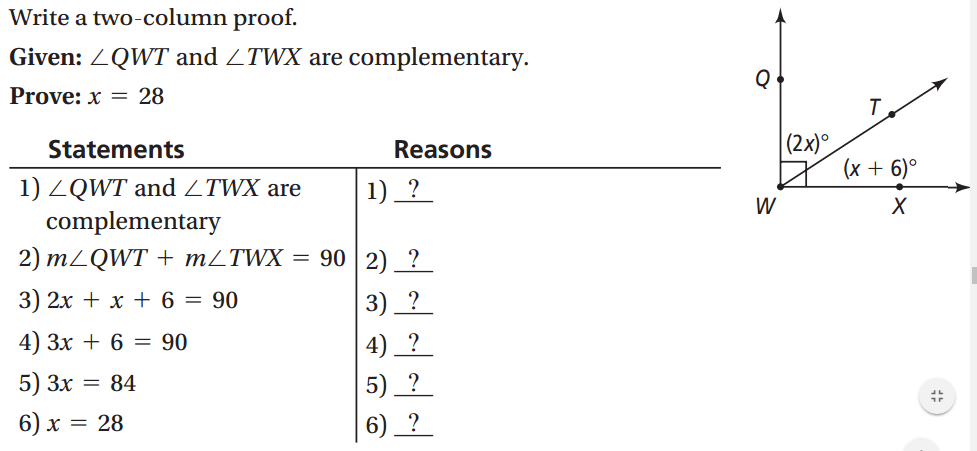
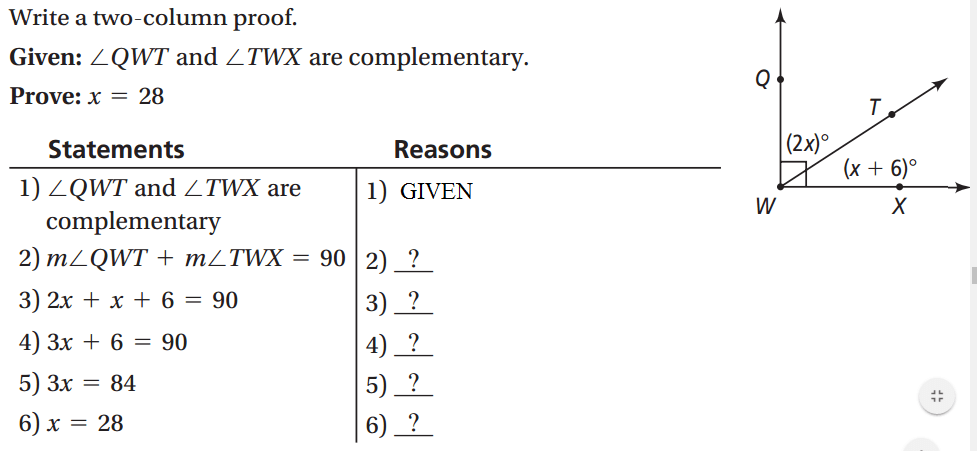
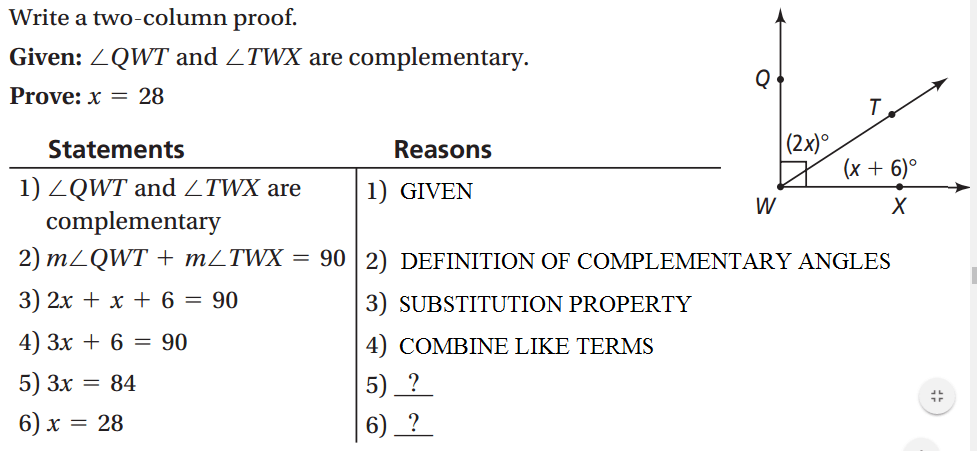
What is the REASON for Statement #1?
a)
Given
b)
Definition of Complementary Angles
c)
Substitution Property
d)
Reflexive Property of Congruence
68.
What is the REASON for Statement #2?
a)
Given
b)
Definition of Complementary Angles
c)
Substitution Property
d)
Reflexive Property of Congruence
69.
What is the REASON for Statement #5?
a)
Addition Property of Equality
b)
Subtraction Property of Equality
c)
Multiplication Property of Equality
d)
Division Property of Equality
70.
Using the statements:
If it is Friday, then I will get paid.
It is Friday.
Write the conclusion.
a)
It is not Friday
b)
It is Friday
c)
I will not get paid
d)
I will get paid
71.
Using the Law of Syllogism, which of the following completes the statement to form a valid conclusion?
If it is snowing heavily, then school will be canceled.
If school is canceled, the big test will not be given today.
It is snowing heavily, then...
a)
Look out for the snowplows while driving to school.
b)
The big test will not be given today.
c)
The roads will be hard to drive on.
d)
You should call the school to see if school is canceled.
72.
Which is a valid conclusion from these statements?
If a quadrilateral is a rhombus, then it is a parallelogram.
If a quadrilateral is a parallelogram, then its opposite angles are congruent.
a)
Opposite angles of a quadrilateral are congruent
b)
Opposite angles of a rhombus are congruent
c)
Every quadrilateral is a rhombus
d)
Every parallelogram is a rhombus
73.
If an angle is 40⁰, then it is acute.
∠A is 40⁰.
Using the Law of Detachment, what is the logical statement to conclude?
a)
∠A is complementary to ∠B
b)
∠A is acute.
c)
∠A is obtuse.
d)
∠A is 40⁰
74.
Use Law of Syllogism to make a conclusion.
 If a number is divisible by 10, then it is divisible by 2.  If a number is divisible by 2, then it is even.
a)
If a number is divisible by 10, then it is even,
b)
If a number is even, then it is divisible by 10.
c)
If a number is divisible by 2, then it is even.
d)
If a number is even, then it is divisible by 2.
75.
Using the Law of Detachment, what can you conclude?
If x has a value of 4, then 2x has a value of 8.
The value of x is 4.
a)
x = 4
b)
no conclusion can be made
c)
2x does not have a value of 8
d)
2x has a value of 8
76.
What can be concluded from the following statements?
If Tom goes fishing then he brings a pole.
If Tom brings his pole then he catches a fish.
a)
If Tom goes fishing then he catches a fish.
b)
If Tom brings his pole then he goes fishing
c)
 If Tom catches a fish then he brought his pole.
d)
If Tom brings his pole then he catches a fish.
77.
Write the if-then statement that follows from the pair of true statements. If Todd goes to the movies, then Sarah will go to the movies.  If Chris goes to the movies, then Todd will go to the movies.
a)
If Chris goes to the movies, then Sarah will go to the movies.
b)
If Todd goes to the movies, then Chris will go to the movies.
c)
If Sarah goes to the movies, then Chris will go to the movies.
d)
If Chris goes to the movies, then Todd will go to the movies.
78.
Which of the following statements is valid based on the given scenario?
If Jason plays basketball, then Steve sits on the bench.
 
If Steve sits on the bench, then Ronald starts at center.
  
a)
If Steve sits on the bench then Jason plays basketball.
b)
If Ronald starts at center then Jason plays basketball.
c)
If Steve sits the bench then Ronald does not start at center.
d)
If Jason plays basketball then Ronald starts at center.
79.

Use the Law of Detachment to determine what you can conclude from the given information, if possible.


If you passed the final, then you pass the class. You passed the final.

a)

You passed the class.

b)

You didn't pass the class

c)

Not possible

80.

Use the Law of Detachment to determine what you can conclude from the given information, if possible.


If your parents let you borrow the car, then you will go to the movies with your friend. If you went to the movies with your friend, that means that....

a)

Your parents let you borrow the car.

b)

Your parents didn't let you borrow the car.

c)

Not possible

d)

You and your friends bought popcorn

81.

What can be concluded from the following statements?

If Mike rakes leaves, then he bags them .

If Mike bags the leaves then he mows the lawn.

a)

If Mike mows the lawn then he bags the leaves.

b)

If Mike bags the leaves then he rakes.

c)

If Mike rakes the leaves then he will mow the lawn

d)

If Mike does not mow the lawn then he cannot bag the leaves

82.

IF an apple a day keeps the doctor away.

AND Joe ate an apple every day.

THEN

a)

He will get a stomach ache

b)

This makes no sense, what do apples have to do with doctors?

c)

Joe will be spending lots of time at the dentists office

d)

The doctor will stay away

83.

Jason and Jackson are in a band

The band plays on Saturday night

The band goes on at 8:00 pm

Conclusion:

a)

Jason and Jackson need to get girlfriends to watch them play

b)

It is Saturday night

c)

On Saturday night at 8:00 Jason and Jackson will be performing

d)

The time is 8:00 pm and the crowd is yelling

84.

If an angle measures 40⁰, then the angle is acute.
m∠A=40m\angle A=40  
What is the logical conclusion?

a)

∠A is complementary to ∠B

b)

∠A is acute.

c)

∠A is obtuse.

d)

∠A is 40⁰

85.
What can be concluded from the following statements?
If Tom goes fishing then he brings a pole.
If Tom brings his pole then he catches a fish.
a)
If Tom goes fishing then he catches a fish.
b)
If Tom brings his pole then he goes fishing
c)
 If Tom catches a fish then he brought his pole.
d)
If Tom brings his pole then he catches a fish.
86.

Determine if the conjecture is valid.


Given: If you are in California, then you are in the west coast. If you are Los Angeles, then you are in California.

Conjecture: If you are in Los Angeles, then you are in the west coast.

a)

No, the conjecture is not valid.

b)

Yes, the conjecture is valid.

87.
Using the Law of Detachment, what can you conclude?
If you earn more than $14, then you can buy a new CD.
You earn $15.
a)
you can buy a new CD
b)
you cannot buy a new CD
c)
no conclusion can be made
d)
you earn more than $14
88.
Draw a conclusion from the statement.
Given: If you are at least 25 year old, then you can rent a car.
Clay can rent a car.
Conclusion: ?

a)
Clay is at least 25 years old
b)
Clay can rent a car
c)
Clay can go on a road trip
d)
Invalid