
 Worksheets
periodicity, structure and bonding
Total questions: 45
Worksheet time: 30mins
Lithium (Li)
Metallic
Colvalent molecular
Colvalent network
Monatomic
Beryllium (Be)
Metallic
Colvalent molecular
Colvalent network
Monatomic
Sodium (Na)
Metallic
Colvalent molecular
Colvalent network
Monatomic
Magnesium (Mg)
Metallic
Colvalent molecular
Colvalent network
Monatomic
Aluminium (Al)
Metallic
Colvalent molecular
Colvalent network
Monatomic
Potassium (K)
Metallic
Colvalent molecular
Colvalent network
Monatomic
Calcium (Ca)
Metallic
Colvalent molecular
Colvalent network
Monatomic
Hydrogen(H2)
Metallic
Colvalent molecular
Colvalent network
Monatomic
Nitrogen(N2)
Metallic
Colvalent molecular
Colvalent network
Monatomic
Oxygen(O2)
Metallic
Colvalent molecular
Colvalent network
Monatomic
Fluorine (F2)
Metallic
Colvalent molecular
Colvalent network
Monatomic
Phosphorus (P4)
Metallic
Colvalent molecular
Colvalent network
Monatomic
sulfur(S8)
Metallic
Colvalent molecular
Colvalent network
Monatomic
Chlorine (Cl2)
Metallic
Colvalent molecular
Colvalent network
Monatomic
Fullerenes
Metallic
Colvalent molecular
Colvalent network
Monatomic
Boron(B)
Metallic
Colvalent molecular
Colvalent network
Monatomic
Carbon (C, diamond, graphite)
Metallic
Colvalent molecular
Colvalent network
Monatomic
Silicone (Si)
Metallic
Colvalent molecular
Colvalent network
Monatomic
Nobel gases
Metallic
Colvalent molecular
Colvalent network
Monatomic

Name the element from the third period that exists as a covalent network.
(a)
Explain why the covalent radius of sulfur is smaller than that of phosphorus.
Increased nuclear attraction for electrons
increased nuclear charge
sulfur has more protons in nucleus
increased attraction of electrons for nucleus
Explain fully, in terms of the structures of sulfur and phosphorus molecules and the intermolecular forces between molecules of each element, why the melting point of sulfur is much higher than
that of phosphorus.
that the forces are stronger between sulfur (molecules) than between the phosphorus molecules
there are London dispersion forces between the molecules of both these elements.These forces are stronger due to sulfur structure being S8 whereas phosphorus is P4
there are London dispersion forces between the molecules of both these elements.These forces are weaker due to sulfur structure being S8 whereas phosphorus is P4
that the forces are weaker between sulfur (molecules) than between the phosphorus molecules
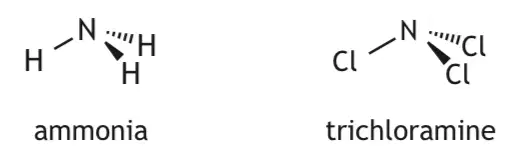
Explain the difference in polarities of ammonia and trichloramine molecules.
Ammonia is polar and trichloramine is non-polar
Ammonia is non-polar and trichloramine is polar
Ammonia contains hydrogen bonds making it polar & the electronegativity difference in ammonia is higher than in trichloramine
Ammonia contains hydrogen bonds making it non-polar & the electronegativity difference in ammonia is lower than in trichloramine
Explain why covalent radius decreases across the period from
sodium to chlorine. (1) = The electron shells are pulled 1 closer because
(a)
Explain fully why the covalent radius of sodium is larger than the ionic radius of sodium.
Phosphine (PH3) is used as an insecticide in the storage of grain.State the type of bonding and structure in phosphine
Covalent molecular
Hydrogen
Ionic
State what is meant by the term electronegativity.
(a)
Covalent radius
Increases down a group, decreases across a period
Increases down a group, increases across a period
Decreases down a group, decreases across a period
Decreases down a group, increases across a period
ionisation energy
Increases down a group, decreases across a period
Increases down a group, increases across a period
Decreases down a group, decreases across a period
Decreases down a group, increases across a period
Electronegativity
Increases down a group, decreases across a period
Increases down a group, increases across a period
Decreases down a group, decreases across a period
Decreases down a group, increases across a period
Covalent radius increases down a group because
Increased number of occupied electron shells
Increased positive nuclear charge
Increased screening effect
Decreased atomic size
Increased covalent radius
Covalent radius decreases across a period because
Increased number of occupied electron shells
Increased positive nuclear charge
Increased screening effect
Decreased atomic size
Increased covalent radius
Ionisation energy increases across a period because
Increased number of occupied electron shells
Increased positive nuclear charge
Increased screening effect
Decreased atomic size
Increased covalent radius
Ionisation energy decreases down a group because
Increased number of occupied electron shells
Increased positive nuclear charge
Increased screening effect
Decreased atomic size
Increased covalent radius
Electronegatvity decreases down a group because
Increased number of occupied electron shells
Increased positive nuclear charge
Increased screening effect
Decreased atomic size
Increased covalent radius
Electronegatvity increases across a period because
Increased number of occupied electron shells
Increased positive nuclear charge
Increased screening effect
Decreased atomic size
Increased covalent radius
What elements would have the most ionic character
Biggest difference in electronegativey
Smallest difference in electronegativey
LDFs are
Forces of attraction between all atoms and molecules as a result of electrostatic attraction between temporary dipoles and induced dipoles
Additional electrostatic forces of attraction between polar molecules
Electrostatic forces of attraction between molecules that contain highly polar bonds
permanent dipole- permanent dipole are
Forces of attraction between all atoms and molecules as a result of electrostatic attraction between temporary dipoles and induced dipoles
Additional electrostatic forces of attraction between polar molecules
Electrostatic forces of attraction between molecules that contain highly polar bonds
Hydrogen bonding is
Forces of attraction between all atoms and molecules as a result of electrostatic attraction between temporary dipoles and induced dipoles
Additional electrostatic forces of attraction between polar molecules
Electrostatic forces of attraction between molecules that contain highly polar bonds
Why is ice less dense than water
(a)
When looking at melting and boiling point you look at..
Type of van der vaal
Number of electrons
Hydrogen bonding
If they have similar intermolecular forces
When looking at viscosity you look at..
Type of van der vaal
Number of electrons
Hydrogen bonding
If they have similar intermolecular forces
When looking at solubility you look at..
Type of van der vaal
Number of electrons
Hydrogen bonding
If they have similar intermolecular forces
The anomalous bp of ammonia, water & hydrogen fluoride is a result of
Hydrogen bonding
LDP
Ionic bonding
Covalent lattice

