
NEW
Font size
 Worksheets
Fiscal Policy (Part 4 Week 1)
Total questions: 10
Worksheet time: 14mins
The Budget process includes the:
The Minister of Finance proposing the budget, then Parliament debating and amending the request where necessary and the President passing the budget act into law.
President passing the budget as proposed by governor of the Reserve Bank.
President proposing the budget and Parliament passing the budget.
Parliament proposing the budget and the Governor of the Reserve Bank passing the budget.
None of these are correct.
Suppose the only revenue taken in by the government is in the form of income tax, and the tax rate is 10 per cent. If aggregate income is R800 billion, and government outlays are R100 billion then the government budget has.
a surplus of R20 billion
a deficit of R80 billion
a surplus of R80 billion
a deficit of R20 billion
a deficit of R100 billion
The main aim of fiscal policy is:
a deliberate attempt to move the economy to full employment and achieve sustainable economic growth.
a deliberate attempt to finance the activities of the President.
only the use of a government deficit or surplus to keep the economy at full employment.
a deliberate attempt to get the government involved in an economy as much as possible.
All of the answers are correct.
If tax revenues exactly equal government expenditures in a given year, we can say that:
the government has achieved a balanced budget.
government debt will equal zero
government debt is positive.
the budget deficit will equal zero.
A and D are correct
An increase in taxes on labour income shifts the labour supply curve ________ and the ________.
leftward; after-tax wage rate falls.
rightward; before-tax wage rate rises
leftward; after-tax wage rate rises.
rightward; before-tax wage rate falls.
leftward; before and after tax wage rate rises.
According to the Laffer curve, a cut in tax rates
will always increase tax revenue
will always decrease tax revenues
will increase tax revenues if the economy is on the positively sloped portion of the Laffer curve, and reduce tax revenues if the economy is on the negatively sloped portion of the Laffer curve
will not affect tax revenue
will decrease tax revenues if the economy is on the positively sloped portion of the Laffer curve, and increase tax revenues if the economy is on the negatively sloped portion of the Laffer curve
Taxes and government expenditures that change in response to changes in the level of economic activity, without the need for additional government action, are examples of:
discretionary fiscal variables.
automatic fiscal policy.
built-in monetary stabilizers.
cyclically balanced budgets.
government expenditure multiplier.
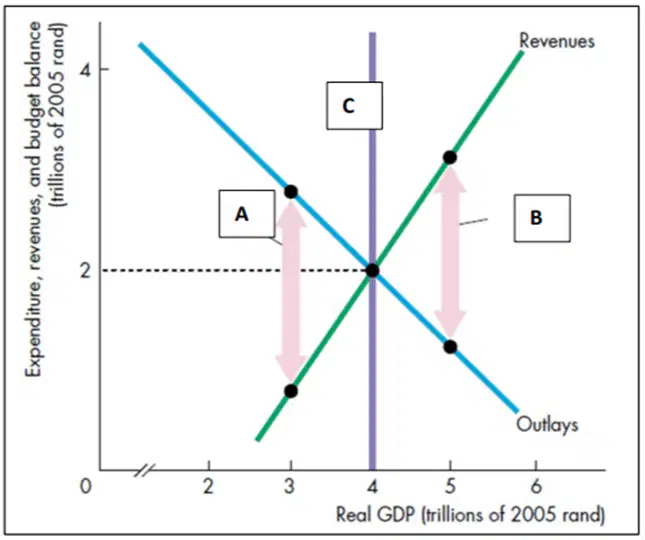
Assume potential GDP is R4 trillion. Which of the following could describe the state of the economy if actual output corresponds with points A, B and C above?
A – full employment; B – cyclical surplus; C – structural deficit
A – cyclical deficit; B – cyclical surplus; C – unemployment below natural rate
A – unemployment above natural rate; B – cyclical surplus; C – balanced budget
A – cyclical deficit; B – full employment; C – structural surplus
A – unemployment below natural rate; B – cyclical surplus; C – full employment
An example of ________ fiscal policy would be to ________ which would shift the AD curve ______.
contractionary; increase government expenditure; rightwards
expansionary; increase government expenditure; rightwards
expansionary; cut taxes; leftwards
contractionary; increase government expenditure; leftwards
contractionary; decrease taxes; rightwards
Which of the following statements is CORRECT?
The recognition lag is the time is the time it takes parliament to pass laws to change taxes or spending.
An increase in government expenditure alone is not an effective way to stimulate production and create jobs.
The law-making lag is the time it takes from passing a tax change to its effects on real GDP being felt.
The impact lag is the time it takes to figure out that fiscal policy actions are needed.
A fiscal stimulus package that is heavy on government spending and light on tax cuts works well

