
 Worksheets
Unit 4 Vocab - Rational Functions
Total questions: 86
Worksheet time: 49mins
We stand and fight!
We run and hide!
We negotiate and compromise!
We surrender!
We will!
Rational Functions have both a numerator a denominator
A Rational Function is a ratio function of polynomial can't divide into 0.
When transforming Rational Functions, we get y = a/x-h +k. What does a, h, and k do?
What is a parent function of a Rational Function
There are two asymptotic lines on a Rational Function. Vertical and Horizontal.
As the horizontal change occurs, vertical asymptotic change. If vertical change occurs, the horizontal asymptotic changes occur.
A Rational Function will never reach an asymptote
What are characteristics of Rational Functions in a graph.
Reflection across the origin
When looking at the parent function function of a Rational Function, the domain is all real number except x=0
The range of a parent Rational Function is all real except y=0
An End Behavior (Arrows)
x ---> -infin ----> y----- 0
x ------ in -----> y---->0
The reason why the denominator in a rational function cannot be equal to zero because anything being divided by zero is undefined!
When you get an undefined answer, the calculator says error.
We like to call Horizontal Asymptote like H.A. while Vertical Asymptote, V.A.
S.A
Characteristics of Rational Functions.
Two chvrres
Odd Symmetry
2 Boundary line
What are the main characteristics of Rationals in Standard Form?
X-intercepts
Vertical asymptote
Y-intercept
Horizontal asymptote
To find the x-intercept you plug in 0 in the equation. Yes or No
To find the y-intercept you plug in 0 in the equation. Yes or No
Yes
No
To find the x-intercepts of a Rational, make the numerator equal to zero!
To find the Vertical asymptote, we must find the denominator with factors equaling to zero as those are zeros that are undefined!
When finding H.A, the degree has an effect on Rationals Asymptote!
If a Degree is the same on a Rational Function on top to bottom, the coefficient gets to decide!
When the denominator is greater than the numerator, the Horizontal Asymptote is 0.
Follow Pemdas when transforming Rationals on graphs.
What is a slant asymptote?
If the degree on the numerator is greater than the denominator, divide the numerator in long division! The quotient is the slant asymptote.
If given Standard Form, Factor (GCF and Box) our rational first!
Yes
No
Holes exist when the factors on the numerator and denominator can cancel out!
Hole: If factors are the same in top/bottom, we cancel out!
This x-value of our hole, circle in for empty
(x,-) Plug in x to equation to get y-val
If Degree on top is bigger (No H.A) we will divide using top bottom to find the answer out slant form!
All factors are being divided by 1! Better yet, everything is divided by 1!
Yes
No
Dividing both sides of a rational function, you are effecting and removing the same value on both, making them still equal on both n and d
You can't divide out factors or terms if they aren't the same.
In a rational function, q(x) can never be 0 as dividing anything by zero is undefined. Of course, if p(x) is 0, it can work.
p(x)/q(x)
Even if you cancel out factors in a rational function, they still are parts of the exuded part of the denominator
Slant asymtopes occur when the degree on the numerator is ------ than the denominator
When the degree on top is higher than the bottom, remember that the Horizontal Asymptote becomes a Slanted Asymptote!
Yes
No
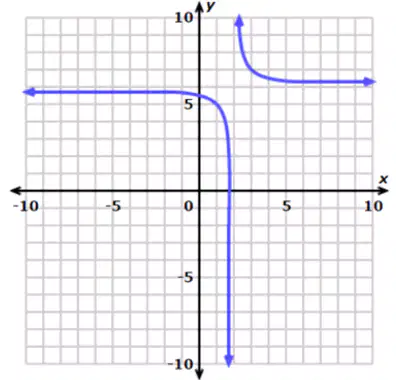
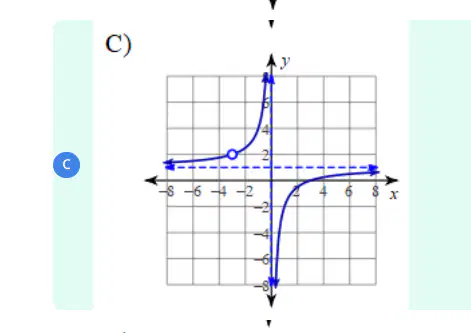
Find the equation of the horizontal asymptote and the vertical asymptote of the graph shown below.
y = 6
y = 2
x = 2
x = 6
Which function has a vertical asymptote at x= -4 and a horizontal asymptote at y=2?
f(x)=1/(x+4)+2
f(x)=1/(x-4)-2
f(x)=1/(x-4)+2

Determine the vertical asymptote(s), zero(es) and/or hole(s) for the graph of
Hole at x = 2
Vertical asymptote at x =-4
Zero at x=5
Hole at x = -2
Vertical asymptote at x =4
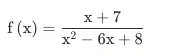
Find the horizontal asymptote of the following rational function.
y = 0
0

Find the equation of the slant asymptote in slope/intercept
Hint: Unit 3
(a)
If your vertical asymtope is zero, then of course you won't have any y-intercepts!
When finding the holes in a rational function, keep in mind that these holes will be marked with = !
The Domain excludes all denominator factors.
Domain is excluding x = -2 and Range is excluding y = -3
Yes
No
Domain is a set of x values that give real y values. This also applies to Range.
Rational Functions are just ratios! And such, you can find the y in end behaviors by the horizontal asymptote!
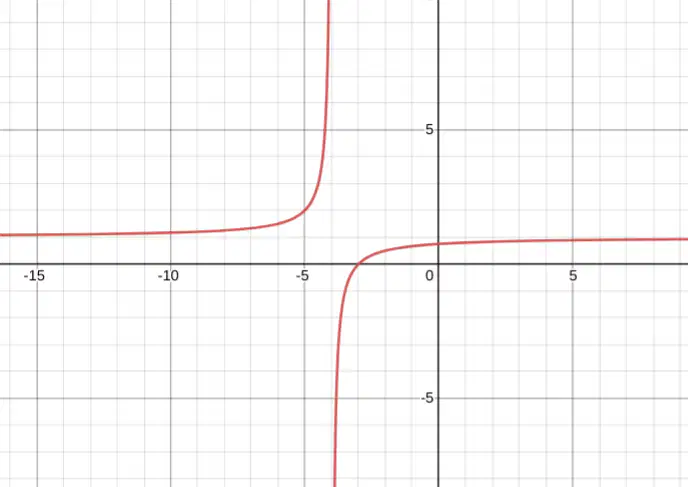
What is the range and domain of this function?
D: All real numbers except x=-4
R: All real numbers except y=1
D: All real numbers except x=-3
Given the function y = (x^2 +3)/x-5, what is the Domain, Range, Intercepts, Asymtopes, and possible holes? Don't forget the end behaviors! x
Domain: All real numbers except x=5
Range: All real numbers except x-5=y
X: No real intercepts
Y=(0,3/-5)
End Behavior:
As x ---> in, y ----> x+5
x-----> -in ----> x+5
Domain: All real numbers except x=x-5
Range: All real numbers except 5=y
X: All real intercepts
Y=(0,3/-5)
End Behavior:
As x ---> in, y ----> x+5
x-----> -in ----> x+5
Multiplying Rationals
Factor everything as needed
Rewrite as 1 fraction with tops and bottom multiplied
Cancel out common factors.
Dividing Rationals
Rewrite dividing as by the reciprocal (Flip the 2nd fraction)
Finish like alone
When dividing fractions, it is like multiplying with the rational dividing in reverse
Adding/Subtracting Rational:
1. Factor Denominator
2. Multiply top/bottom with missing factors to create a common denominator
3. Do multiplication on Top
4. Combine to 1 fractions by CLT on top
Make sure you distribute the you
When adding and subtracting rational functions, remember to factor out the greatest common fact on the denominator! Also, GCF can be -1 or a variable!
Degrees are how many times a number or term is multiplied, the coefficient does not decide the degree!
When graphing Rational Functions, you want to make sure that you draw the graph with x-intercepts and y intercepts.
When graphing your rational functions, and if for whatever reason, you have points inbetween asymtopes, graph it! You will end up with more than 2!
What is an improper fractions in rational function?
What does SOH CAH TOA stand for? Respond in a sci-fi future way.
When adding/subtracting rationals, remember that you need to find GCF on the denominator first! This includes negatives!
When dividing rational functions, remember that the reason why you flip the reciprocal of the function that is dividing is because multiplication and dividing are opposite!
Dividing is the opposite of multiplication!
If for any reason your rational has not enough points, plug in x values to graph it!
Plug in values
What is the difference between numbers and rationals?
When writing end behaviors, the slant asymptote can be used for for rational function end behaviors!
Horizontal Asymptote are very weird. When drawing out a rough image of ratioal functions, we sometimes have graphs in the middle of vertical asymtopes, if there is point in-between the horizontal, draw it! If there isn't in between, but below, draw it!
When finding the slant asymptote, don't include the remainder as part of it
When dividing out factors after adding/subtracting/multiplying/dividing, understand that we write variables and numbers together to signify multiplication.
When writing rational functions, make sure that factors are in parenthesis
(18x) can be also written as (18)(x) because they are multiplying. It can also be simplified even more to (2)(3)(3)(x)
Rationals have no minimum or max
Sometimes looking at a square rooted of a number may you think its something that is not. Check the number you squared rooted just in case!
What are the steps to solving a rational function?
Separate Factor
Separate Factor
Multiply to undo division
Multiply to undo division
Solve
Solve
Check for extraneous solutions?
Check for extraneous solutions?
Extraneous includes undefined values from denominator you eliminate and not undefined values that are not your solutions
A y coordinate will be excluded from the range unless there is another equal y coordinate that is not a hole.
Extraneous solutions are solutions that are also undefined, meaning numbers that make the denominator equal to 0, therefore being extraneous.
When graphing rational functions with their characteristics in mind, understand that if two points are above the horizontal, connect them! Make them into their pair buds.
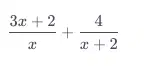
The common denominator is (a)
To add the expressions, first multiply 3x+2 by (b) and multiply 4 by (c)
a
x(x + 2)
b
x+2
c
x

Solve it and Beat it!
(x+5)(x−10)/2x(x+5)
(x+6)/(x+2)

State the excluded values (domain restrictions).
X should not equal 7
X should not equal 7
CLT is (x-6)(x-7)
The solution is extraneous
The solution is not extraneous.
Which equation is the correct set up for the work problem described below? (NOTE: you do not need to solve)
Buffy, Xander, and Willow have to work together to research information about a demon on the loose!
Working alone, it would take Buffy 6 hours to complete the research.
Working alone, it would take Xander 8 hours to do the research.
All three working together could finish researching in 2 hours. BUT, Buffy is out fighting demons and Xander is interviewing witnesses.
Willow is on her own. How long will it take Willow to complete the research herself?
1/6+1/8+1/x=1/2
1/6+1/8+1/2=1/x
(x^2-9)/x(x+3)
Yes
No
Its good to review your results after simplifying/solving your rationals. Silly errors could occur here.
When having graphing rationals, make sure they are reflecting over the origin. If you don't have one of them, reflect it over the other side directly from the origin.
Yes
no

