Worksheets
AP Macro Unit 1 Review
Total questions: 75
Worksheet time: 2hrs 53mins
Which of the following is true for all economies regardless of their economic system?
Every economy must determine what to produce and how it produces goods and services
Every economy must find a way to distribute income equally
Every economy must find ways to privatize markets to maximize efficiency
Every economy must prevent unemployment through government intervention
Every economy must open free trade with other economies
When making a decision, the next best alternative is called
The production possibilities
The opportunity cost
Scarcity
The absolute advantage
Efficiency
Which of the following must be true if an individual's next best alternative to going to the beach is studying for an economics exam?
They will decide to study for the exam
The opp. cost is seeing their friends at the beach
The person prefers playing volleyball at the beach to studying for the exam
The Opp Cost of going to the beach is all the other things they could have done
The Opp Cost of going to the beach is being better prepared for the exam.
A point outside the PPC would represent
An efficient use of resources
Future output once producers become more efficient
An inefficient use of resources
A combination that cannot be achieved due to scarcity
Full employment of resources in the economy
If demand for golf balls decreases when the price of baseball gloves decreases, we can stay that baseball gloves and golf balls players are
normal goods
inferior goods
substitute goods
complementary goods
unrelated due to the substitution effect
If the price of cars significantly increases, then the
Supply of cars will increase
supply of auto repair shops will decrease
quantity supplied of cars will increase
The demand for cars will decrease
Car producers will find it more profitable to produce trucks
Which of the following will NOT cause the demand for video games to change?
a change in the price of a close substitute
a change in consumer incomes
a change in the price of video games
a change in consumer tastes
a change in consumer preferences
A leftward shift of the supply curve for avocados ( a normal good) might be caused by:
an improvement in avocado picking techniques
a decrease in the wages that must be paid to avocado pickers
an increase in consumer incomes
some avocado farmers leaving the market
a news report stating that avocados are associated with good health
Assuming Ramen is an inferior good, a decrease in income will shift the:
supply curve for Ramen to the left
supply curve for Ramen to the right
demand curve for ramen to the right
demand curve for ramen to the left
there is no shift
When the government establishes a binding price floor on a good or service then there will be:
An increase in demand for that good or service
a surplus because of the quantity demand will decrease
a shortage because the quantity supplied will decrease
no incentive to place a tax on the good or service
a decrease in the price once the market adjusts
Claire is an economist who can earn $150 per hour. She is also an excellent chef who can cook three times as fast as the best chef in the area, whose hourly wage is $20 per hour. Which of the following is a correct economic statement?
Claire has a comparative advantage in economics so she should specialize in econ and hire the chef to cook for her
Claire has an absolute and comparative advantage in both econ and cooking, so she should work as an economist and as a chef
claire is 3 times faster than any chef so she could give up econ and be a chef
when chefs work for economists, they should charge $150 per hour instead of $20 per hour
Because claire is an excellent chef, when the best chef works for claire, she should pay the chef only 1/3 the hourly rate.

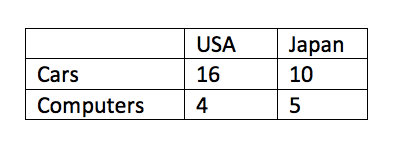
Which country has the comparative advantage in producing trucks and what is their opportunity cost?

Refer to the above diagram, in which S1 and D1 represent the original supply and demand curves and S2 and D2 the new curves. In this market the indicated shift in supply may have been caused by:
an increase in the wages paid to workers producing this good.
the development of more efficient machinery for producing this commodity.
this product becoming less fashionable.
an increase in consumer incomes.
Allie is shopping when she finds a pair of running shoes priced at $90. When Allie uses her debit card to pay, it is declined because her balance is insufficient to cover the cost of the running shoes. Allie’s situation best illustrates which economic concept?
Opportunity cost
Scarcity
Trade-offs
Which of the following contributes to the economic problem of scarcity?
Resources have alternative uses.
Resources are unlimited.
Human wants are limited.
Which of the following illustrates the effect of a decrease in an economy’s resources using a production possibilities curve (PPC)?
The economy’s PPC will shift outward and to the right.
The economy’s PPC will shift inward and to the left.
The economy’s PPC will remain the same.

A city government received a $1 million grant to build swimming pools and skating rinks for youth. Based on the data provided in the graph, what is the opportunity cost of building one swimming pool?
0.50 skating rink
2 skating rinks
2 swimming pools

The shape of a PPC illustrates the type of opportunity costs involved in production. What type of costs do PPC1 and PPC2 illustrate?
PPC1 illustrates constant opportunity costs and PPC2 illustrates increasing opportunity costs.
PPC1 illustrates increasing opportunity costs and PPC2 illustrates decreasing opportunity costs.
PPC1 illustrates increasing opportunity costs and PPC2 illustrates constant opportunity costs.

Based on the data provided, which of the following terms of trade are mutually beneficial for the two countries?
1 ton of coffee for 3 trucks
1 ton of coffee for 4 trucks
1 ton of coffee for 5 trucks
Which of the following describes the relationship between price and quantity demanded according to the law of demand?
Negative relationship, illustrated by a horizontal demand curve
Positive relationship, illustrated by a downward-sloping demand curve
Negative relationship, illustrated by a downward-sloping demand curve
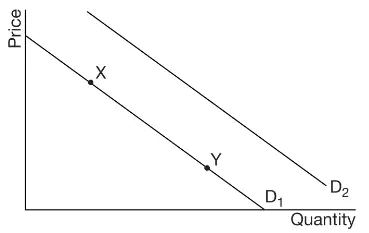
The diagram above shows two demand curves for video games identified as D1 and D2.
Which of the following changes will most likely cause a shift of the demand curve from D1 to D2 as shown in the diagram?
A decrease in the price of mobile games, a substitute good
Michael has a comparative advantage in changing tires.
Michael has an absolute and a comparative advantage in changing oil.
Which of the following changes will increase the demand for bicycles?
An increase in the price of bicycle helmets, a complementary good
An increase in the price of scooters, a substitute good
A decrease in the price of bicycles
Which of the following will increase the market supply for new automobiles?
An increase in subsidies to automobile manufacturers
An increase in the price of steel, an input in the production of automobiles
An increase in the price of gasoline, a complementary good

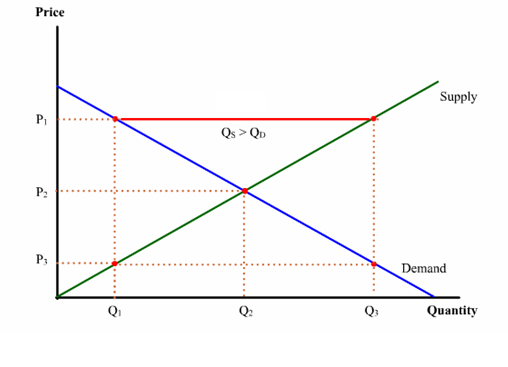
When the price of a candy bar is $6.00, which of the following is true?
The market does not clear because the price is lower than the equilibrium price and there will be a shortage in the market.
The market does not clear because the price is higher than the equilibrium price and there will be a surplus in the market.
The market does not clear because the price is higher than the equilibrium price and there will be a shortage in the market.
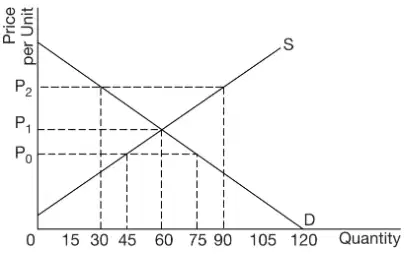
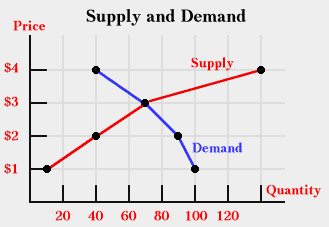
The supply (S) and demand (D) for a good are shown in the diagram above.
At a price of P2 in the diagram above which of the following will happen in the market?
There will be a shortage of 30 units and 90 units will be exchanged.
There will be a surplus of 30 units and 90 units will be exchanged.
There will be a surplus of 60 units and 30 units will be exchanged.

Matcha green tea is primarily cultivated by Japanese farmers. Suppose that Matcha green tea grows in popularity as its health benefits, and at the same time the government reduces taxes imposed on Japanese tea farmers. What is the likely effect on the equilibrium price and quantity in the Japanese Matcha tea market?
Price decreases, and quantity decreases.
Price is indeterminate, and quantity decreases.
Price is indeterminate, and quantity increases.
Which country has the comparative advantage in producing trucks and what is their opportunity cost?

Which country has the comparative advantage in producing airplanes and what is their opportunity cost?
Suppliers often reduce prices because they
have a shortage of products
have a surplus of products to sell
want decrease consumer demand
want to increase the product supply

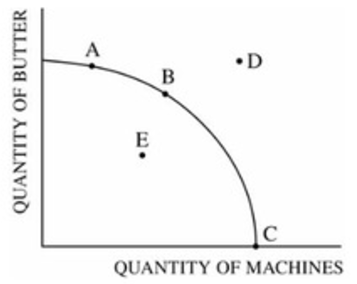
Refer to the above diagram. This economy will experience cyclical unemployment if it produces at point:
A
B
C
D

Refer to the above diagram. At which point will this economy NOT be able to produce, it is currently unattainable?
A
B
C
E
When the price of a product rises, consumers shift their purchases to other products whose prices are now relatively lower. This statement describes:
an inferior good.
the rationing function of prices.
the substitution effect.
the income effect.
An increase in demand means that:
given supply, the price of the product will decline.
the demand curve has shifted to the right.
price has declined and consumers therefore want to purchase more of the product.
the demand curve has shifted to the left.
Refer to the above diagram, in which S1 and D1 represent the original supply and demand curves and S2 and D2 the new curves. In this market the indicated shift in supply may have been caused by:
an increase in the wages paid to workers producing this good.
the development of more efficient machinery for producing this commodity.
this product becoming less fashionable.
an increase in consumer incomes.
Related goods impacts Demand because its relationship to what determinant of Demand?
Increasing Marginal Cost
Diminishing Marginal Utility
Scarcity
Substitution Effect

The economic problem is that
resources are limited and wants are limited.
resources are unlimited and wants are limited.
resources are limited and wants are unlimited.
resources are unlimited and wants are unlimited.

In the time period covered by the production possibilities curve, the company decides to make 4 gallons of red paint. How many gallons of blue paint can the company make with the available time and resources?
2
3
6
8
Human-made materials used to produce goods and services.
capital
land
labor
entrepreneur
An economy where the government controls the factors of production resources.
command
market
capitalism
mixed

Point D on the graph is a period of:
contraction
expansion
recession
decline