
 Worksheets
Quiz Lecture 6
Total questions: 22
Worksheet time: 11mins
Which of the following examples describes a type of potential rather than kinetic energy?
heat released by a campfire
a sucrose molecule
flashes of light emitted by a firefly
water rushing out of Hoover Dam
Which of the following statements best describes induced fit?
The conformation of the active site is determined by the tertiary or quaternary structure of the enzyme.
Binding of substrate to the active site changes the shape of the active site of an enzyme.
Substrate binds to an allosteric site rather than to the active site of an enzyme.
Binding of an activator molecule changes the shape of the active site of an enzyme.
Which of the following is part of the first law of thermodynamics?
Exergonic reactions are coupled with endergonic reactions.
Potential energy equals kinetic energy in a reaction.
Kinetic energy is stored energy.
Energy cannot be transferred or transformed.
Which of the following statements best describes enzyme function?
Enzyme function is generally increased if the 3-D structure or conformation of an enzyme is altered.
Enzymes increase the rate of chemical reactions by lowering activation energy barriers.
Enzymes increase the rate of chemical reactions by stimulating ATP hydrolysis.
Enzyme function is independent of physical and chemical environmental factors such as pH and temperature.
Most reactions in the body occur too slowly to sustain life. This is because
many reactions require large inputs of activation energy.
no catalysts are present in body cells.
all reactions in the body are endergonic.
most biological catalysts are not active at body temperature (37°C).
there is not enough ATP in body cells.
Which of the following statements best describes the central role that ATP plays in cellular metabolism?
The terminal phosphate bond is stronger than most covalent bonds in other biological macromolecules.
Hydrolysis of ATP provides an input of free energy for exergonic reactions.
Hydrolysis of the terminal phosphate group from ATP stores free energy that is used for cellular work.
ATP provides energy coupling between exergonic and endergonic reactions.
Enzymes are important because they
allow reactions to occur at body temperature.
can enable organisms to evade the laws of thermodynamics.
bind irreversibly to substrates.
are structural proteins that make up bodily tissues.
increase the body temperature of organisms.
When a high-energy bond of ATP is broken, what primarily happens to the released energy?
It drives endergonic reactions in the cell.
It polarizes the cell.
It functions as a second messenger.
It is lost as light energy.
It converts inorganic phosphates to energy carrier molecules.
Which of the following statements best summarizes an important consequence of the first law of thermodynamics for living organisms?
Each organism ultimately must obtain all of the necessary energy for life from its environment.
The entropy of an organism decreases with time as the organism grows in complexity.
The energy content of a single organism is constant
An organism grows by converting energy into organic matter.
To say that an enzyme has been denatured means that
the enzyme is working at an optimal temperature.
an inhibitor has bound the enzyme at the active site.
its three-dimensional structure has changed and the enzyme can no longer function properly.
the enzyme is working at its maximal rate.
Animals have enzymes that break apart starch molecules but not cellulose, despite the fact that both are made up of glucose subunits. Which enzyme characteristic best explains this?
Enzyme activity is regulated.
All enzymes are proteins.
Enzymes usually speed up chemical reactions.
Enzymes are highly specific.
Enzymes are not permanently changed by the reactions they promote.
Which of the following molecules is most similar in structure to ATP?
a DNA nucleotide
an RNA nucleotide
an amino acid with three phosphate groups attached
a pentose sugar
When chemical, transport, or mechanical work is performed by an organism, what happens to the heat that is generated?
It is used to generate ADP from nucleotide precursors.
It is lost to the environment.
It is used to power yet more cellular work.
It is captured to store energy as more ATP.
Which of the following statements best describes the first law of thermodynamics?
The entropy of the universe is constant.
Energy cannot be transferred or transformed.
Energy cannot be created or destroyed.
The entropy of the universe is decreasing.
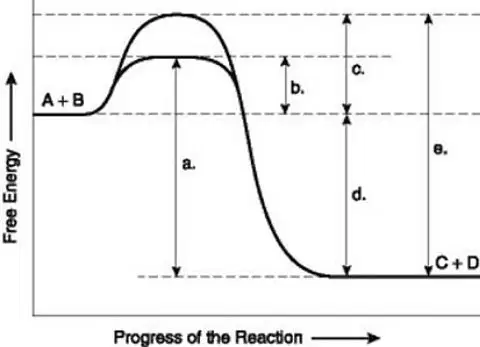
The figure illustrates the energy states associated with the reaction A + B ↔ C + D. Which of the lower-case letters represents the activation energy required for the enzyme-catalyzed reaction in the figure?
a
b
c
d
What is the ultimate source of energy for almost all forms of life on Earth?
Chemical energy
Solar energy
Heat energy
Thermal energy
Nuclear energy
The most common energy carrier molecule in living organisms is
DNA.
ATP.
NADPH.
ADP.
glucose
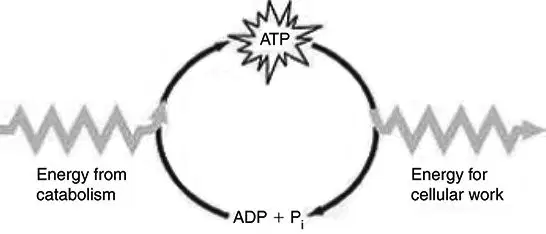
Which of the following statements best summarizes the figure above?
Pi acts as a shuttle molecule to move energy from ATP to ADP.
ATP is a molecule that acts as an intermediary to store energy for cellular work.
Energy from catabolism can be used directly for performing cellular work.
ADP + Pi are molecules that store energy for catabolism.
All of the following statements pertaining to catalysts are true EXCEPT:
catalysts are not permanently altered during reaction.
catalysts can be used over and over again.
catalysts increase activation energy requirements.
catalysts increase the reaction rate.
biological catalysts are specific enzymes.
Imagine you are conducting an experiment on an enzyme known as sucrase. This enzyme is synthesized and used by yeast cells to break down the disaccharide sucrose (table sugar) into the monosaccharides glucose and fructose. You decide to conduct an experiment to test whether the sucrase enzyme can break down the artificial sweetener sucralose. Sucralose (a "chlorinated" carbohydrate) has some chemical similarity to sucrose, but is different in that three of its hydroxyl groups are missing and replaced with chlorine atoms instead.
Based on the details provided in this scenario, do you think the sucrase enzyme will be able to interact with sucralose?
No; all enzymes are highly specific and can react with only a specific substrate.
Yes; enzymes such as sucrase are not specific for their substrate.
Yes; the enzymes in human cells can interact with artificial sweeteners as if they were sugars.
No; sucralose is an ion and not a true carbohydrate.
When solid sodium hydroxide is added to water, the solution gets hot. This is an example of a(n)
enzyme-catalyzed process.
endergonic process.
exergonic process.
conversion of kinetic energy to potential energy.
release of activation energy.
Energy that is not converted to useful energy is usually given off as
electricity
entropy
radioactivity
heat
light

