
Font size
 Worksheets
IDEAL GAS & REAL GAS
Total questions: 30
Worksheet time: 30mins
What method is used to collect carbon dioxide?


Ammonia cannot be collected by displacement of water. Why?
Ammonia is insoluble in water.
Ammonia is soluble in water.
Ammonia is denser than air.
Ammonia is less dense than air.
Dalton's Law states that....
at a constant temperature the volume of a confined ideal gas varies inversely with its pressure.
the total pressure exerted by the mixture of non-reactive gases is equal to the sum of the partial pressures of individual gases
gases tend to expand when heated
the density of an ideal gas at constant pressure varies inversely with the absolute temperature of the gas.
Three gases, Ar, N2, and H2 are mixed in a 500L container. Ar exerts a pressure of 255 torr, N2 exerts a pressure of 228 torr and H2 exerts a pressure of 752 torr. What is the total pressure in the container?
483 torr
270 torr
1235 torr
269 torr
Under which conditions of temperature and pressure does carbon dioxide behave most like an ideal gas?
A) Low temperature and low pressure
B) Low temperature and high pressure
C) High temperature and low pressure
D) High temperature and high pressure
A real gas and ideal gas are similar at (a) pressures because the real gas particles (b) and have (c) collisions, like an ideal gas.
low
slow down
less
speed up
high
more
As temperature of gas particles increase, the average KE energy increases, and the speed of particles decreases
True
False
Temperature and average KE energy are directly propotional
False
True

You can identify certain qualities of a gas by using the Ideal Gas Law, given by the equation: ___
P/V = nRT
P = VnRT
PVn = RT
PV = nRT

A gas starts to deviate from what the ideal gas law predicts when ___
the particles are dispersed
the particles are crowded
under low pressure
at high temperatures

What did van der Waals explain in his doctoral thesis?
the value of absolute zero
why real gases don't behave ideally
the importance of closed systems
solid state physics
What is an ideal gas?
a. which obeys the law pv = RT
b. which obeys the law p = vR / T
c. which obeys the law pv = R / T
d. none of the above
What assumptions are made for the ideal gas equation?
There is no attraction between the molecules of the gas.
The volume occupied by the molecules is negligible.
Both of the mentioned.
None of the mentioned.
In which condition can real gas obey closely the ideal gas equation?
Pressure is very small and temperature is very high.
Pressure is very high and temperature is very low.
Both pressure and temperature are very high.
Both pressure and temperature are very low.
Choose the correct form of van der Waals Equation:
(P+(a/V2)) (V+ b) = RT
(P + (a/V2)) (V– b) = RT
(P– (a/V2)) (V – b) = RT
(P – (a/V2)) (V+ b) = RT
Which of the following statement is true about the correction terms in van der Waals Equation?
"a" accounts for mutual attraction between the molecules.
"b" accounts for the volumes of the molecules.
All of the mentioned.
Value of constant 'a' in van der Waals equation increases with increase in:
intramolecular forces.
ionic bond.
intermolecular forces.
covalent bond.
All of the following are properties of ideal gases except:
Small amounts of energy are lost during collisions between gas molecules
Volume occupied by molecules is negligible compared to the volume occupied by the gas
Gas molecules do not interact with each other except during collisions
Gas molecules do not interact with each other except during collisions
Gases found in the environment are most likely to exhibit properties similar to that of ideal gases under conditions of:
low temperatures and high pressures
high temperatures and high pressures
high temperatures and low pressures
low temperatures and low pressures
Which properties reflected in real gases does the van der Waals equation attempt to account for by modifying the ideal gas law?
I. Volume
II. Pressure
III. Temperature
II
I and II
I, II and III
I
What is the difference between particles in a gas and a solid?
gas particles are closer together
solid particles move faster than gas particles
solid particles expand on heating
gas particles have more kinetic energy than solid particles
How can we increase the gas pressure inside a sealed container?
Increase the number of particles inside the container
Increase the temperature
Decrease the volume of the container
All of these
Which of the following gases is expected to behave most ideally at a given temperature and pressure?
H2O
NH3
Xe
He
Which of the following gases is expected to behave most ideally at a given temperature and pressure?
H2O
NH3
Xe
He
Which is a correct unit for R?
L.atm/mol.K
L.atm
mmHg/mol.K
L.atom/mol
How does a real gas deviate from ideal behavior?
Real gas particles have volume and travel in a circular path
Real gas particles attract each other and travel in a circular path
Real gas particles have volume and attract each other
Real gas particles collide with each other and all have the same kinetic energy
A gas that has a pressure of 2 Pa and a volume of 10 dm3. Choose the equation which should be used to find out the new volume if the pressure was changed to 1 Pa keeping the system at 300 K?
P1/T1 = P2/T2
P1V1 = P2V2
V1/n1 = V2/n2
PV = nRT

For an ideal gas several assumptions are made about the particles including
they collide elastically with each other and the container wall
they experience significant intermolecular forces
the volume they occupy as individual particles is insignificant compared to the volume of the container
there are a very large number of particles inside the container
Which answer shows the correct Combined Gas Law
T2P1V1=T1P2V2
T1P1V1=T2P2V2
T1P1V2=T2P2V1
T1P2V1=T2P1V2
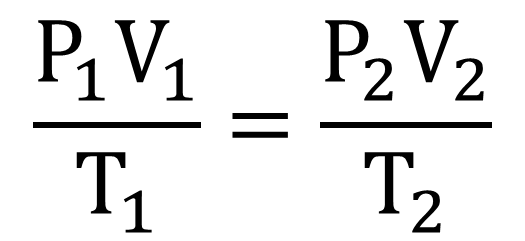
A gas is heated from 263K to 298K. The volume is increased from 24.0L to 35.0L. If the original pressure was 1.00 atm, what is the new pressure?
0.78 atm
1.65 atm
1.28 atm
0.61 atm

