Worksheets
Biochemistry Test Review
Total questions: 41
Worksheet time: 21mins
The space surrounding the nucleus of an atom contains which of the subatomic particles?
protons
electrons
neutrons
ions
all of the above.
When an atom loses electrons, it forms an ion of what charge?
negative
positive
neutral
it could be positive or negative.
If a substance like sugar dissolves in water, sugar would be the:
solvent
solute
reactant
ion
heterogeneous solution.
The nucleus of an atom is composed of:
protons and electrons
protons and neutrons
neutrons and electrons
protons, neutrons and electrons.
A substance formed by the combination of two or more elements in a definite proportion is called a(n):
mixture
solution
compound
atom
ion.
Covalent bonds are formed when:
electrons are shared between two atoms
electrons are transferred from one atom to another atom
protons are shared between two atoms
protons are exchanged from one atom to another atom.
Which one of the following is true of the polarity of water?
The oxygen atom is slightly positive, and the hydrogen atom is slightly negative.
Both the oxygen and the hydrogen atoms are slightly positive.
Both the oxygen and the hydrogen atoms are slightly negative.
The oxygen atom is slightly negative, and the hydrogen atom is slightly positive.
When water dissolves a substance and forms a solution, water is considered to be the:
solvent
solute
suspension
mixture
reactant.
A bond that is formed between the oxygen atom of one water molecule and the hydrogen atom of a different water molecule is called a(n):
ionic bond
covalent bond
hydrogen bond
metallic bond
it could be ionic or covalent.
The basic unit of matter is:
a compound
an element
a mixture
an atom.
A substance composed of two or more elements or compounds that are not chemically combined is called a(n):
mixture
element
compound
polar substance.
Smaller molecules are linked together to form larger molecules in a _____ reaction.
condensation
double displacement reaction
hydrolysis reaction
decomposition reaction.
Which of these elements would not be found in a carbohydrate?
hydrogen
carbon
nitrogen
oxygen.
The 1:2:1 ratio of carbon to hydrogen to oxygen is seen in which group of organic compounds?
proteins
lipids
nucleic acids
carbohydrates.
Three fatty acids bonded to one molecule of glycerol forms a:
triglyceride
phospholipid
starch molecule
polypeptide.
A molecule composed of many repeating subunits is called:
a polymer
a monomer
an enzyme
a lipid
a functional group.
Which of the following is not an example of a carbohydrate?
sugars
starches
cellulose
wax.
The part of an amino acid that gives the amino acid its unique shape and determines its properties is the:
carboxyl group
hydroxyl group
amino group
R group
single hydrogen atom.
A long string of simple sugars linked together is called a:
polysaccharide
polypeptide
disaccharide
monosaccharide.
In the equation, V + XYXZ 🡪 XY + XZ + V, the enzyme would be:
V
XYXZ
XY
XZ.
Which of the following is a function of the nucleic acids?
They are used to store and transmit genetic information.
They are used to store energy.
They are used for structural purposes.
They are used to insulate the body.
The building blocks for proteins are:
glucose molecules
amino acids
glucose and fatty acids
fatty acids and glycerol
polysaccharides.
The building blocks for carbohydrates are:
glucose molecules
glycerol molecules
fatty acids and glycerol
fatty acids and glucose.
A monosaccharide is a:
protein
nucleic acid
lipid
carbohydrate.
A long chain of amino acids bonded together is called a:
polysaccharide
dipeptide
polypeptide
disaccharide
nucleic acid.
Which of the following organic compounds is the main source of energy for all living things?
proteins
carbohydrates
lipids
nucleic acids.
Which one of the following is NOT a function of proteins?
They are used for structural purposes such as bones and muscles.
They are used to fight diseases (antibodies).
They are used to store and transmit genetic information.
They can be used to transport substances (hemoglobin).
Small, simple molecules that are joined together to form much larger molecules are called:
functional groups
monomers
polymers
ions
macromolecules.
Which one of the following is not considered a use for lipids?
They are used to insulate the body.
They are used as the structural component of the cell wall of plants.
They are an important component of the cell membrane.
They help to form waterproof coverings on fruits, leaves, and feathers.
The subatomic particles differ from one another in charge, mass, and location in the atom. Which one of the following is NOT a true statement about the subatomic particles?
Electrons are negative in charge and have very little mass in comparison to the protons and neutrons.
Protons have a mass nearly equal to neutrons.
Neutrons have a positive charge and are found in the nucleus of the atom.
Protons are always found in the nucleus of the atom and have a positive charge.
What type of bond is formed when electrons are shared equally between two atoms?
nonpolar covalent bond
polar covalent bond
polar ionic bond
nonpolar ionic bond.
Small clusters of atoms attached to carbon skeletons that give the molecule a unique shape and determine the properties of the molecule are known as:
enzymes
macromolecules
monomers
amino acids
functional groups.
A cluster of atoms has the formula -PO4. This cluster of atoms is referred to by what name?
carboxyl
amino
phosphate
hydroxyl
carbonyl.
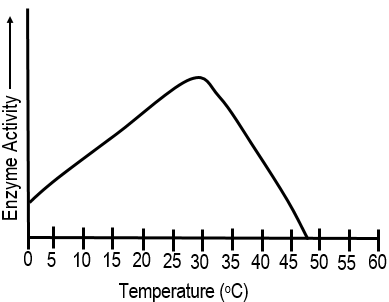
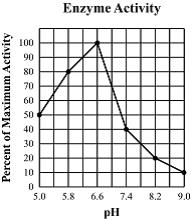
Which 2 factors can affect the rate of enzyme activity?
Light intensity
Temperature
pH
Oxygen concentration
Salivary amylase is an enzyme in the human body that digests carbohydrates from food. When food mixed with saliva enters the stomach, the action of salivary amylase slows dramatically. Which causes salivary amylase enzyme to stop digesting food?
The pH of the stomach is lower than in the mouth.
The concentration of food decreases in the stomach.
The temperature of the food increases in the stomach.
The food is mixed more in the mouth than in the stomach