
 Worksheets
AICE International-Chapter 1.3 - Japan Emerging as a World Power
Total questions: 29
Worksheet time: 15mins
Commodore Matthew Perry’s visits to Japan in 1853 and 1854 resulted in the
colonization of Japan by the United States
transfer of spheres of influence to China
introduction of Christianity to Japanese society
opening of trade and diplomatic relations with Japan
One effect of industrialization on Meiji Japan was that it
strengthened the power of the Shogunate
decreased the level of pollution
modernized transportation
increased the number of small farms
Japan’s increased foreign trade during the Meiji Restoration was closely related to its
need to maintain a traditional society
desire for a modern industrialized society
colonization by Western nations
encouragement of foreign investment
One reason for Japan’s rapid industrialization during the Meiji Restoration was that Japan had
rejected Western ideas
used its access to the sea for fishing
relied on traditional isolationist policies
reformed its political and economic systems
Emperor Meiji promoted what in Japan?
isolation and nationalism
capitalism and democracy
revolution and absolutism
reform and modernization
What was one impact of industrialization on Japan during the Meiji Restoration?
Japan became more isolated from world affairs
Demand for natural resources increased
Japan became a colonial possession of China
Traditional practices of Bushido were reintroduced
In the years following the Meiji Restoration in Japan and the unification of Germany in the 19th century, both nations experienced
an increase in military production and strengthened military forces
a reduction in tensions with neighboring nations
a restructuring of government that included popularly elected monarchs
a decrease in the reliance on industrialization and trade
The Meiji Restoration in Japan was prompted in part by
a fear that Japan would be colonized by western nations
the failure of Japanese expansion
the Shogun’s conversion to Christianity
a desire to stay isolated

During the first Sino-Japanese war, China and Japan competed for control of______________.
Russia.
China.
Korea.
What policy did the Tokugawa Shogunate take towards Europeans?
Isolationism
Devshirme
Chivalry
Nihilism
The Meiji Restoration included all of the following EXCEPT:
ending feudalism
modernization of the military
absolute rule
the military defeat of the USA
What years was the Russo Japanese War?
1904-1905
1900
1908-1910
1910
Japan and Russia fought over Manchuria and the Korean Peninsula.
True
False
In the 1500s Europe began to send traders to Japan. Missionaries were also sent to convert people to Christianity. Japan feared losing their culture so they became _____________ in the early 1600s.
Opened
Isolated
Attacked
Allied
The Sino-Japanese War (the fight for the control of Korea) was a war between Japan and
USA
Russia
China
Vietnam
In which wars were the Chinese defeated by Britain in 1839 and 1856?
Sino-Japanese War
Russo-Japanese War
Boxer Rebellion
Opium Wars
Taiping Rebellion
Fro 1185-1868, who had the political power in Japan?
The Daumyo
The Emperor
The Shogun
The Samurai
What was a shogun?
viewed only as" god on Earth" with no real power
educated military class
feudal landlords
a military leader that held power as a hereditary dictator
What document presented by the emperor in 1868, showed the emperor's commitment to transforming Japan into a modern nation state? (Hint, this was in the Meiji Packet you did in class)
Treaty of Kanagawa
The Meiji Constitution
The Charter Oath
Boxer Protocol
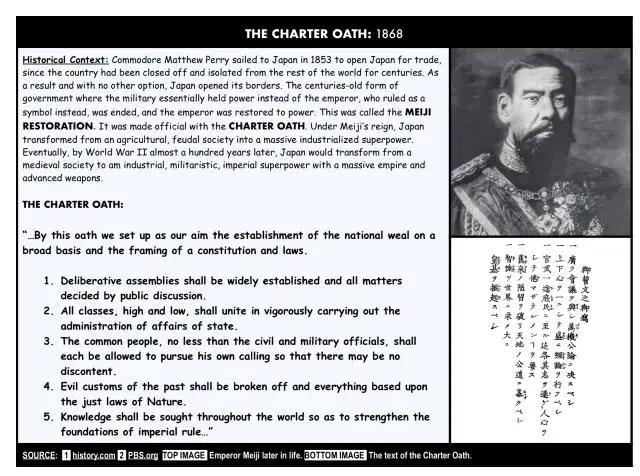
Read the Charter Oath (see document attached to the reading). Which article reflects the Enlightenment principle of citizen participation in government?
1 & 2
4 & 5
3
5
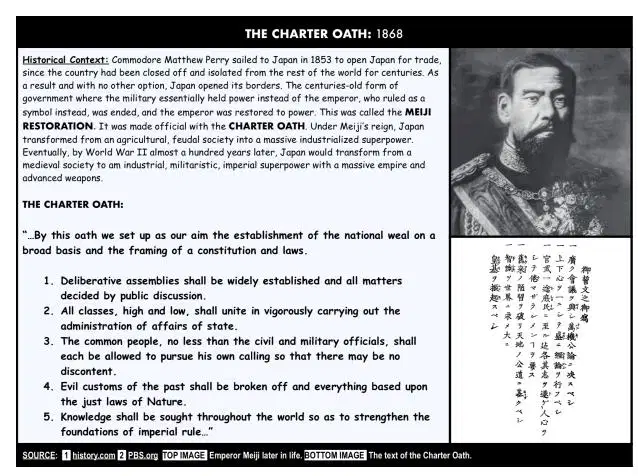
Read the Charter Oath. Which article reverse the idea that people must only work certain jobs ?
1
2
4
3
5
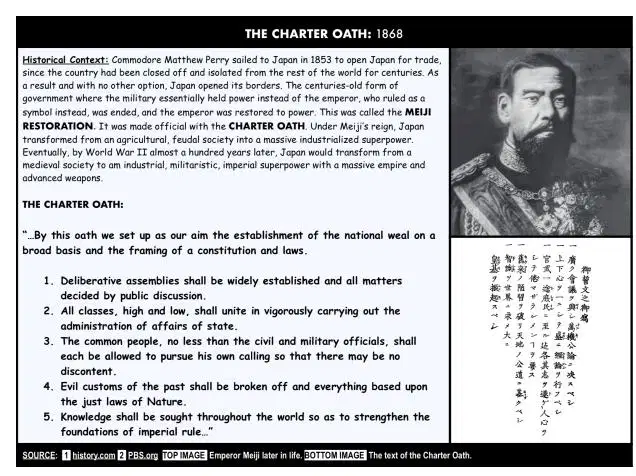
Which article of the Charter Oath are similar to Enlightenment ideas of reason, science and progress?
3
2
4 & 5
2 & 3
Japan forced China out of ____ during the Sino-Japanese War.
Manchuria
Korea
Russia
Philippines
During the Meiji Restoration, what factors contributed to Japan's rapid industrialization?
Isolation from foreign influence, reliance on traditional methods, lack of government support, and a shortage of skilled workers.
Government support and policies, adoption of Western technology and knowledge, investment in infrastructure, and a skilled and disciplined workforce.
Emphasis on agriculture, limited access to resources, lack of infrastructure development, and resistance to Western ideas.
Political instability, economic recession, lack of technological advancements, and a weak education system.
What were the major outcomes of the Sino-Japanese War?
The major outcomes of the Sino-Japanese War were the establishment of a military alliance between China and Japan, the division of Taiwan between China and Japan, and the recognition of China's sovereignty over Korea.
The major outcomes of the Sino-Japanese War were the annexation of Taiwan by China, the establishment of a puppet government in Korea by Japan, and the signing of a peace treaty between China and Japan.
The major outcomes of the Sino-Japanese War were the recognition of China's sovereignty over Taiwan, the establishment of a military alliance between China and Korea, and the loss of influence for Japan in the region.
The major outcomes of the Sino-Japanese War were the Treaty of Shimonoseki, which ceded Taiwan and the Pescadores Islands to Japan, the recognition of Korea's independence, and the loss of influence for China in the region.

