
Font size
 Worksheets
Unit 2 Review
Total questions: 20
Worksheet time: 14mins
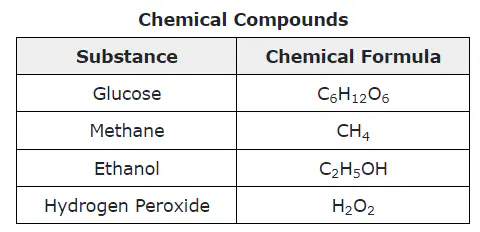
According to the Chemical Compounds table, how many atoms of hydrogen are in Ethanol?
0
2
5
6
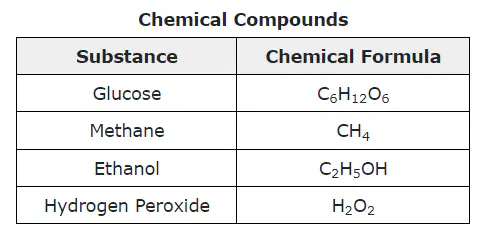
According to the Chemical Compounds table, how many total atoms are in Glucose?
3
18
24
432

According to the Chemical Compounds table, how many total elements are in Ethanol?
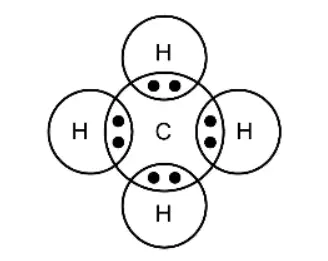
This diagram is a model of a molecule of methane. What is the formula for methane?
CH8
C8H4
CH4
C8H8
The formula below represents the most common carbohydrate known as glucose. It is classified as a monosaccharide. Glucose is synthesized by chlorophyll in plants as they use carbon dioxide from the air and sunlight as an energy source during the process of photosynthesis. Which information can be determined from the chemical formula?
C6H12O6
The structural arrangement of the atoms in a glucose molecule
The color of the glucose molecule
The size of the glucose molecule
The number of atoms of each element in a glucose molecule

Which of the statements in the table is true?
I and II
III and IV
I and III
II and III
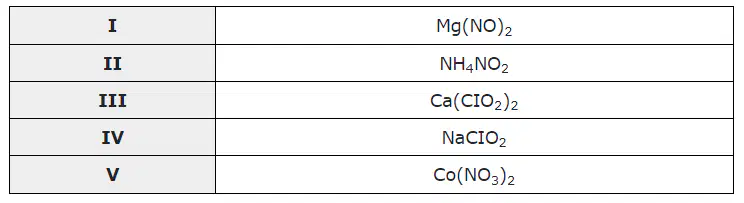
Which of the formulas in the table contain the same number of oxygen atoms?
Formulas I and II
Formulas II and IV
Formulas I, II and III
Formulas I, II and IV
How many atoms are in one molecule of baking soda, NaHCO3?
The chemical formula represents the substance glucose.
2C6H12O6
How many molecules of glucose are represented?
2
6
12
24
A student placed 2 grams of baking soda in a balloon and 100 ml of vinegar in an Erlenmeyer flask. After stretching the opening of the balloon across the neck of the flash, the student raised it to dump the baking soda into the flask. He immediately observed foaming bubbles in the flask and the balloon began to expand. An accurate conclusion would be that
only a physical change was occurring
the baking soda and vinegar were products of a chemical reaction
the gas was oxygen
the bubbles indicated a chemical change was occurring
Which substances form due to a chemical reaction?
Mass
Products
Atoms
Reactants

A scientist performed an investigation in which different solid substances were added to four different beakers containing the same amount of water. After stirring the combined substances for 2 minutes, the scientist recorded the observations in the table.
The results of which of the above investigations indicates that the substances least likely reacted chemically?
1
2
3
4
During an investigation, a student combined two substances as shown.
The student observed a decrease in temperature when the substances were combined. A milky substance formed and sank to the bottom of the flask. What is the most likely reason for these results?
The decrease in temperature produced ice crystals.
A solid appeared after the liquid evaporated.
The combined substances chemically reacted.
A portion of the substances dissolved.
During an investigation, students dropped a tarnished penny into a solution of acetic acid and sodium chloride. Tiny bubbles formed around the penny, and the penny was less tarnished after two minutes of soaking in the acetic acid and sodium chloride solution. The student inferred that a chemical reaction occurred. What evidence supports the student's inference?
The penny experienced a color change, and a gas was produced.
The penny experienced a color change, and a precipiate was formed.
The penny experienced a color change, and is in a new state of matter.
The penny experienced a color change and produced light.

Students in a science lab conducted an investigation. Students recorded the observations in the table.
Which of the substances produced a chemical change?
Substances 1 and 2
Substances 1 and 3
Substances 1 and 4
Substances 2 and 3
How can a student determine that a chemical reaction demonstrates the law of conservation of mass?
Students can compare the products and reactants to determine if the same molecules are present before and after the reaction.
Students can compare the mass of the products and reactants to determine if the mass is the same before and after the reaction.
Students can compare the products and reactants to determine if the same number of molecules are present before and after the reaction.
Students can compare the products and reactants to determine if the same elements are present before and after the reaction.
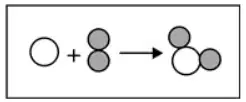
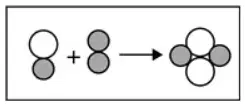
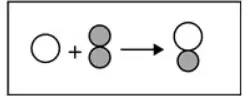
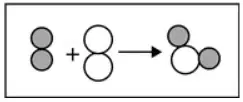
Which of the following models best demonstrates the law of conservation of mass?

Hydrogen peroxide decomposes quickly when exposed to light. The reaction for decomposing hydrogen peroxide shown in the picture. What is the mass of H2O in the reaction above?
66.99 g
24.11 g
21.44 g
48.22 g

This chemical equation demonstrates that -
matter cannot be created or destroyed by a chemical reaction
the reactants are the same substances as the products
the number of molecules in the reactants is equal to the number of molecules in the products
the atoms on the reactants side are changed into different atoms on the products side
Below is the chemical equation for photosynthesis.
6CO2 + 6H2O -> C6H12O6 + 6O2
Drag the correct answer to each box.
Before the chemical reaction:
Carbon (C) (a)
Oxygen (O) (b)
Hydrogen (H) (c)
After the chemical reaction:
Carbon (C) (d)
Oxygen (O) (e)
Hydrogen (H) 12

